Every Guitarist Has Been There
You pick up your guitar and it just will not stay in tune. Whether it’s a string catching in the nut or imprecise tuning pegs, these are often hardware problems rather than playing issues. This Guyker Guitar Hardware Review examines a Chinese manufacturer that has become a dominant force in the guitar modification parts market. By offering everything from bridges to knobs at an average price of $22, they target the budget-to-mid-range segment.
What Is Guyker?
Guyker positions itself as a global provider of guitar and bass accessories. This Guyker Guitar Hardware Review finds that the brand sits at the intersection of affordability and performance. It is designed for players who want to improve upon factory components without paying premium prices. Their most distinctive visual signature is the Dopamine series hardware, featuring vivid anodized finishes that are genuinely unique in the industry.

Who Is Guyker For?
Players with mid-range guitars from brands like Epiphone or Squier are the primary audience. This Guyker Guitar Hardware Review highlights that for these instruments, premium parts can often cost more than the guitar itself, making Guyker a rational financial choice. It is also an excellent starting point for first-time modifiers exploring guitar tuning stability upgrades.
The Product Lineup: What Guyker Actually Makes
Locking Tuners — The Best Reason to Try Guyker
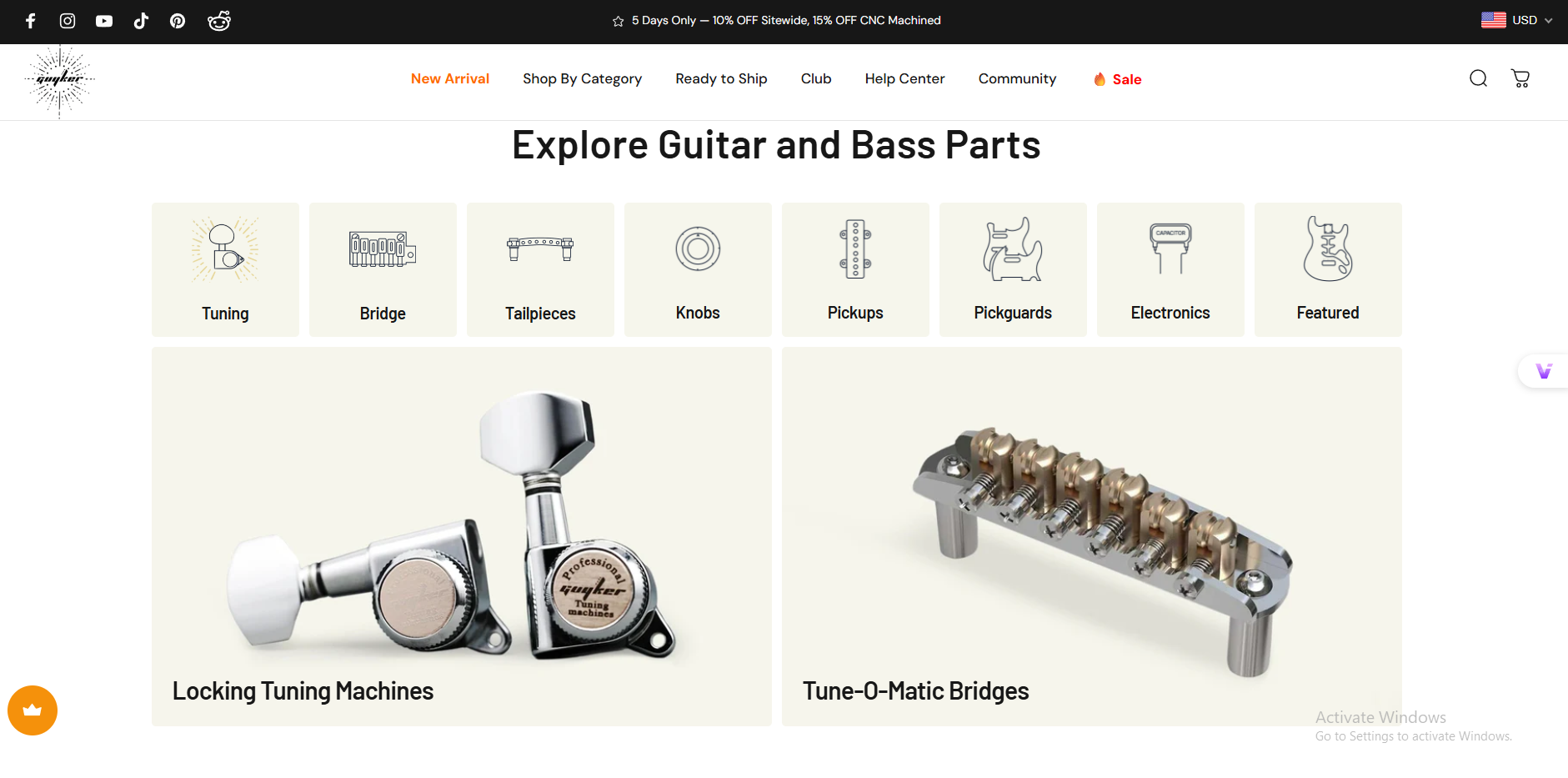
The most consistent praise in any Guyker Guitar Hardware Review surrounds the locking tuner series. With gear ratios up to 1:21, these locking tuners for guitar offer precise control and significant stability improvements over factory hardware. Users frequently report that the materials and feel are noticeably better than stock pegs, providing a smooth tuning experience.
Bridges — Genuine Upgrades for Common Platforms
The bridge lineup is equally diverse, covering Tune-O-Matic and tremolo systems. This Guyker Guitar Hardware Review notes that their high-mass designs can improve sustain and clarity. However, bridge hardware is where consistency varies most, with some community members reporting durability issues under high string tension. These affordable guitar bridges are worth trying for cosmetic and functional gains, provided you acknowledge the inherent risks of budget manufacturing.

Nuts — Proceed With Caution
The nut is one of the most precision-critical components on a guitar. Slot depth, width, and spacing tolerances measured in thousandths of an inch determine whether the instrument plays cleanly in first position, whether strings bind during tuning, and whether open string intonation is accurate.
The most common complaint in Guyker’s nut product reviews reflects a real risk with any pre-slotted nut from a mass-production source — the slot dimensions may not match the specific string gauges and playing action of a particular instrument. One buyer described a Guyker brass nut as so shallow it was unusable on their specific guitar.
Guyker’s titanium and brass nuts have received positive feedback in scenarios where the buyer understood that pre-slotted nuts typically require fitting to the specific instrument rather than drop-in installation. The raw material quality — titanium alloy construction — is praised where the dimensional fit was appropriate. The problem is that pre-slotted nuts from any manufacturer are approximations of an instrument-specific component, and Guyker’s tolerances have not always approximated closely enough.
The nut represents Guyker’s most technically demanding product category — the one where the gap between a good result and a useless result is entirely determined by dimensional precision that cannot be assessed without measurement or installation. Players who understand nut fitting and are comfortable with the filing and adjustment process may find Guyker nuts adequate raw material. Players expecting a true drop-in replacement will face a higher probability of disappointment.
Control Knobs — Consistently Excellent
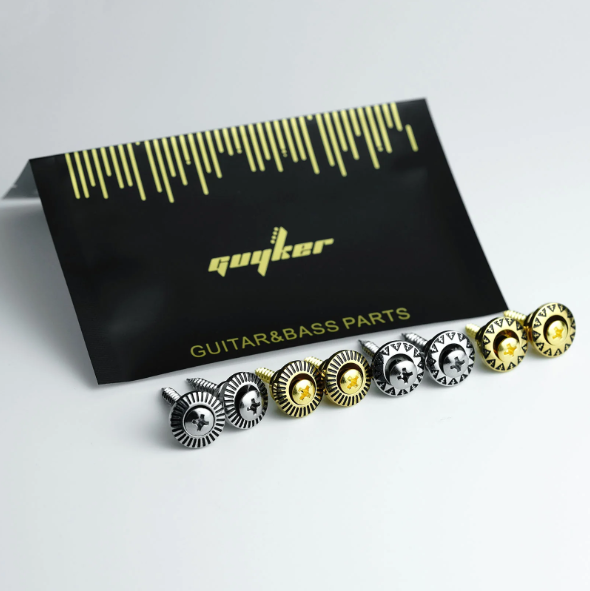
If there is a “safe bet” in this Guyker Guitar Hardware Review, it is the control knobs. Made of superior aluminum alloy, they provide a professional-caliber feel and excellent grip. Beyond functionality, the brand’s aesthetic hardware—like Damascus pattern plates or embossed neck plates—offers creative options that mainstream brands simply do not pursue.
Pickguards and Aesthetic Hardware — Standout Visual Options
The aesthetic hardware category — pickguards, neck plates, control plates, pickup surrounds, and decorative components — represents Guyker’s most distinctive creative contribution to the guitar modification market. Products like the Damascus Pattern titanium control plate, the custom-embossed goat motif neck plates, and the splattered paint lined control plate sets offer genuinely unique visual options that do not exist elsewhere at any price point from mainstream manufacturers.
The Brass Cog Design Stratocaster Pickguard specifically — designed to fit modern Strats with an 11-hole single-coil pickup configuration — exemplifies the brand’s willingness to explore aesthetic directions that traditional manufacturers consider too niche or too unconventional to pursue. For players who want their instrument to be genuinely unique — not just a differently colored version of something that already exists — Guyker’s aesthetic hardware catalog provides options that premium manufacturers have not considered worth making.
Custom-designed neck plates with embossed motifs combine aesthetic appeal with genuine durability — manufactured from aluminum and zinc alloys in brass or black finishes that add visual character without compromising structural function.
Acoustic Bridge Pins — A Surprising Winner
Bridge pins are among the most overlooked upgrade opportunities on acoustic guitars — and among the most impactful for string transfer and sustain characteristics. Guyker’s brass bridge pins have received specific praise from users who did not expect meaningful tonal improvement from such an inexpensive component.
One buyer who installed the brass bridge pins described the result as more focused, brighter, and definitely louder — expressing genuine surprise at the improvement. They specifically noted that they tested on strings they had already been using, to ensure the comparison was fair and the improvement was attributable to the bridge pins rather than new strings. The strings sounded newer and brighter after the pin upgrade alone.
This account captures why bridge pins are worth considering as part of any acoustic guitar upgrade — the physics of how the string vibration transfers through the pin into the bridge plate affects tone in ways that are perceptible even to players who were not expecting improvement.
The Reality: Quality and Compatibility
A balanced Guyker Guitar Hardware Review must mention that quality can be variable. While many buyers receive excellent units, some report inconsistencies in machining or finish. Furthermore, compatibility is a critical hurdle. You must measure your specific instrument’s dimensions before ordering, as “drop-in” claims are not always universal across different guitar production years.
Shipping and Customer Service: The Most Variable Dimension
Shipping timelines are the most consistent operational criticism in Guyker’s review record. Orders ship from China — sometimes with local warehouse fulfillment for domestic US orders, but often through international shipping channels that require patience measured in weeks rather than days.
The customer service experience reflects a company with genuine intention to resolve issues but inconsistent capacity to do so at scale. Positive accounts describe quick, helpful responses to material and shipping inquiries — one buyer who received a product labeled zinc alloy when they had ordered brass described reaching out and receiving fast, helpful clarification alongside quality products. The customer service in that case was described as excellent.
The most serious documented customer service failure involves warranty support for Amazon purchases. One buyer who received defective tuners through Amazon described being denied warranty support by Guyker on the basis that the purchase was not made directly through their website — leaving the buyer stuck with unusable tuners and no recourse. This is not an acceptable outcome for a buyer who purchased through a channel the brand chooses to distribute through. Whether it represents a policy decision or a customer service failure in the specific interaction, the result undermines trust in the brand’s post-purchase support.
The return facility being located in China creates additional friction for international returns — a reality the brand has acknowledged openly while describing active efforts to improve. For most buyers making relatively low-cost purchases, the practical reality is that returning a $20 to $30 product internationally is not economically rational regardless of how cooperative the brand is about processing the return.
The Compatibility Question: Measure Before You Buy
Compatibility is the most important practical consideration for any guitar hardware purchase — and it is the area where Guyker’s website and product listings have the most documented room for improvement. Guitar hardware dimensions vary significantly between manufacturers, model generations, and market regions. A Tune-O-Matic bridge that fits an Epiphone may not fit an identical-looking Epiphone from a different production year. A locking tuner set that fits one 9mm headstock hole may not fit another with a slightly different diameter.
The buyer advice that appears most consistently across positive Guyker reviews is simple and consistent: check what the dimensions on your specific guitar are before buying. Verify that the stud spacing, post diameter, hole diameter, and scale length match the product specifications before placing an order. The seller is generally described as excellent and reliable when the right product is ordered — the frustration arises when buyers assume compatibility without verification.
One buyer described all their Guyker orders fitting no guitars or basses in their collection and noting the absence of adequate compatibility information on the website. This experience reflects a genuine documentation gap — the product specifications are available, but the guidance for matching those specifications to specific guitar models is not as thorough as the modification community needs.
The single most important piece of advice for any prospective Guyker buyer is to measure your specific instrument’s hardware mounting dimensions before ordering any component. Treat compatibility claims as starting points for verification rather than guarantees.
Pricing: The Core Value Proposition
At an average price of $22.18 across 151 products, Guyker occupies a specific and defensible market position. The comparison that matters most is not Guyker versus Gotoh — it is Guyker versus the factory hardware on the guitar you are trying to improve.
The factory hardware on an Epiphone or Squier costs the manufacturer approximately $8 to $15 per complete hardware set at production scale. Guyker’s individual components at $10 to $40 represent genuine quality improvement over that baseline at prices that make the upgrade financially rational.
The comparison against Gotoh — whose locking tuners retail at $80 to $150 per set — is less favorable for Guyker on quality grounds but more favorable on value grounds. Whether the quality difference between a $25 Guyker set and an $80 Gotoh set is worth $55 to a player who is upgrading a $350 guitar is a question each buyer must answer for themselves. For many players in that situation, the honest answer is that the performance improvement from the cheaper option is sufficient for their use case — and the $55 difference is better spent on strings, lessons, or new music.
Real Community Consensus
The guitar modification community’s view of Guyker, synthesized across forum discussions and product reviews from verified buyers, reflects a consistent pattern that is useful to articulate clearly.
Guyker is worth trying for visual upgrades — knobs, pickguards, neck plates, aesthetic hardware — where quality inconsistency risk is low and the price-to-impact ratio is very favorable. Guyker locking tuners are generally worth the risk for players upgrading mid-range guitars, with compatibility verification as a prerequisite and the understanding that results are not guaranteed to match premium alternatives. Guyker bridges are higher risk — the mechanical stress that string tension places on a bridge creates more opportunity for quality inconsistency to manifest as functional failure. Guyker nuts require luthier-level knowledge to fit correctly and are not appropriate for buyers expecting drop-in installation.
The collectors and customizers who follow Guyker’s product releases specifically for the Dopamine color series have a different relationship with the brand — one where the aesthetic uniqueness justifies the purchase regardless of whether the performance matches premium alternatives. These are buyers for whom no alternative exists, and for that audience, Guyker fills a genuine market gap.
How Guyker Compares to Alternatives
The direct comparison reveals meaningful differentiation across the hardware market.
Gotoh is the most frequently cited premium alternative — offering manufacturing tolerances, material consistency, and long-term reliability that Guyker cannot match. Gotoh locking tuners at $80 to $150 per set are a genuinely different product than Guyker tuners at $25 — better in quality consistency, durability documentation, and the confidence that comes from decades of professional use data. For players upgrading a $1,000-plus instrument, the Gotoh price premium is entirely justifiable.
Schaller occupies the same premium tier as Gotoh — German manufacturing, decades of professional endorsement, and quality consistency that makes the higher price defensible for serious instrument upgrades.
Fender and Gibson replacement parts offer brand-matched compatibility guarantees and the assurance of original-equipment-grade specifications. The premium over Guyker pricing is real — but for players with authentic Fender or Gibson instruments, the compatibility confidence may be worth the cost difference.
Generic alternatives from Temu, AliExpress, and similar platforms offer even lower prices than Guyker — but with less consistent quality, less product-specific documentation, and no meaningful community of users who have tested the products and reported their experiences. Guyker’s documented community presence is itself a meaningful differentiator from the anonymous generic hardware market.
| Feature |
Guyker |
Gotoh |
Schaller |
Generic |
| Price Range |
$10-$65 |
$30-$200 |
$40-$200 |
$5-$20 |
| Quality Consistency |
Variable |
Excellent |
Excellent |
Very Variable |
| Color Options |
Extensive Dopamine |
Limited |
Limited |
Very Limited |
| Community Documentation |
Good |
Excellent |
Excellent |
Poor |
| Warranty Support |
Inconsistent |
Strong |
Strong |
None |
| Drop-in Fit Reliability |
Mixed |
Generally Good |
Generally Good |
Very Mixed |
| Best For |
Budget upgrades & aesthetic |
Professional installs |
Professional installs |
Absolute minimum cost |
Pros and Cons
Pros:
- Very competitive pricing — average $22 per product across 151 Amazon listings
- Dopamine Color series offers genuinely unique anodized colorways unavailable anywhere else
- Control knobs consistently praised for aluminum quality and machining precision
- Locking tuner lineup covers virtually every common headstock configuration
- Active product development with new items added continuously
- Roller saddle bridges improve tuning stability and intonation on common platforms
- Acoustic brass bridge pins deliver noticeable tonal improvement at minimal cost
- Jazzmaster tremolo bridge specifically addresses documented tuning stability issues
- Aesthetic hardware designs — cog patterns, embossed motifs, Damascus patterns — genuinely unique
- Covers guitars, basses, and specialized instruments across multiple configurations
- Customer service generally responsive to material and shipping inquiries
- Amazon availability makes initial purchasing straightforward for many buyers
- Blog content provides installation guidance and product context
- Dopamine series fills a genuine market gap for players wanting colorful hardware
Cons:
- Quality inconsistency documented across product categories — particularly tuners and bridges
- Shipping from China creates long delivery timelines for international orders
- Return process requires shipping to China for quality inspection — economically impractical for low-cost items
- Warranty support inconsistent when purchased through Amazon rather than directly
- Compatibility information incomplete — requires independent measurement before purchasing
- Nut products require professional fitting and are not genuine drop-in replacements
- Bridge metal durability concerns documented in forum-level feedback under string tension
- Some product descriptions have been noted as inaccurate regarding materials in at least one documented case
- Not appropriate for high-value instrument upgrades where component failure would be costly
- Generic Amazon-level quality consistency does not match premium tier brands at any price comparison
Who Should Buy Guyker and Who Should Look Elsewhere
Guyker is the right choice for players upgrading mid-range guitars who want genuine hardware improvements at prices proportionate to the instrument’s value. It is specifically compelling for players who want the Dopamine color series or other distinctive aesthetic options that simply do not exist from premium manufacturers at any price. Luthiers building or repairing student instruments who need adequate hardware at budget pricing will find Guyker components consistently superior to the cheapest generic alternatives.
The control knobs represent the single lowest-risk, highest-reward purchase in the Guyker catalog — excellent quality at excellent prices, with consistent manufacturing that makes them a safe recommendation for virtually any electric guitar.
Consider Gotoh, Schaller, or brand-specific replacements if you are working on a high-value instrument where component quality directly affects the guitar’s performance ceiling and resale value, if you need the confidence of long-established quality data and consistent manufacturing tolerances, or if you need a nut replacement and are not equipped to fit it to your specific instrument.
Always measure your specific guitar’s hardware dimensions before ordering any Guyker product — and treat compatibility claims as starting points for verification rather than guarantees of fit.
Final Verdict: Is Guyker Worth the Risk?
To conclude this Guyker Guitar Hardware Review, the brand offers a vital middle ground in the market. It provides a way to upgrade mid-range instruments without overspending. While it may not match the long-term reliability of premium brands like Gotoh, this Guyker Guitar Hardware Review confirms that for the right price, it delivers enough performance to earn its place in the modification community.
Final Score Summary
| Category |
Score |
| Product Range & Variety |
⭐⭐⭐⭐⭐ |
| Locking Tuner Quality |
⭐⭐⭐⭐ |
| Control Knob Quality |
⭐⭐⭐⭐⭐ |
| Bridge Quality Consistency |
⭐⭐⭐ |
| Aesthetic & Color Options |
⭐⭐⭐⭐⭐ |
| Pricing & Value |
⭐⭐⭐⭐⭐ |
| Compatibility Documentation |
⭐⭐½ |
| Shipping & Delivery |
⭐⭐½ |
| Customer Service |
⭐⭐⭐ |
| Warranty Support |
⭐⭐ |
| OVERALL |
⭐⭐⭐½ |
Review based on publicly available customer feedback from Trustpilot, Unofficial Warmoth Forum, Fractal Audio Systems Forum, CherryPicks reviews, Riverbeats independent analysis, Guyker product page reviews, and third-party assessments as of March 2026. Individual results may vary. Always verify hardware compatibility with your specific instrument before purchasing.