Quick note on approach: this review is based on hands-on research of PongBot’s official product page, technical specifications, and the brand’s own comparison data for the Pace S tennis ball machine. We have not trained with the Pace S on court ourselves for weeks, and we say that plainly rather than pretend otherwise.
Quick Verdict: PongBot Pace S
The Pace S is PongBot’s standard tennis ball machine, built on the same core ball-delivery hardware as the flagship Pace S Pro but without the Pro’s AI-driven Smart Functions like Recovery Trigger, Arena of Dash, and NTRP-based Match Challenge. At $999.99 (list $1,699.99), it still delivers 80 mph ball speed, 60 rps spin, full court coverage, and access to 396+ preset drills with custom drill building in the companion app. It suits players and coaches who want serious ball-machine performance without paying for the Pro tier’s reactive AI layer. See current Pace S pricing on the official PongBot store before deciding which configuration fits your training goals and budget.
PongBot Pace S: What Is It and Who Should Use It?
The Pace S is PongBot’s entry point into its AI-brand tennis ball machine lineup, sitting one tier below the Pace S Pro. It shares the same launch mechanism, 150-ball hopper, and up to 8 hours of battery life as the Pro model, and it runs through the same companion app and included remote control. What it leaves out is the Pro’s sensor-driven Smart Function suite: there is no Recovery Trigger, Arena of Dash, Adaptive Rally, or Match Challenge mode on the standard Pace S. PongBot positions the Pace S for players and coaches who want genuine full-court ball delivery and a large drill library, but who do not need, or do not want to pay for, the Pro’s movement-tracking AI. That makes the PongBot Pace S a fit for intermediate club players building match-realistic practice routines, coaches running group drills on a budget, and solo practicers comfortable working through preset or custom drills rather than a machine that reacts to their positioning in real time.
Real Experience: Features and Everyday Training Feel
First Impressions
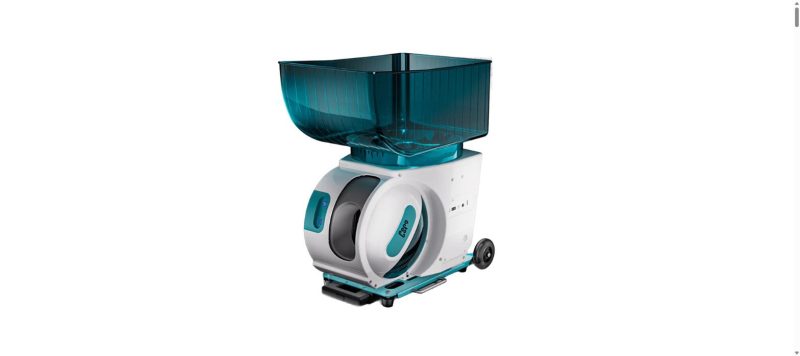
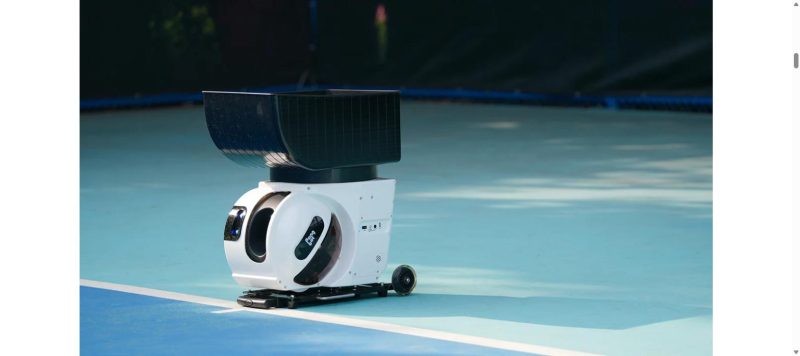
On the official listing, the Pace S looks nearly identical to the Pace S Pro: the same wheeled, hopper-topped unit finished in white and teal, sized at 700 x 370 x 560 mm and weighing 22 kg net. PongBot ships it with one battery, a remote control, an adapter, and a cable, a lighter box than the Pro’s, which adds two P Station S units and a P Tag S sensor. The listing shows in-stock availability with 48-hour shipping, the same fulfillment promise PongBot makes for the Pro.
Key Features
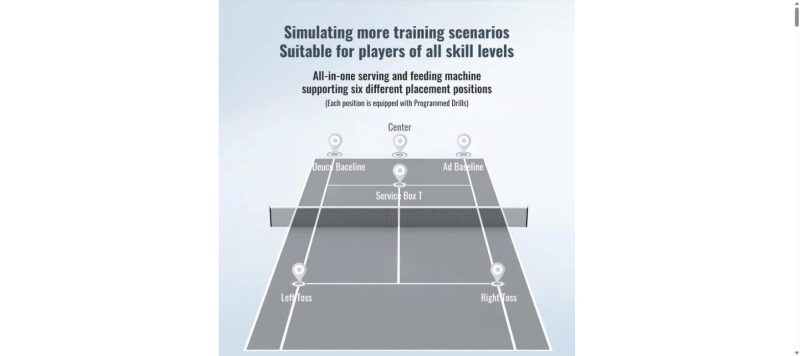
The Pace S carries over the Pro’s core ball-delivery hardware: 80 mph top speed, 60 rps of spin, a 1.5-second spin switch, and PongBot’s claimed full court coverage rather than the half-court limitation common on cheaper oscillating machines. It holds the same 150-ball capacity and runs on the same 7,800 mAh battery for up to 8 hours of play, paired over Bluetooth to the app or run from the physical remote. Where the Pace S differs from the Pro is the drill library and smart features: it ships with 396+ preset drills versus 564+ on the Pro, and it supports custom drill building and PongBot’s smart accessories, such as the T Serve S sensor, but none of the Pro’s AI-adaptive modes.
Marketing Claims vs Reality
PongBot’s spec sheet for the Pace S is largely a subset of the Pro’s, which is a reasonable way to read the product: the same ball-delivery hardware, fewer software-driven extras. The clearest checkable claim is the shared 80 mph, 60 rps, 1.5-second spin-switch spec, which PongBot also uses to market the Pro. If accurate, that means the Pace S is not a watered-down starter machine mechanically, it is specifically the AI layer that is missing. We could not independently verify PongBot’s ball-speed and spin figures ourselves, so treat them as the brand’s own published specifications rather than third-party-tested numbers.
Pros and Cons
Pros: same core ball-delivery hardware as the Pace S Pro (80 mph, 60 rps, full court coverage), a large 396+ preset drill library plus custom drill building, up to 8 hours of battery life, roughly $700 cheaper than the Pro’s list price at $999.99, and a 3-year warranty with 30-day returns. Cons: no AI-driven Smart Functions (Recovery Trigger, Arena of Dash, Adaptive Rally, Match Challenge), fewer preset drills than the Pro (396 vs 564), a compact 150-ball hopper that still means more frequent refills on longer sessions, and a lighter accessory bundle than the Pro with no P Station S or P Tag S included.
PongBot Pace S vs Pace S Pro
Since PongBot doesn’t publish a head-to-head comparison against outside competitors, the clearest apples-to-apples comparison is against its own sibling, the Pace S Pro, using PongBot’s published specification data.
| Feature |
Pace S |
Pace S Pro |
| Base price |
$999.99 (list $1,699.99) |
From $1,239.99 (list $1,999.99) |
| Smart Function (AI adaptive modes) |
Not supported |
Supported |
| Recovery Trigger |
Not supported |
Supported |
| Match Challenge (NTRP 1.0-7.0) |
Not supported |
Supported |
| Preprogrammed drills |
396 drills |
564 drills |
| Custom drills |
Supported |
Supported |
| Smart accessory support (e.g. T Serve S) |
Supported |
Supported |
Pricing and Value
The Pace S currently lists at $999.99, discounted from $1,699.99, a $700 savings, and sits roughly $240 to $300 below the Pace S Pro’s discounted starting price of $1,239.99. PongBot also offers 0% APR installment plans through PayPal on both tiers. For buyers who mainly want full-court ball delivery and a solid drill library without the AI-driven modes, the PongBot Pace S is the more budget-friendly way into the brand’s ecosystem; those who plan to use Match Challenge or Recovery Trigger regularly will get more value stepping up to the Pro. Compare current Pace S and Pace S Pro pricing on PongBot’s official store before choosing a configuration.
Final Verdict
The PongBot Pace S makes a reasonable case for itself as the practical, lower-cost half of the Pace lineup: it keeps the mechanical specs that matter most for match-realistic practice, full court coverage, 80 mph speed, fast spin switching, while cutting the AI software features that drive the Pro’s higher price. It is not the machine to buy if adaptive, sensor-driven training is the whole point of the purchase, but for players and coaches who want serious ball-machine performance on a tighter budget, it is a legitimate alternative to the Pro rather than a stripped-down compromise. See the Pace S and build your setup on PongBot’s official store.
FAQs
What’s the difference between the Pace S and the Pace S Pro?
The Pace S Pro adds AI-driven Smart Functions, Recovery Trigger, Arena of Dash, Adaptive Rally, and NTRP-based Match Challenge, plus a larger 564-drill library and extra P Station S and P Tag S accessories, none of which come with the standard Pace S.
Is the Pace S suitable for beginners?
Yes. The preset drills can be run at lower difficulty, and without the Pro’s adaptive AI modes, the Pace S is arguably a simpler, more predictable machine to learn on than the Pro.
Does the Pace S work on all court surfaces?
PongBot lists compatibility with clay, artificial grass, hard, and natural grass courts for the Pace lineup, and the machine is also optimized for padel.
What’s included in the box?
The Pace S ships with one unit and one battery included, a remote control, an adapter, and a cable, a lighter bundle than the Pace S Pro, which adds two P Station S units and a P Tag S sensor.
How long does the battery last?
PongBot rates the Pace S for up to 8 hours of play per charge from its 7,800 mAh battery, the same battery life as the Pace S Pro.