Accountability software is one of the few product categories where the question “what happens to my data?” is not a footnote — it is the whole decision. The Ever Accountable app answers it more thoroughly than most: it publishes exactly what its reports contain, who can see them, which of its features work on which operating system, and it holds two ISO certifications that no regulator required it to get.
This guide walks through the mechanics rather than the marketing: how the reports are built, what the partner on the other end actually receives, where the platform coverage has gaps, and what the certifications cover. Every figure below comes from the company own published pages. Ever Accountable publishes all of it openly.
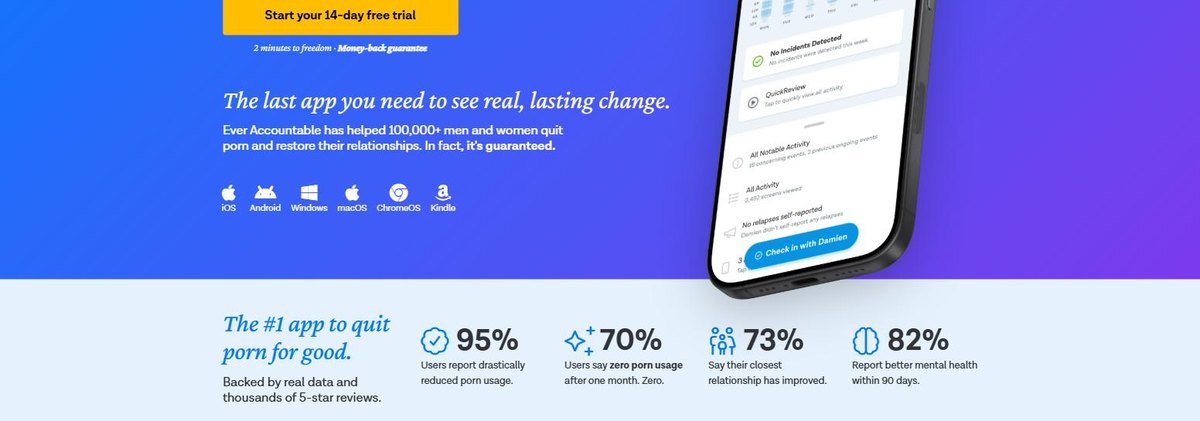
The platforms supported and the outcomes the company reports from its own user base.
What the Ever Accountable app actually does
Ever Accountable is accountability software rather than a content blocker. It installs on a person devices, records what is viewed, and forwards a summary to someone that person has chosen to trust. The company says it has helped more than 100,000 men and women, reports 700,000+ installs, and carries a 4.7 out of 5 rating from over 3,300 Google Play reviews.
The outcomes it publishes from its own customer base are specific rather than vague: 95% report drastically reduced use, 70% report none at all after a month, 73% say their closest relationship improved, and 82% report better mental health within 90 days. Those are self-reported customer figures rather than independent trial results, which is worth reading them as — but they are at least concrete and attributed.
Everything starts on a 14-day free trial with a money-back guarantee, and the company holds an A+ rating with the Better Business Bureau.
The two-person model behind the Ever Accountable app
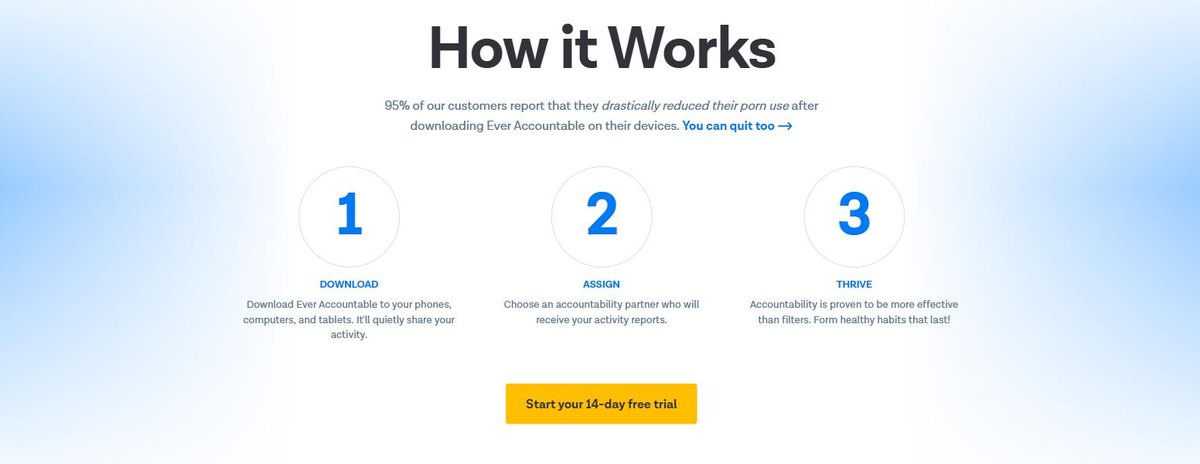
Three steps: install on every device, choose a partner, then let the reports do the work.
The design rests on two roles. One person is the reporting user, with the app installed on every phone, tablet and computer they use. The other is the accountability partner, who receives a report of that activity. The company own walkthrough uses two names to explain it: everything the user views on their devices is temporarily made available to their partner in a weekly report.
Setup is three steps, and the company describes them plainly:
Download — install on phones, computers and tablets. The app runs quietly and shares activity in the background.
Assign — choose the accountability partner who will receive the reports.
Thrive — build habits, with accountability rather than filtering doing the work.
The number of partners is not capped. Both membership tiers include unlimited accountability partners and unlimited devices on the account, so a person can share with a spouse and a mentor at the same time, or add a device later without paying more.
What the reports flag, and why loopholes do not work
A partner does not just get a tally. The report includes a summary plus every screen, app and website the user viewed, and anything inappropriate is highlighted rather than left for the partner to spot. That distinction matters in practice: a partner who has to scroll a raw log will stop reading within a fortnight.
Three behaviours are specifically covered:
Clearing browser history does not help. The company states directly that trying to mislead a partner this way simply will not work.
Uninstall attempts trigger an instant alert. Removing the app is itself a reportable event, which closes the most obvious escape route.
Blacklisted material triggers an instant alert rather than waiting for the weekly report.
On loopholes generally the company position is blunt: the app was built by people who know the tricks, and fixes ship continuously, some of them silently in the background. That is a claim rather than a proof, but the uninstall-alert design is the part that matters most, because it is the one gap that would make every other feature moot.
The Ever Accountable app does not block by default, and that is the point
This is the design decision that separates the category. By default nothing is blocked. The user browses normally, knowing a report is going to a person who cares about them. The company argument is that transparency to another human being removes the temptation more durably than a wall does, because a wall only works while you are standing behind it.
Filtering is available as a supplement rather than the main event. On Android and iOS it can be switched on at no extra charge: it activates safe search and filters known pornography, malware and spyware domains. The company is candid that it does not catch everything, which is precisely why the accountability layer exists.
Several smaller design choices reinforce the same philosophy:
No significant battery or cellular data usage.
No password protection on the app itself, except on iOS.
The user can stop sharing at any time — nothing traps them in.
Reports cover screens and apps, not keystrokes; the company recommends using a banking app rather than a banking website, since some information may otherwise be recorded.
That last note is unusually forthcoming for a monitoring product, and it is the sort of detail worth knowing before installing on a work laptop.
Six platforms, one Ever Accountable app account
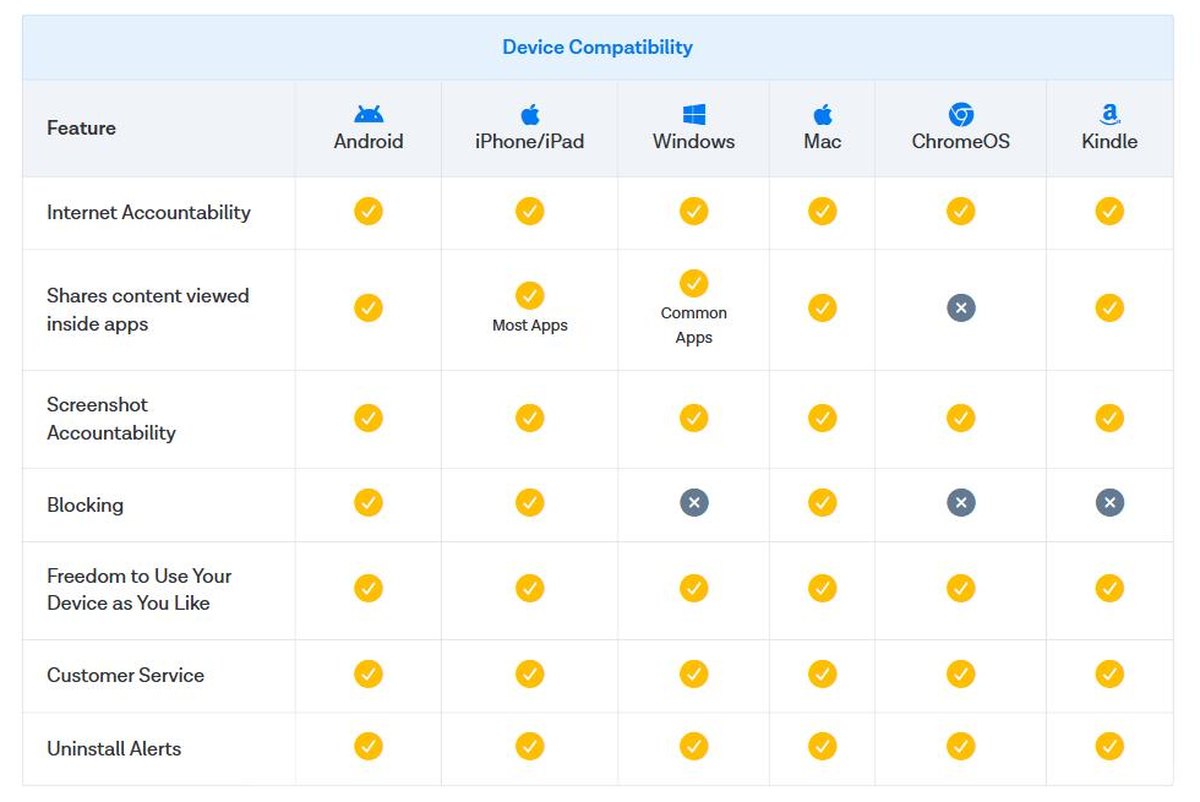
The published compatibility matrix, including the features that are not available on every platform.
Coverage runs to six platforms, with published minimum versions:
Android 7.0 and up, with a sideload version available
iPhone and iPad on iOS 18 and up
Windows 10 and 11
macOS 11.0 and up
ChromeOS on Chromebooks
Amazon Kindle version 7.0 and up
The compatibility table is worth reading rather than skimming, because the coverage is genuinely uneven and the company does not hide it. Internet accountability, screenshot accountability, customer service and uninstall alerts are present on all six. Optional blocking is available on Android, iPhone and Mac, but not on Windows, ChromeOS or Kindle. Sharing content viewed inside apps is full on Android, Mac and Kindle, limited to “most apps” on iOS, limited to “common apps” on Windows, and not available on ChromeOS.
Anyone whose main device is a Chromebook should read that row twice before subscribing — screenshot accountability still applies, but in-app content sharing does not.
ISO 27001 and ISO 27701: why certification matters for the Ever Accountable app
The certification page names the auditor and the year the management systems were established.
Software that records screens holds some of the most sensitive data a person will ever hand to a company. Most products in this space ask for that trust and offer a privacy policy in return. Ever Accountable went further and got audited.
ISO 27001 — an active, certified Information Security Management System established in 2021. The standard covers risk management, security controls and operations planning, and maintaining it requires ongoing evidence rather than a one-off sign-off.
ISO 27701 — a certified Privacy Information Management System, also established in 2021, layered on top of the security standard and mapped to legal requirements including CCPA and GDPR.
A-LIGN acts as auditor and registrar for both, and both certificates are published on the site.
Annual internal and third-party audits, plus 256-bit AES encryption on stored data.
The company makes a point of saying that nobody required this: no government mandates it, and to its knowledge no other accountability software company holds anything close to this level of certification. That is the company own claim rather than a verified market survey, but the certificates themselves are real and independently issued, which is more than a privacy policy can offer. Both certificates are linked on the privacy and security page.
How the Ever Accountable app protects the data it collects
Behind the certificates sits an operating routine that the company publishes in outline. It is the sort of list that is easy to write and hard to fake for an auditor:
A privacy and security programme with a dedicated budget and staff covering all company operations.
A written privacy and security strategy with goals and objectives, reviewed and updated on a regular basis.
A maintained set of privacy and security policies and procedures.
Risk assessments twice a year, with the results feeding the security roadmap.
Regular security awareness training for the whole team.
Key performance indicators tracking how well the controls actually work.
Internal processes governing any change, removal or export of collected data.
Reports are described as temporarily available to the partner rather than archived indefinitely, which fits the data-minimisation logic ISO 27701 is built around.
Choosing an accountability partner for the Ever Accountable app
The software is only half the system. The company is explicit that choosing the right partner is the single most important decision a new user makes, and it publishes four criteria:
Supportive — someone who cares and understands this is a process rather than a switch.
Non-judgemental — honest, and clear that nobody is perfect.
Trustworthy — the reports are genuinely private material.
Reliable — someone who will actually open the report each week.
It also suggests picking someone with similar values, or who has been through something comparable. Partners receive guidance from the company on how to respond constructively rather than being left to improvise, which is the difference between a partner who helps and one who quietly stops replying.
Because partner slots are unlimited on both plans, a user can start with one trusted friend and add a second later without changing anything about their subscription. The full guidance on choosing a partner is on the site.
What the subscription costs, and what the company is prepared to refund, is covered separately in our breakdown of Ever Accountable pricing — two plans, a 90-day money-back guarantee and a no-loophole refund if the monitoring turns out to have a gap.
Who the Ever Accountable app suits
Three groups get clear value from this particular design:
Anyone who has tried blockers and bounced off them. Filters create a game of finding the gap. Reporting to a person you respect removes the incentive to look for one.
People using prevention rather than recovery. The company notes many customers run it as an insurance policy against temptation rather than a response to a crisis.
Anyone rebuilding trust in a relationship. Transparency that a partner can verify is worth more than a promise, and 73% of users say their closest relationship improved.
The practical way in is the 14-day free trial, which requires no long commitment and is backed by a money-back guarantee. Ever Accountable runs the trial from its own site, and the ISO certificates, compatibility table and partner guidance are all published there for anyone who wants to read the detail before installing anything.
If you want the broader verdict on the product rather than the mechanics, our earlier Ever Accountable review covers pricing and overall value, and for a different take on habit change through accountability see our Pavlok Collective review.
The iPhone 18 no ports theory is suddenly everywhere. A video making the rounds on TikTok and social media appears to show something startling: an iPhone — labeled as the “iPhone 18” — charging through a small magnetic connector instead…
Hottest fashion trends 2026 reviewed honestly — which trending styles are actually wearable, which are overhyped, and what’s worth buying right now in the US market. Quick Verdict: 2026’s biggest fashion trends fall into two camps: genuinely wearable evolutions of…
PS5 Pro review 2026 — I tested it for 30 days. Here’s the honest verdict on performance, graphics, and whether upgrading from a standard PS5 is actually worth the money. Quick Verdict: The PS5 Pro is the most capable PlayStation…