How this review was done. This is a desk review. No font was bought, no licence was activated and no file was downloaded. Everything below is read from the company’s own public pages on 23 October 2026 – the four end user licence agreements, the About page, the App Fonts page, the stock art licence and the live catalogue – with the store set to US dollars. Where two pages state the same fact differently, both wordings appear here rather than an average.
Most design-asset marketplaces have converged on one business model: pay every month, download as much as you like, stop paying and the right to use what you downloaded gets complicated. YouWorkForThem runs the older model instead. You buy a licence for one typeface or one graphic, you pay once, and that is the end of the transaction. There is no subscription anywhere on the YouWorkForThem site.
That sounds simpler than it is, because paying once is not the same as paying once for everything. A single typeface at YouWorkForThem can carry four different licences depending on where the type is going to end up, and the price multiplies accordingly. This review reads all four agreements, works out what they cost in practice, and flags two pieces of arithmetic the store does not do for you. The catalogue is here if you want to follow along.
What YouWorkForThem is, and how long it has been there
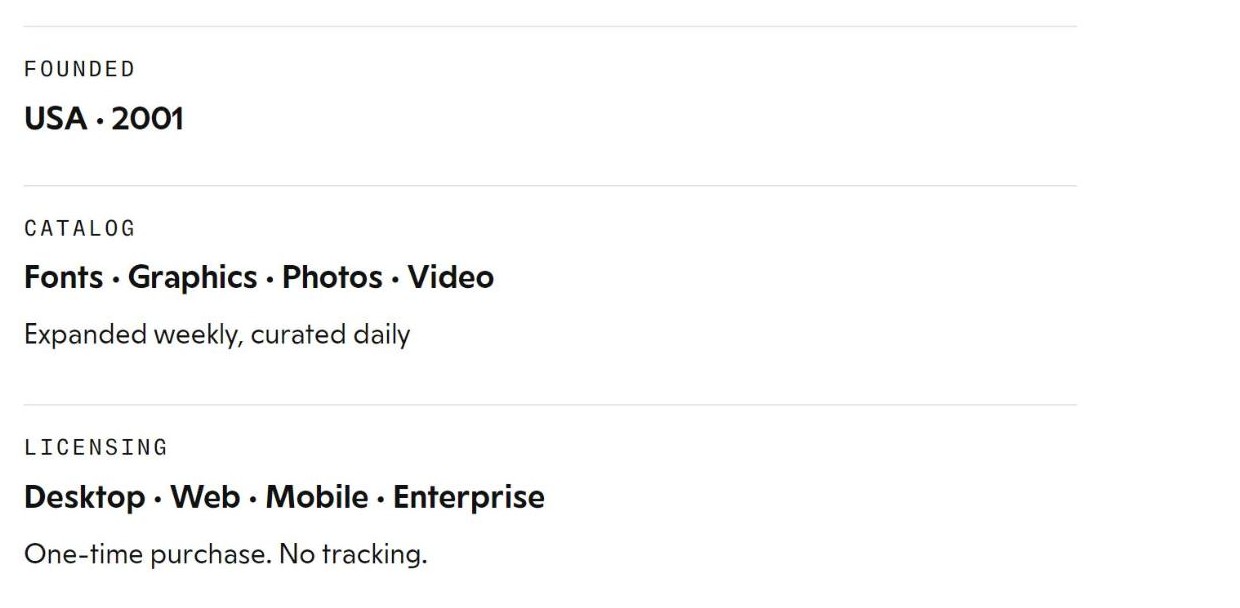
The About page states the founding year and the licensing model in four lines (screenshot from youworkforthem.com).
YouWorkForThem describes itself as three things at once: a type foundry, a marketplace and a studio. In its own words it licenses fonts, stock art and graphics to brands and to the designers behind them. The About page gives a founding line of USA, 2001, and the copyright notice in the footer reads 2001 to 2026 – so the twenty-five years in the homepage headline is checkable rather than decorative.
The same page compresses the business into one phrase worth keeping in mind for the rest of this review: one-time purchase, no tracking. Those four words explain most of what follows, including why the licence agreements are as specific as they are. If nobody is monitoring how a font gets used after the sale, the agreement has to do the work up front.
The stated YouWorkForThem mission is to build the most usable and affordable fonts and stock art available, and – the company’s phrasing – to keep licensing honest. Whether it is the cheapest is a question of what you compare it against; whether the licensing is unusually explicit is something anyone can verify in about ten minutes, and this review did.
Does the YouWorkForThem catalogue number check out
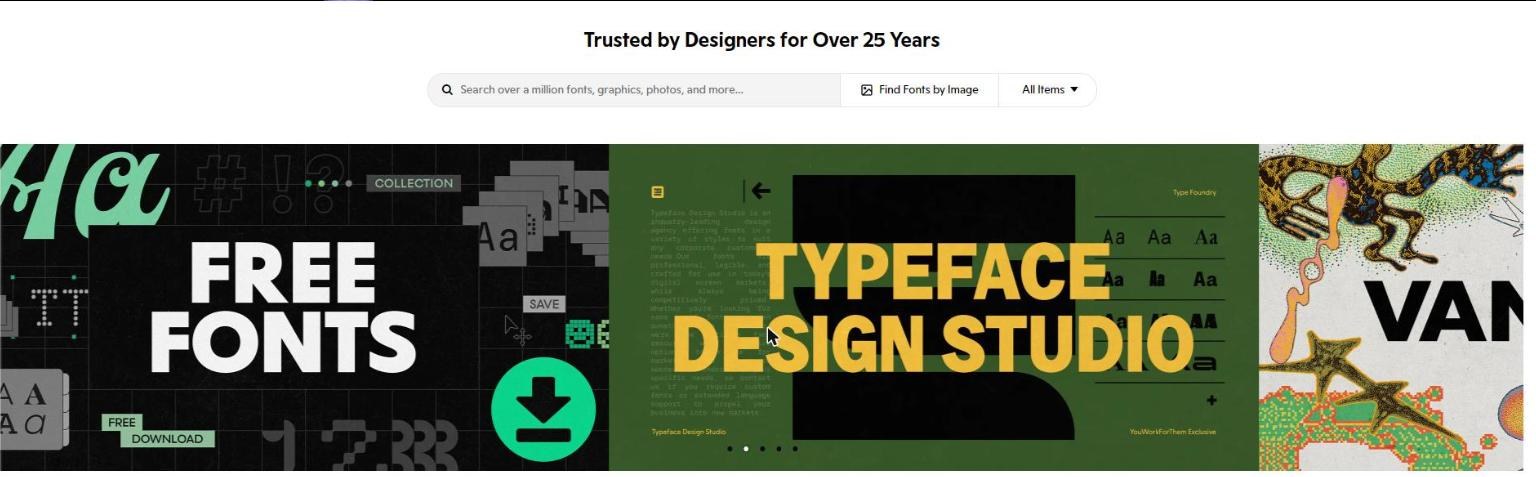
The homepage search box and the Find Fonts by Image tool (screenshot from youworkforthem.com).
The homepage promises a search across “over a million fonts, graphics, photos, and more”. That is the kind of round number worth testing, and YouWorkForThem makes it easy: the site footer carries a running count. On the day of this review it read 273,000 fonts and 789,000 graphics. Add them and you get 1,062,000 – so the headline is accurate, with room to spare.
A second YouWorkForThem page states it slightly differently. The App Fonts page offers “270,000+ fonts” from “1,600+ foundries worldwide”. The two font figures are compatible – 270,000-plus and 273,000 describe the same library – but they are written by different hands, and the foundry count only appears on the one page. It is the single most useful number on the site for judging breadth, and it is oddly well hidden.
The YouWorkForThem catalogue is split six ways in the navigation – fonts, graphics, photos, videos, extras and curated collections – and the About page notes it is expanded weekly. One feature deserves a mention because it is rare outside the big stock libraries: a Find Fonts by Image tool sitting next to the search box, which matches an uploaded picture of type against the library.
What a single YouWorkForThem font costs
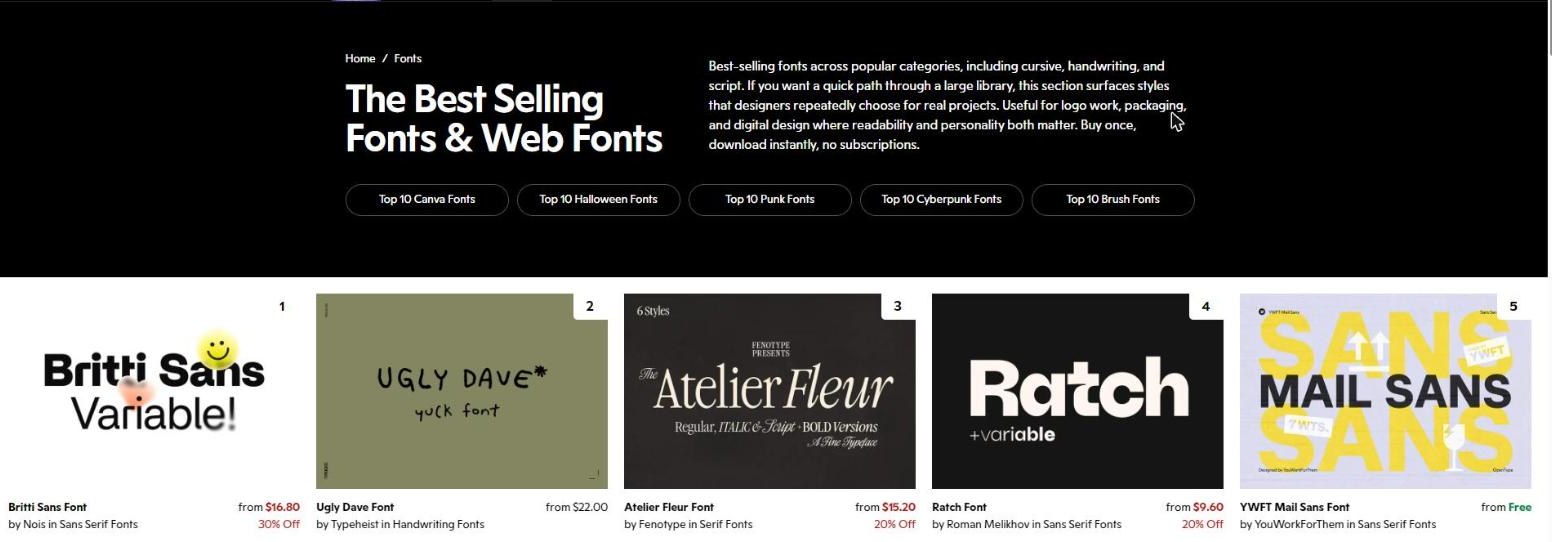
Best-selling fonts with live prices and discounts (screenshot from youworkforthem.com).
At YouWorkForThem, prices are per typeface and shown on the browse grid before you click anything, which is more than some competitors manage. On the best-selling page at the time of writing, the top ten ran from free to 22.00 USD, with several carrying 20 to 30 percent discounts. Britti Sans, the number one seller, showed “from 16.80 USD” against a 30 percent reduction ending on 5 December 2026.
The phrase “from” is doing real work in that price. A typeface is a family, and YouWorkForThem prices the family by the cut. Britti Sans lists fifteen named styles plus a variable version, and the product page offers sixteen separate buying options. The headline figure is the cheapest single weight, not the family.
That matters for budgeting, because the number you see on the grid is the floor. It also matters for the two findings later in this review, both of which are calculated as multiples of what YouWorkForThem calls the desktop price – so a cheap weight makes every add-on cheap, and an expensive family makes every add-on expensive. The best-selling page shows the live prices and the current discounts side by side.
The four licences YouWorkForThem sells for one typeface
Open the YouWorkForThem licence page and you get four tabs rather than one document. Each is a complete end user licence agreement in its own right, and each covers a different place the type can appear:
Desktop – installing the font and setting type with it
Web Fonts – serving the font to browsers with CSS
ePub – embedding the font in an electronic publication
Mobile Apps – embedding the font inside an application
The structural point, and the one that catches people out, is that the last two are add-ons. Both the ePub and the Mobile App agreements state plainly that the desktop licence is required first. You do not choose between them; you buy the desktop licence and then buy the extension on top. Web fonts are the exception – they are priced as a multiple of the desktop price but sold as their own licence.
Everything YouWorkForThem sells is a licence rather than a transfer of ownership. Each agreement repeats that full ownership stays with the font creator, which is standard across the type industry but worth knowing if you have ever assumed that buying a font means buying the font.
Desktop licences: two devices each
The YouWorkForThem desktop agreement is the shortest to summarise and the one most readers will need. A single YouWorkForThem desktop licence permits installation on no more than two devices – the agreement lists desktop or laptop workstations, notebooks, netbooks, tablets and smartphones as all counting toward that pair. Beyond two, an additional end user must be purchased for each one.
Two is a sensible number for a freelancer with a desktop and a laptop and a stingy one for a studio. It is also unambiguous, which is the useful part: there is no “reasonable use” language to argue about later. A five-person team doing desktop work on five machines needs five licences, and YouWorkForThem says so in a single sentence rather than in a footnote.
Web fonts: priced by pageviews, paid once
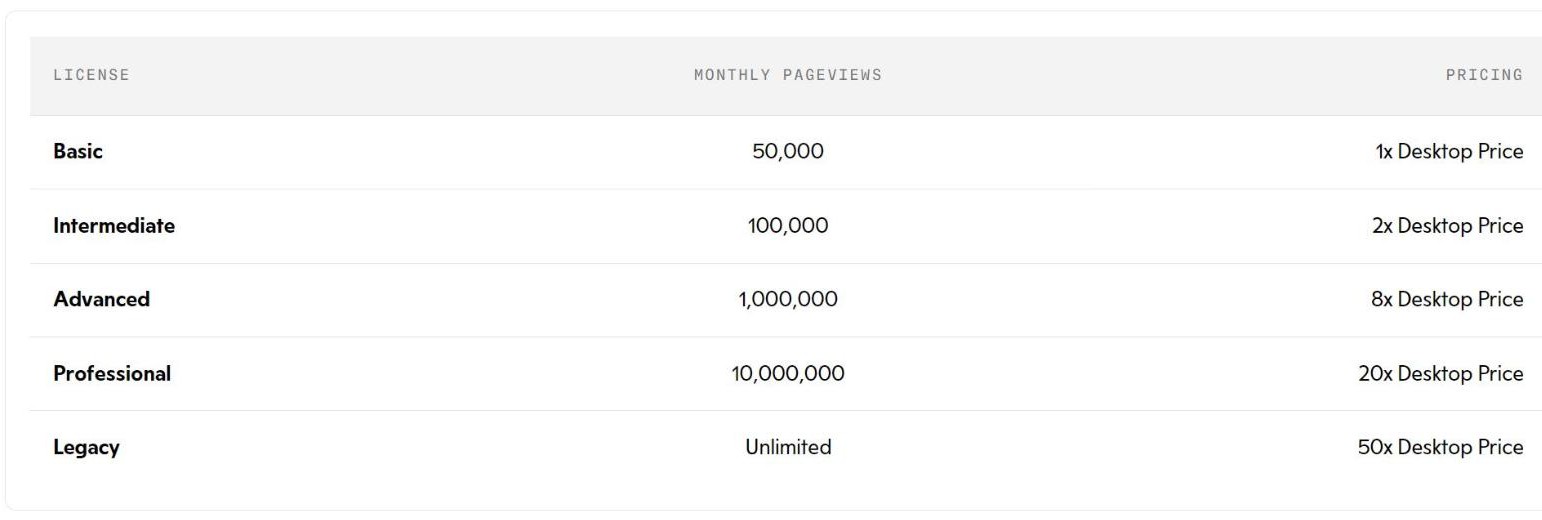
The published web font tiers, from Basic to Legacy (screenshot from youworkforthem.com).
Web fonts are where YouWorkForThem diverges most sharply from the hosted-service model. The agreement opens with the pricing logic: web fonts are licensed on monthly pageviews, for a one-time fee, and then the sentence that makes the model work – “There are no subscriptions, no re-occurring fees, and no tracking.”
Practically, that means you host the YouWorkForThem files yourself. YouWorkForThem supplies WOFF2 and WOFF generated from the current desktop font, and the agreement is blunt that you are responsible for hosting them and writing the CSS that points at them. Only the web formats may go online; putting the TrueType or OpenType desktop file on a server is specifically prohibited. For the formats themselves, the W3C WOFF2 specification is the standard both files are built against.
Two restrictions shape how far a purchase stretches. One licensed web font covers one domain, and linking the files across multiple domains is not permitted, with workplace intranets held to the same rule. Within that one domain, the font may be used across any site the licensee owns or controls. The published tiers look like this:
Licence
Monthly pageviews
Price
Pageviews per unit of price
Basic
50,000
1x desktop price
50,000
Intermediate
100,000
2x desktop price
50,000
Advanced
1,000,000
8x desktop price
125,000
Professional
10,000,000
20x desktop price
500,000
Legacy
Unlimited
50x desktop price
unlimited
The first three columns are YouWorkForThem’s. The fourth is arithmetic, and it is where the first finding lives.
Finding one: two YouWorkForThem tiers cost exactly the same per pageview
Divide the traffic allowance by the price multiple and the ladder stops being a ladder in one place. Basic buys 50,000 pageviews for one unit of desktop price. Intermediate buys 100,000 for two units – which is also 50,000 pageviews per unit. Moving from Basic to Intermediate buys more headroom but not one cent of better value.
From there the curve improves sharply. Advanced delivers 125,000 pageviews per unit of price, two and a half times the rate of the first two tiers. Professional delivers 500,000 per unit – ten times Basic. In other words the cheap tiers are priced flat and the expensive tiers are priced at a volume discount, with the break happening between Intermediate and Advanced.
None of that is hidden; it is simply not calculated anywhere on the site, and the tier names imply a smooth progression that the numbers do not deliver. The practical reading for a buyer: if a site is near 100,000 monthly pageviews and growing, the Intermediate tier is the one worth thinking twice about. Anyone can confirm the whole table on the YouWorkForThem licence page in under a minute.
The honour system YouWorkForThem runs on
A YouWorkForThem pageview-based licence with no tracking has an obvious question attached, and the agreement answers it without euphemism. If the six-month average of monthly pageviews exceeds the tier you bought, you must upgrade – and then: “Determining this information is up to you, the End User. Please be honest, and pay for what you use.“
Upgrading costs only the difference between tiers, and the benchmark is explicitly a six-month average rather than a peak, or an estimate if six months of statistics do not yet exist. For an agency the agreement adds a service-provider clause covering work done on behalf of multiple clients, which is the usual place this kind of licence gets abused.
It is a YouWorkForThem design decision with a trade-off in both directions. Nobody has to install a counting script or report traffic to a vendor, and nothing stops working if a campaign goes unexpectedly well. Equally, compliance is the buyer’s responsibility to track, and a studio with several client sites on several tiers will need its own record of what was bought for which domain.
ePub and mobile apps: how the add-on maths works
The ePub pricing structure, with the company’s own worked examples (screenshot from youworkforthem.com).
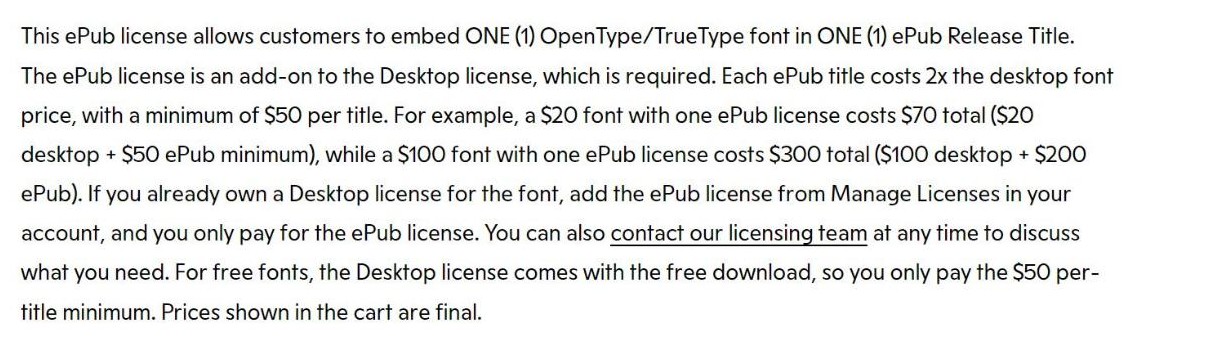
The YouWorkForThem ePub licence covers one font in one published title, and is valid for eBook, Kindle, iBooks, PDF, EPUB and Mobipocket formats – anything outside that list requires a conversation. It costs 2x the desktop price with a 50 USD minimum per title. YouWorkForThem works the examples itself: a 20 USD font plus one ePub licence is 70 USD total, because twice twenty falls below the floor; a 100 USD font plus one ePub licence is 300 USD.
The mobile app licence multiplies the desktop price by ten (screenshot from youworkforthem.com).
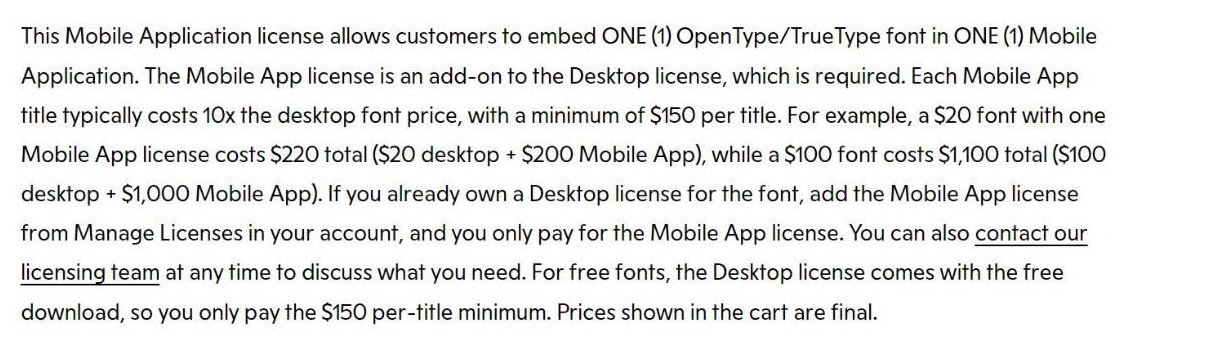
The YouWorkForThem mobile app licence follows the same shape with a much larger multiplier: one font in one application, at 10x the desktop price with a 150 USD minimum per title. Again the store does the sums: a 20 USD font becomes 220 USD, a 100 USD font becomes 1,100 USD.
Two details soften the arithmetic. If you already hold the desktop licence, the add-on is bought on its own from Manage Licenses and you pay only for the extension. And for the free fonts in the YouWorkForThem catalogue, the desktop licence comes with the free download, so shipping one inside an app costs the 150 USD minimum and nothing more.
Finding two: the sticker price is not the price for app work
Put the 10x multiplier next to the real catalogue and the gap between browsing and budgeting opens up. Britti Sans at 16.80 USD is a cheap font by any standard. Ship one weight of it inside a mobile application and the licence is 168 USD, for a total of 184.80 USD – about eleven times what the grid showed. Nothing about that is concealed, but nothing on the browse page hints at it either.
The effect runs the other way too, and this is the genuinely useful half. Because every add-on is a multiple of the desktop price, a 9.60 USD font costs 96 USD to put in an app while a 100 USD font costs 1,000 USD for exactly the same right. On most platforms extended licences are flat fees; at YouWorkForThem the choice of typeface sets the whole bill. Picking a less expensive face early is worth roughly ten times its own saving.
And because the free fonts carry a desktop licence at no cost, the floor for app work at YouWorkForThem is a flat 150 USD regardless of which free face you choose – a number worth knowing before anyone starts browsing paid families for a small product.
The clause that sends a project to an enterprise quote
One passage on the YouWorkForThem App Fonts page deserves its own section because it decides whether the standard licence applies at all. If the product lets end users type, generate, customise or otherwise create their own content in the font, that use sits outside the standard licence. The examples YouWorkForThem gives are design tools, text editors, sticker and meme builders, video apps and user-generated publications.
That is a broad net, and it is drawn around exactly the kind of app that would otherwise look like an ordinary embed. A recipe app that sets its headings in a licensed face is standard use. The same app with a feature letting users caption their own photos in that face is not. Those projects go to a custom enterprise licence through the corporate page.
Enterprise work is a visible part of the business rather than an afterthought – YouWorkForThem lists custom type, bespoke licensing and in-house team solutions alongside the catalogue. The company also states that designers at a long list of large companies use its work. That is the company’s claim about its own customers rather than something a reader can verify, and it is repeated here as a claim, not a fact.
Stock art is a separate licence with a 250,000 ceiling
Graphics, photos, illustrations, video and audio do not run on the YouWorkForThem font agreements at all. They have one licence of their own, and it is written around a single number: 250,000 instances.
Within that ceiling the YouWorkForThem permissions are wide. The agreement allows printing multiple copies of products including clothing, packaging, posters and mugs, and allows the art to be placed inside a PDF, PowerPoint, Word or similar document distributed physically or online – provided the document is not itself for sale or mass-market distribution, the online use does not redistribute usable copies of the art, and the distribution stays under 250,000 instances.
The things it forbids are the predictable ones: no transferring the files to a third party, and no redistributing the art in a form someone else could extract and reuse. For a merchandise run, a packaging job or a campaign, a quarter of a million units is a generous ceiling. For a product expecting to cross it, the number is at least stated plainly enough to plan around.
Who YouWorkForThem suits, and who should ask first
It suits a designer or small studio that buys type occasionally and wants the transaction finished when it is finished – no renewal date, no account to keep alive, no question about what happens to past work if the card expires. It suits anyone who needs a specific display face rather than access to everything, because paying for one typeface is cheaper than paying monthly for a library you use twice a year. The browse pages price every item before you click.
It suits publishers and app teams who can budget the multiplier in advance, and it suits people who would rather read a four-page agreement once than guess at a licence summary. The free fonts section is a real entry point rather than a teaser, since those downloads carry the desktop licence.
It fits less comfortably for a studio churning through dozens of assets a month, where a subscription library will cost less per item. It needs a conversation first for any product with user-generated type, per the clause above. And it needs internal record-keeping for web fonts, because the honour system puts tier compliance on the buyer. None of those is a defect; they are the shape of the model, and the model is stated clearly enough to decide against.
How this review of YouWorkForThem was done
Every figure above about YouWorkForThem was read from the company’s own pages on 23 October 2026: the desktop, web font, ePub and mobile app agreements on the licence page, the stock art agreement, the About page, the App Fonts page, the best-selling fonts grid and one product page. Prices were read with the store set to US dollars and reflect the discounts live that day.
Nothing was purchased, downloaded or installed, and no claim here about file quality or support response is made on our own authority. Where the text says YouWorkForThem does something, it means the company states that it does. The two findings in sections seven and ten are arithmetic performed on published numbers, and both are reproducible by any reader with a calculator. Screenshots are unedited captures of those pages, cropped only to remove navigation furniture; the customer logo wall was deliberately not reproduced.
The short version
YouWorkForThem is a 25-year-old marketplace with a verifiable million-item catalogue, per-item pricing visible before you click, four licence agreements written in plain enough English to read in one sitting, and a web font model that charges once and declines to track you. The free font section is genuinely free, the stock art ceiling is stated as a number rather than a vibe, and the enterprise carve-out is described before you buy rather than after.
Against that: the YouWorkForThem desktop licence caps at two devices, the add-on multipliers mean a cheap font and an expensive font cost wildly different amounts for identical rights, two of the five web tiers offer the same value per pageview, and tier compliance is the buyer’s job to monitor. All four are consequences of the pay-once model rather than surprises buried in it.
Overall: 4.4 / 5. The clearest licensing documentation of any design-asset store this review has read, attached to a catalogue big enough to make the clarity matter. Current pricing, discounts and the full agreements are on the YouWorkForThem site.
The iPhone 18 no ports theory is suddenly everywhere. A video making the rounds on TikTok and social media appears to show something startling: an iPhone — labeled as the “iPhone 18” — charging through a small magnetic connector instead…
Hottest fashion trends 2026 reviewed honestly — which trending styles are actually wearable, which are overhyped, and what’s worth buying right now in the US market. Quick Verdict: 2026’s biggest fashion trends fall into two camps: genuinely wearable evolutions of…
PS5 Pro review 2026 — I tested it for 30 days. Here’s the honest verdict on performance, graphics, and whether upgrading from a standard PS5 is actually worth the money. Quick Verdict: The PS5 Pro is the most capable PlayStation…