Finding a rental in the Netherlands is not really a search problem. The listings are public and anyone can read them. The problem is speed: a decent flat in Amsterdam or Utrecht collects its first serious applicants within the hour, and the person who sees it at 09:02 is in a different queue from the person who sees it at 11:40. RentHunter is built around exactly that gap. It watches the whole Dutch rental market, tells you the moment something matches, and files your application for you.
How this review was done. Everything below was read on 3 November 2026 from pages RentHunter publishes itself: the homepage, the how-it-works page, the About page, the live rental index, fourteen city pages, the guarantee page and the full Terms and Conditions dated 30 September 2026. No account was created, nothing was paid for, and no claim here is that the reviewer used the product. Where the company states a figure, this article says so. Prices are in euros, as the Terms list them, VAT included. This article contains affiliate links: if you subscribe through them the company may pay a commission, at no extra cost to you, and it has not changed a single number below.
What RentHunter actually is
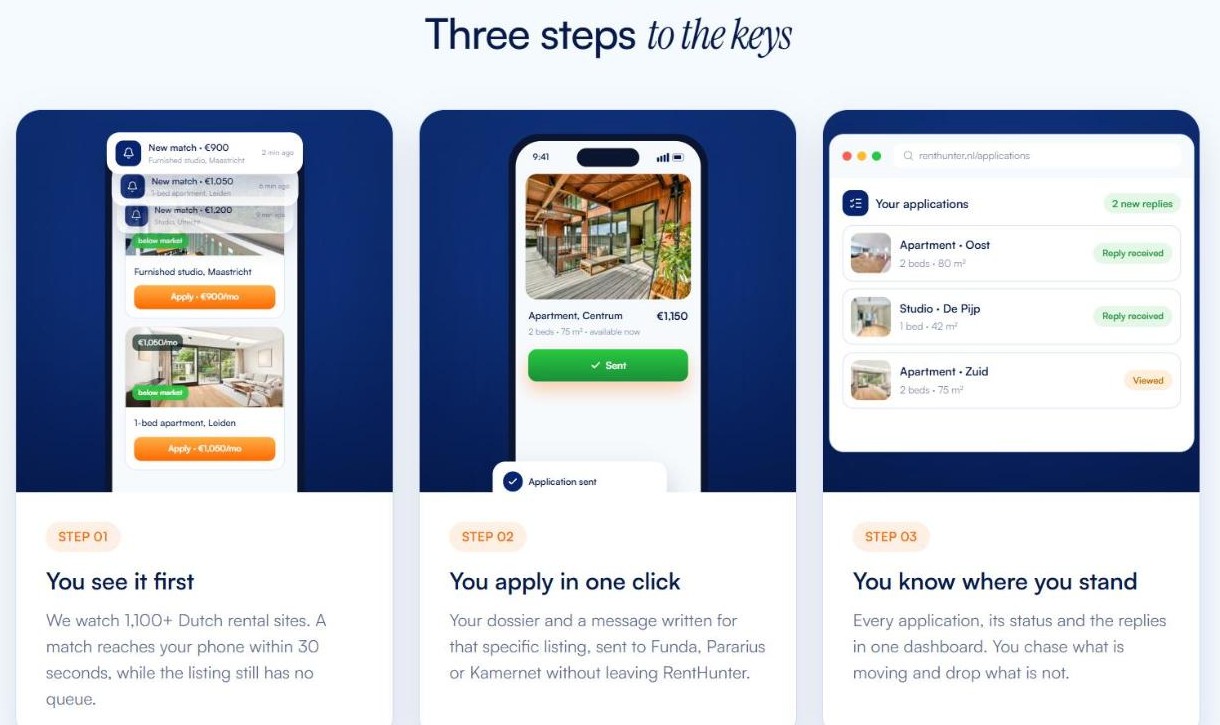
The three steps RentHunter builds its product around (screenshot from renthunter.nl)
RentHunter is an aggregator with an application layer bolted on. Its own Terms describe it in a sentence that is worth reading before the marketing: “a tool that collects rental listings in the Netherlands and alerts you. We are not an agency or a landlord.” That framing matters, because it tells you what you are buying. You are not hiring someone to find you a flat. You are buying earlier sight of listings that are public anyway, plus the machinery to act on them quickly.
The product has three jobs. RentHunter watches 1,100+ Dutch rental sites and pushes a match to your phone, the company says, within 30 seconds. It then lets you apply without opening another account, sending your dossier and a message written for that specific listing to the platform the listing sits on. Finally it tracks every application, its status and the replies, in one dashboard. Around that sit six smaller features the company lists: scam filtering, a reusable rental dossier, message templates for platforms it cannot post to directly, a shared search for two people, a contract review against Dutch rental law, and help setting up energy, internet, insurance and banking after you move in.
There is a free tier, but the Terms are blunt about its limits: it “gives access to part of the application (browsing and searching) but does not allow you to apply to Listings or use premium features.” In other words, the free plan is a search engine; the paid plan is the product.
What RentHunter costs
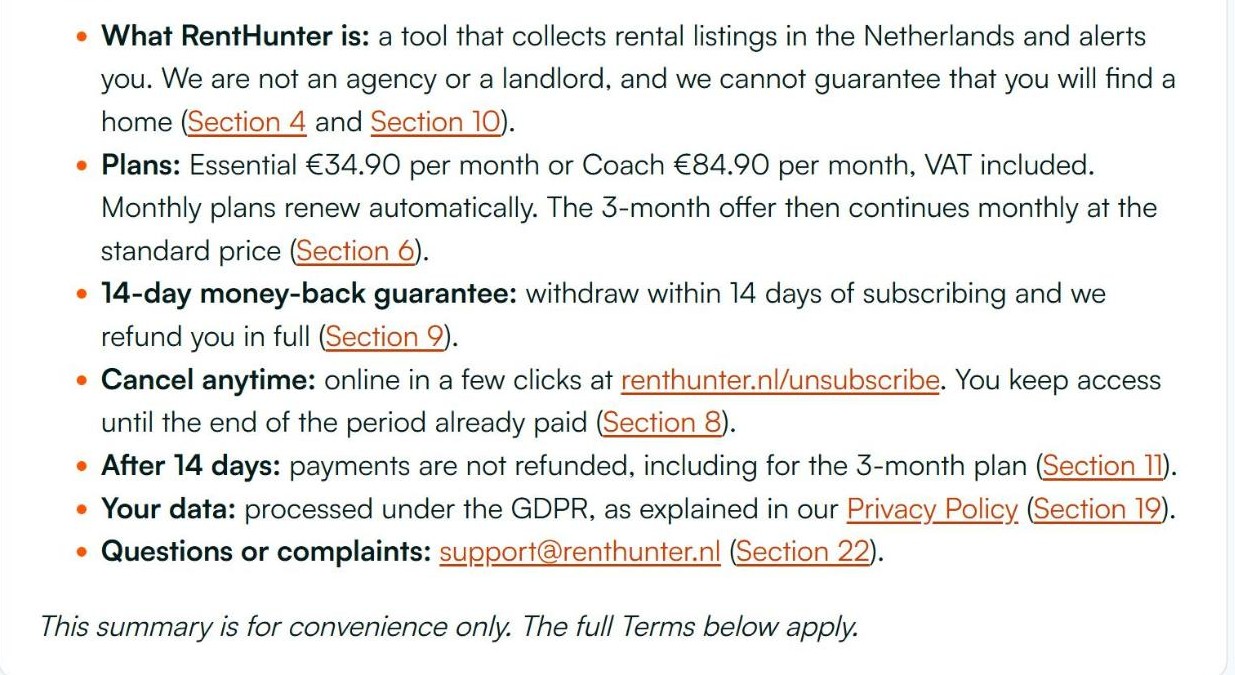
The plan prices and the refund rule, stated in the RentHunter terms rather than on a pricing page (screenshot from renthunter.nl)
There is no pricing page in the site navigation, which is unusual. The prices live in Section 6 of the Terms, and they are stated plainly there, VAT included:
Plan
Monthly
3 months upfront
What you get
Essential
€34.90
€69.90
Full access, including the ability to apply to listings
Coach
€84.90
€169.90
Everything in Essential plus a dedicated human real-estate coach
Free
€0
—
Browse and search only; cannot apply
RentHunter plan prices as listed in the Terms and Conditions dated 30 September 2026
Monthly plans renew automatically. The discounted three-month plan is paid once upfront and then, at the end of the three months, rolls onto the standard monthly rate until you cancel. Payment runs through Stripe, with card, iDEAL, SEPA direct debit, Apple Pay and Google Pay all accepted, which is the right list for a Dutch audience. You can check the current plans on the RentHunter site.
The three-month arithmetic RentHunter does not print
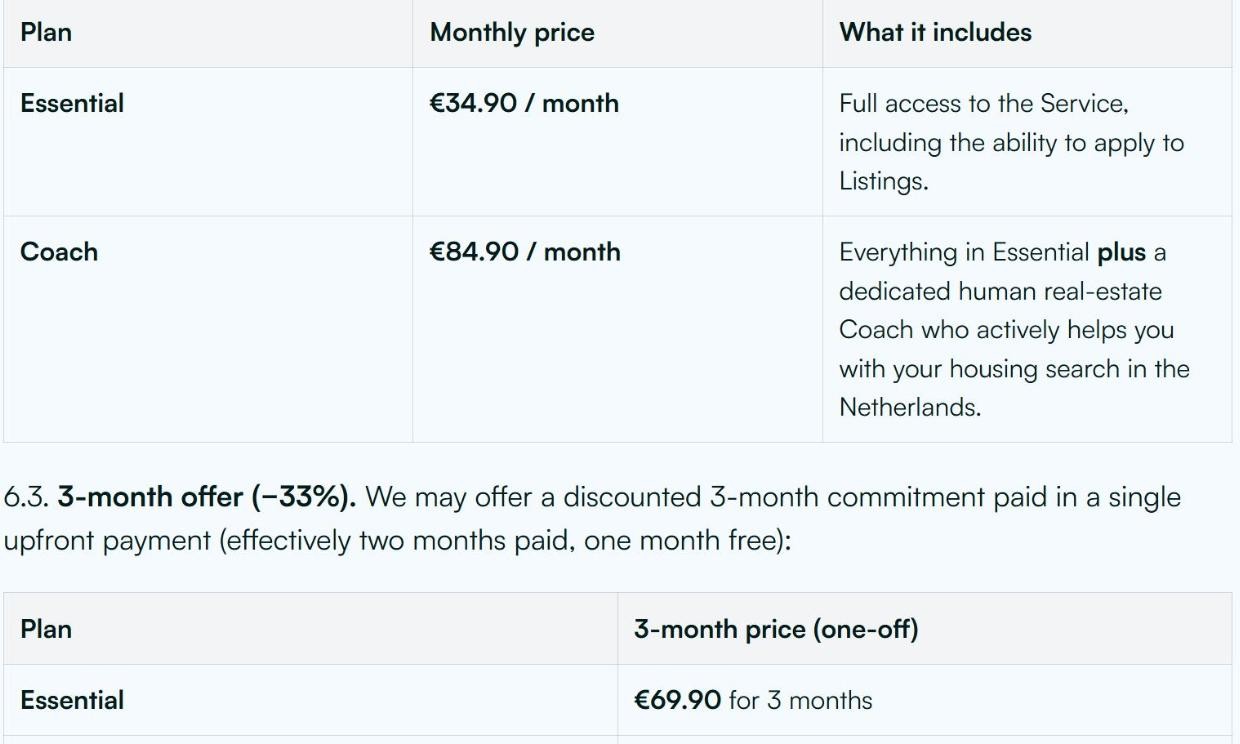
The two plans, and the three-month offer described as two months paid and one month free (screenshot from renthunter.nl)
The Terms label the three-month offer “(-33%)” and gloss it as “effectively two months paid, one month free.” Both halves of that sentence are close to true and neither is exactly true, so it is worth doing the sum once.
Plan
3 x monthly
3-month price
You save
Discount
Effective per month
Essential
€104.70
€69.90
€34.80
33.24%
€23.30
Coach
€254.70
€169.90
€84.80
33.29%
€56.63
What the RentHunter three-month offer is actually worth, calculated from the prices in Section 6
The headline holds: the discount really is a shade over 33 per cent on both plans, a rare case of a rounded marketing number being slightly conservative. The “two months paid” line is off by ten cents each way – two Essential months would be €69.80 against a listed €69.90, two Coach months €169.80 against €169.90. Nobody is being fleeced by ten cents; the three-month price is simply set to a round-looking number rather than derived from the monthly one.
The number that matters more is the effective monthly rate. On the three-month plan, RentHunter Essential works out at €23.30 a month. Against a Dutch rental market where a single viewing can hinge on being an hour early, that is the figure to weigh, not the €34.90 headline.
The 14-day guarantee, read against the law
RentHunter markets a “14-day money-back guarantee” on its homepage and guarantee page. Read the Terms and you find that this is, in substance, the statutory right of withdrawal that EU consumers already have. That is not a criticism; plenty of companies make the legal minimum sound like a favour and then quietly claw back the days you used. RentHunter does the opposite, in a sentence worth quoting in full:
You can start using the Service straight away. Using it during the 14-day period does not affect your right of withdrawal: if you withdraw within the 14 days, we refund the full amount you paid, with no deduction for the days already used.
EU rules generally permit a provider to deduct a pro-rata amount for a digital service you already consumed. RentHunter waives that. Refunds go back to the original payment method within 14 days of notice, and you cancel at renthunter.nl/unsubscribe or by email.
The other half of the rule deserves equal billing. After day 14, RentHunter does not refund payments. Cancelling stops the next renewal but does not refund the period you are in, and the three-month plan is explicitly non-refundable after the withdrawal window even if you stop using it on day 20. There is also no result-based refund: not finding a home does not, by itself, get your money back. All of that is normal for a subscription tool, and all of it is stated plainly rather than buried. The guarantee page sets out the same terms in plain English.
How fast RentHunter says it is
Speed is the entire pitch, so it is the claim to pin down. RentHunter says a match reaches your phone within 30 seconds of the listing going live, “while the listing still has no queue”, and that it re-checks whether a home is still available so you do not write to one that has gone. It also publishes an outcome range on the how-it-works page: two to six weeks to find a home, against “around 3 months searching alone”.
Two things to hold in mind. First, the homepage frames the same outcome differently, as “30 days on average” – which sits inside the two-to-six-week range but is a tighter promise than the range itself. Second, every one of these figures is RentHunter’s own measurement of RentHunter, including the 12,000+ renters housed and the 4.5 on Trustpilot from 379 reviews quoted on the same page. None of it is audited, and this review treats all of it as a company claim rather than an independent finding.
What is actually in the RentHunter index today
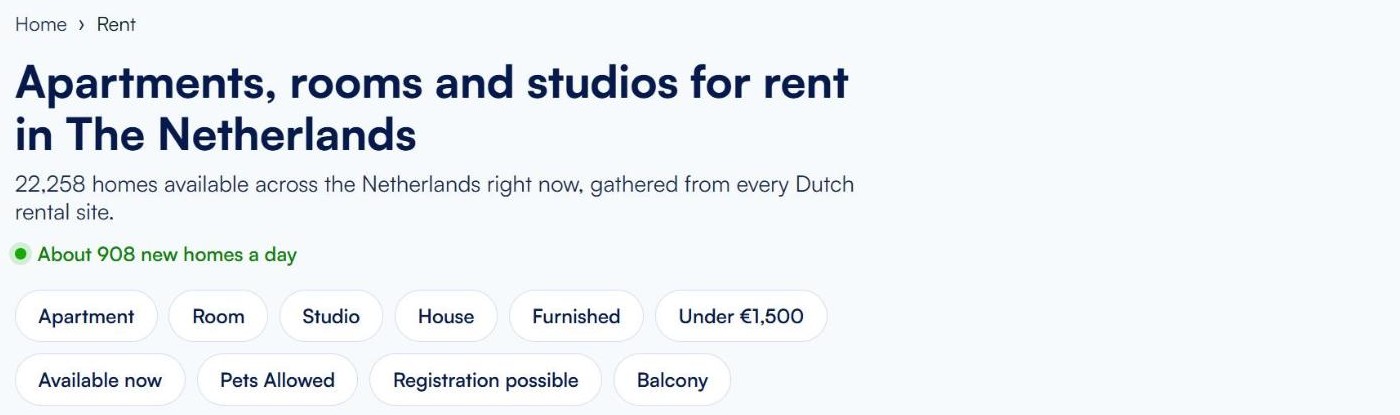
The live RentHunter index: a national count and a daily rate, both updating as you read (screenshot from renthunter.nl)
Claims are one thing; the RentHunter index is something you can count. On 3 November 2026 the RentHunter rental page reported 22,258 homes available across the Netherlands right now, spread over 930 pages of results, and described its own intake as about 908 new homes a day.
That last figure is the third daily number the site publishes, and the three do not say the same thing:
About 908 new homes a day – on the live national index.
1500+ verified listings every day – at the foot of the homepage.
20,000+ listings scanned every day – on the About page.
They are almost certainly three stages of one pipeline: everything the crawler touches, everything that passes verification, and everything genuinely new. RentHunter does not spell that out, so a reader comparing the homepage with the About page sees 1,500 and 20,000 and has to work out that these are not rival claims. The useful number is the smallest one, because 908 new homes a day is what lands in your alerts.
Half an hour earlier the same page read 22,299. The RentHunter index is live and moves in both directions as listings expire – a healthy sign in an aggregator, and a reason not to treat any single screenshot of a stock number as gospel.
Where those homes are: fourteen cities counted
RentHunter publishes a page per city, each with its own live count. Reading all fourteen in one sitting gives a much better picture of the Dutch rental market than any headline figure.
City
Homes listed
Share of the 22,258
Amsterdam
4,061
18.2%
Rotterdam
1,689
7.6%
Den Haag
1,561
7.0%
Utrecht
1,093
4.9%
Groningen
991
4.5%
Eindhoven
799
3.6%
Maastricht
772
3.5%
Tilburg
543
2.4%
Haarlem
437
2.0%
Leiden
384
1.7%
Nijmegen
317
1.4%
Almere
293
1.3%
Breda
266
1.2%
Zwolle
173
0.8%
Live RentHunter city counts read on 3 November 2026
Two things fall out of that table. Amsterdam alone holds 18.2 per cent of everything in the index, more than Rotterdam, Den Haag and Utrecht combined. And the fourteen cities together account for 13,379 homes, about 60 per cent of the national total, which means a serious four in ten listings sit outside the places most internationals think to search. If your job allows Zaandam, Purmerend or Assendelft, the tool is quietly more useful to you than it is to someone locked to the Amsterdam ring.
The flip side is honest too. Zwolle shows 173 homes and Breda 266; on a market that thin an alert service is competing for a small pool. The Amsterdam page claims about 150 new homes a day against a national 908 – so roughly one in six new listings is in one city.
Three counters, three numbers: reading the Amsterdam page
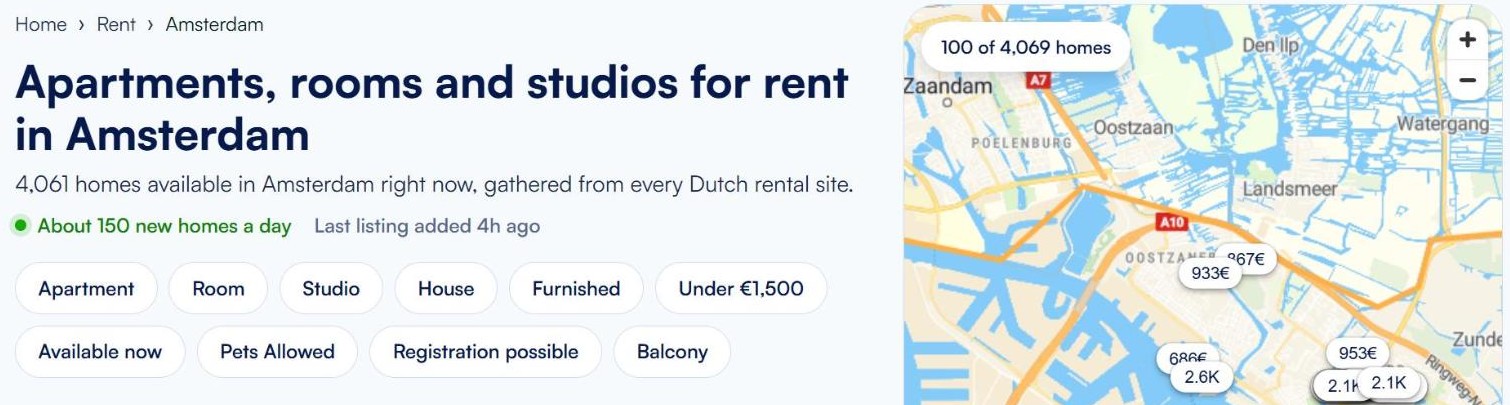
Two different Amsterdam totals on the same screen, four hundred milliseconds apart (screenshot from renthunter.nl)
The Amsterdam page is a good illustration of how a live aggregator behaves, and of why you should read the right number. Opened on 3 November 2026 it showed three different totals at once:
The page text: 4,061 homes available in Amsterdam right now.
The map overlay in the same viewport: 100 of 4,069 homes.
The browser tab title: Apartments, rooms and studios for rent in Amsterdam: 3616 Rentals.
None of these is wrong so much as differently timed. Body and map counts are both live and were read seconds apart, which explains eight homes. The page title is the outlier at 3,616, almost certainly a cached value from when the page was last generated. RentHunter does not flag any of this, so this review notes all three rather than picking one. The number to quote is the one in the page body, which matches the “Showing 1 to 24 of 4,061 homes” line below it.
Why the same flat appears more than once in RentHunter
Scroll the national index and you will see the same property several times. On the day of writing, a three-bedroom 73 m2 apartment at Nieuwersluishof 55 appeared three times at €933, and a 155 m2 Pasteurstraat flat appeared twice, once at €3,995 and once at €3,950.
This is what aggregation looks like from the inside rather than a fault. RentHunter pulls from 1,100+ sources; a landlord who lists on four platforms produces four records, and prices differ by when each platform was updated. The consequence is twofold. The headline 22,258 counts listings, not distinct homes, so the number of addresses is lower. And when two records disagree on price, open the listing rather than trust the card.
Read the other way, it is the clearest argument for using RentHunter at all: the cheaper duplicate at €3,950 is only visible to someone watching every platform at once.
What the city pages say about Dutch rent
Each city page carries a short data headline, and together they are a better cost-of-living briefing than most relocation guides. These are RentHunter’s own figures from its own index, read on the same day:
City
What the page reports
Amsterdam
79% of supply is apartments; median asking rent €2,334
Rotterdam
€726 for a room, €1,834 for an apartment
Den Haag
apartments are 75% of supply
Groningen
49% of listings are rooms
Maastricht
rooms from around €639
Utrecht
apartment rent about 25% above Amersfoort
Eindhoven
apartments about 22% above Tilburg
City-level figures published on the RentHunter city pages, 3 November 2026
The Groningen and Maastricht lines are the ones a student should read twice: in both cities the market is substantially rooms rather than self-contained flats, which changes what a realistic budget looks like. The Amsterdam median of €2,334 is an asking rent across everything on the index, including large family homes, so it is not what a single person should expect to pay. For how rent control, rent increases and housing benefit actually work, the Dutch government publishes a plain-language guide to rented housing.
Applying in one click: what RentHunter sends for you
The application layer is where RentHunter earns the subscription, and it is worth being precise about what happens. You build a dossier once. When a match arrives, the tool writes a message for that specific listing from your profile and sends it, with the dossier attached, to the platform the listing lives on – the company names Funda, Pararius and Kamernet – without you creating an account there. For platforms it cannot post into directly, it gives you a message template instead.
Everything then lands in one dashboard with a status per application: sent, viewed, reply received. That is the part that is genuinely hard to replicate by hand, because the alternative is a spreadsheet and five inboxes.
Two caveats. The message is written by an AI from your profile, so it is personalised to the listing rather than to you in any deep sense; read the first few before letting it run. And RentHunter cannot post everywhere, so “one click” is accurate for the big three platforms and approximate elsewhere. The product pages set out which platforms are covered.
The Coach plan: a person, at 2.43 times the price
Coach costs €84.90 against Essential at €34.90, which is 2.43 times the monthly price, or €56.63 a month on the three-month plan. What the extra buys, per the Terms, is “a dedicated human real-estate Coach who actively helps you with your housing search in the Netherlands” – guidance, prioritising listings, help with applications.
The Terms also draw the line clearly: the coach “provides support and guidance only”, is not your legal representative or agent, and does not sign documents for you. That disclosure sits in the contract rather than the small print of an ad. Whether a human is worth €50 a month on top is a judgement about your own time: searching from abroad, unable to view in person and without Dutch, it is a different proposition than being in the country with evenings free.
Who runs RentHunter
The Terms name the operator, and it is not a Dutch company. RentHunter is run by FAROMIKA, a French societe par actions simplifiee registered at 200 rue de la Croix Nivert, 75015 Paris, with share capital of €100, RCS Paris number 101 754 737, intra-EU VAT FR82 101 754 737, and Fabien Michel as president. Support runs through support@renthunter.nl.
The About page fills in the story: three friends moved from France to Amsterdam in August 2023, spent their first days refreshing the same rental sites, built the alert tool they wanted, and found their own homes in three days. RentHunter now puts itself at 12,000+ renters, 20,000+ listings scanned daily and 1,100+ sites monitored.
None of that is a red flag, and a small share capital is unremarkable for a French SAS. It has one practical consequence worth knowing: your RentHunter contract is with a French company under EU consumer law, which is where the 14-day withdrawal right comes from, and it is separate from your eventual tenancy, which is governed by Dutch rental law and the landlord you sign with.
What RentHunter says it cannot promise
The most persuasive page on the site is the one that promises least. Under a heading reading “What we can’t promise”, RentHunter writes:
The Dutch rental market is tough and competitive. No one can guarantee you a specific home, and we won’t pretend otherwise. What we can guarantee is that you’ll be faster, better prepared, and never miss a listing.
The Terms say the same thing in legal language: the service is “an obligation of means, not of result”, and success depends on the market, landlords’ decisions, your responsiveness, your documentation and your eligibility. Both statements are consistent with the refund policy, which does not pay out for a failed search. A product that writes this down is easier to judge than one that implies a home is included.
Who RentHunter suits
Internationals arriving without Dutch. The entire interface, the dossier and the generated messages are in English, and the alert mechanism does not care which language the source site is in.
People searching the four big cities. Amsterdam, Rotterdam, Den Haag and Utrecht hold 8,404 of the listings in the index. That is where speed decides outcomes and where RentHunter has the most to work with.
Anyone searching from abroad. Applying without holding an account on three Dutch platforms is the single biggest practical win here.
Students in Groningen and Maastricht, where the supply is mostly rooms and the pages give you room-level price anchors before you commit.
Less suited to a thin local market. At 173 listings in Zwolle or 266 in Breda, you can arguably watch the market yourself, and the subscription has less to do.
Less suited to anyone wanting a guarantee. The company does not offer one, and says so twice.
One practical note rather than advice: the subscription renews by itself, and after day 14 the money is not coming back. If you take the three-month plan because you expect a long search, put the renewal date in your calendar the same day you subscribe.
The short version
RentHunter does one thing and documents it unusually well. It turns 1,100+ scattered Dutch rental sites into one feed, alerts you in seconds, and files the application for you – and it tells you in writing that it cannot promise a home. The pricing is in the Terms rather than on a pricing page, which is an odd choice, but the prices themselves are clean: €34.90 a month, €23.30 a month on the three-month plan, with a 14-day withdrawal that is honoured in full without deducting the days you used.
The things to check before you pay are all about your own situation rather than the product. Count the listings in your city on the live index first, because 18 per cent of the national supply is in Amsterdam and the smallest cities carry under 300. Expect the same home to appear more than once. And read the three daily figures on the homepage, the About page and the index as three different measurements, not as one claim told three ways.
Overall: 4.8 / 5. Marked up for a live, countable index, prices and refund rules written in plain language, and a company that puts its limits in writing. Marked down for scattering its own numbers across pages without explaining them, a cached Amsterdam count in the page title, and no pricing page at all. You can see the current plans and the live index at RentHunter.
The iPhone 18 no ports theory is suddenly everywhere. A video making the rounds on TikTok and social media appears to show something startling: an iPhone — labeled as the “iPhone 18” — charging through a small magnetic connector instead…
Hottest fashion trends 2026 reviewed honestly — which trending styles are actually wearable, which are overhyped, and what’s worth buying right now in the US market. Quick Verdict: 2026’s biggest fashion trends fall into two camps: genuinely wearable evolutions of…
PS5 Pro review 2026 — I tested it for 30 days. Here’s the honest verdict on performance, graphics, and whether upgrading from a standard PS5 is actually worth the money. Quick Verdict: The PS5 Pro is the most capable PlayStation…