There is no shortage of chatbots that will happily write you a paragraph about a paper they have never read. AnswerThis is built around the opposite promise: every claim traced to a source, every unsourced sentence dropped before you see it, and a search and screening trail you can hand to a reviewer. It is a Y Combinator-backed AnswerThis research assistant aimed squarely at people who have to defend what they cite.
This review does something the marketing pages do not. It walks the full AnswerThis plan ladder – both audiences, both billing cycles – and works out what each limit actually buys. Doing the arithmetic turned up a $228-a-year gap between two plans with identical feature lists, a discount that is exactly as advertised to the decimal, and one plan name on the security page that does not exist on the pricing page.
What AnswerThis is, in one pass
AnswerThis is a workspace for literature work rather than a chat window bolted onto a search index. You give it a question or paste a protocol, it searches a database the company puts at more than 300 million papers, trials and PDFs, and it returns answers with clickable citations that jump to the passage they came from. From there you can save sources to a library, screen them, and draft in an editor that cites from that library.
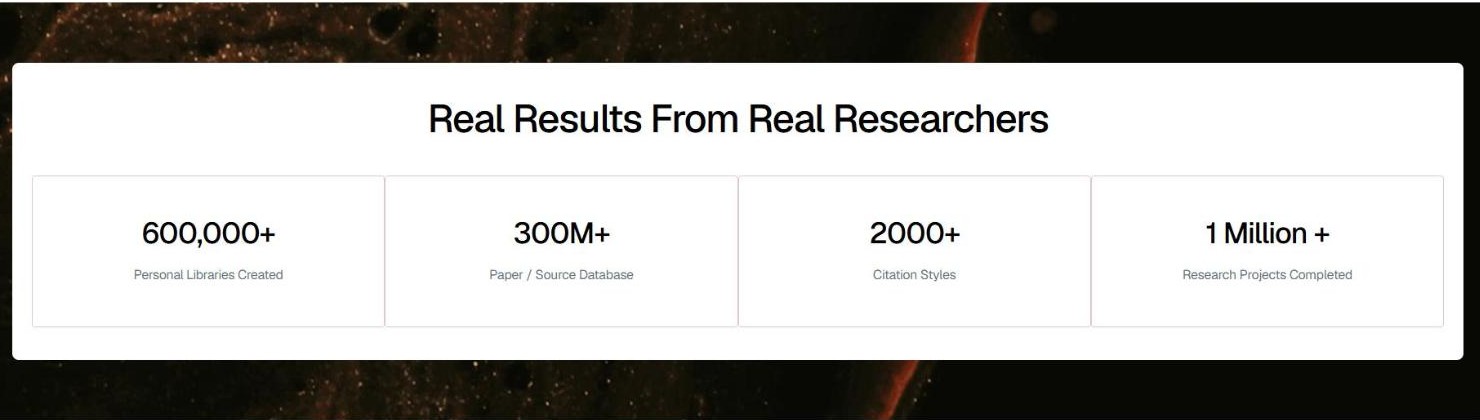
The company publishes a set of headline numbers on its own site. Treat them as company figures – none of them are independently audited – but they do set the scale it is aiming at.
The usage figures AnswerThis publishes on its own homepage (screenshot from answerthis.io).
Company figure
Claimed
Paper / source database
More than 300 million
Personal libraries created
More than 600,000
Citation styles
More than 2,000
Research projects completed
More than 1 million
Researchers
More than 1 million
Figures as published by AnswerThis in November 2026. These are the company own claims.
The five-stage AnswerThis workflow
The AnswerThis product is organised as five numbered stages that write into the same cited document, so nothing has to be exported and re-formatted between steps. Three of them carry names on the homepage: Canvas, Library and AI Writer.
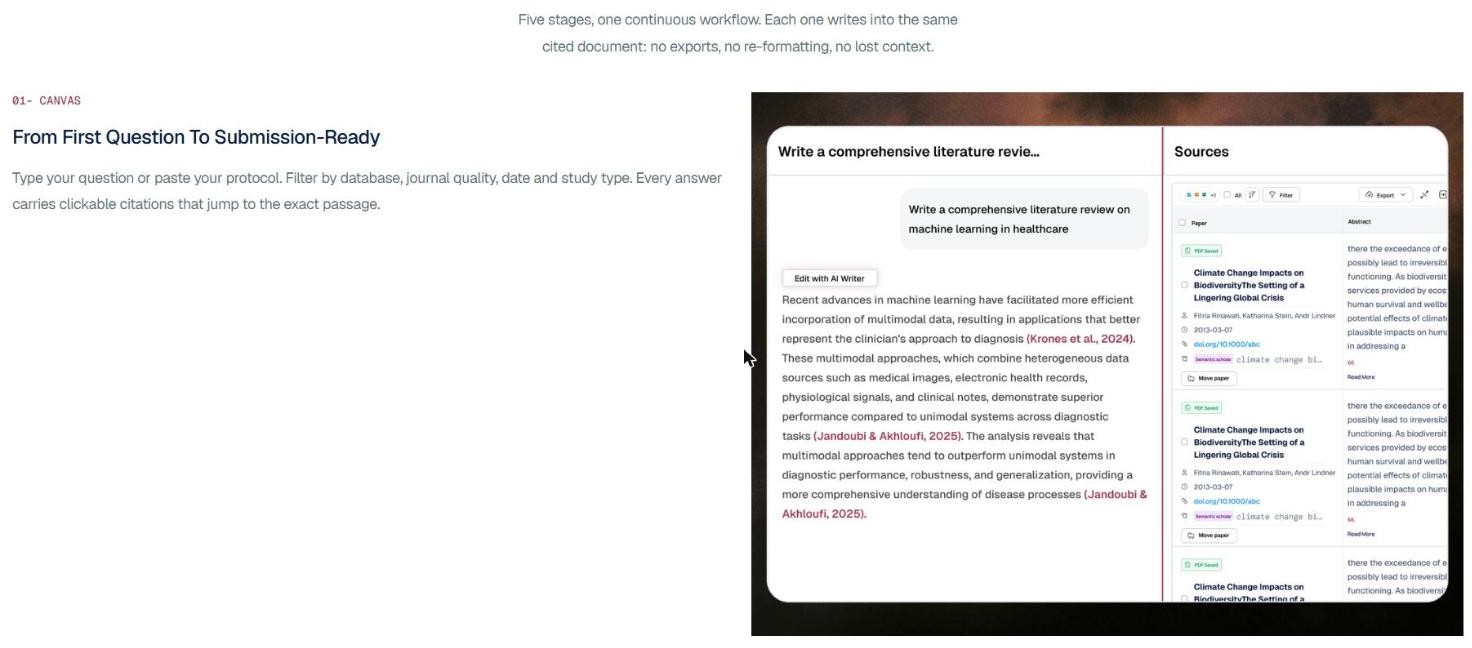
Stage one, the canvas: a drafted review on the left, its sources on the right (screenshot from answerthis.io).
Canvas – type a question or paste a protocol, filter by database, journal quality, date and study type, and read answers whose citations link back to the exact passage.
Library – collections, tags, highlights and full-text search across everything you save, upload, or sync in from Zotero and Mendeley.
AI Writer – import a draft or start fresh, cite from your library in one click, run AI-writing and plagiarism detection, and switch between the 2,000-plus citation styles.
The pitch for that structure is continuity rather than raw speed: search, notes, references and writing sitting in one place instead of four. The full feature breakdown sits on the product site; whether it is worth the subscription depends entirely on which rung of the ladder you land on, which is where this gets interesting.
What the AnswerThis plan ladder costs
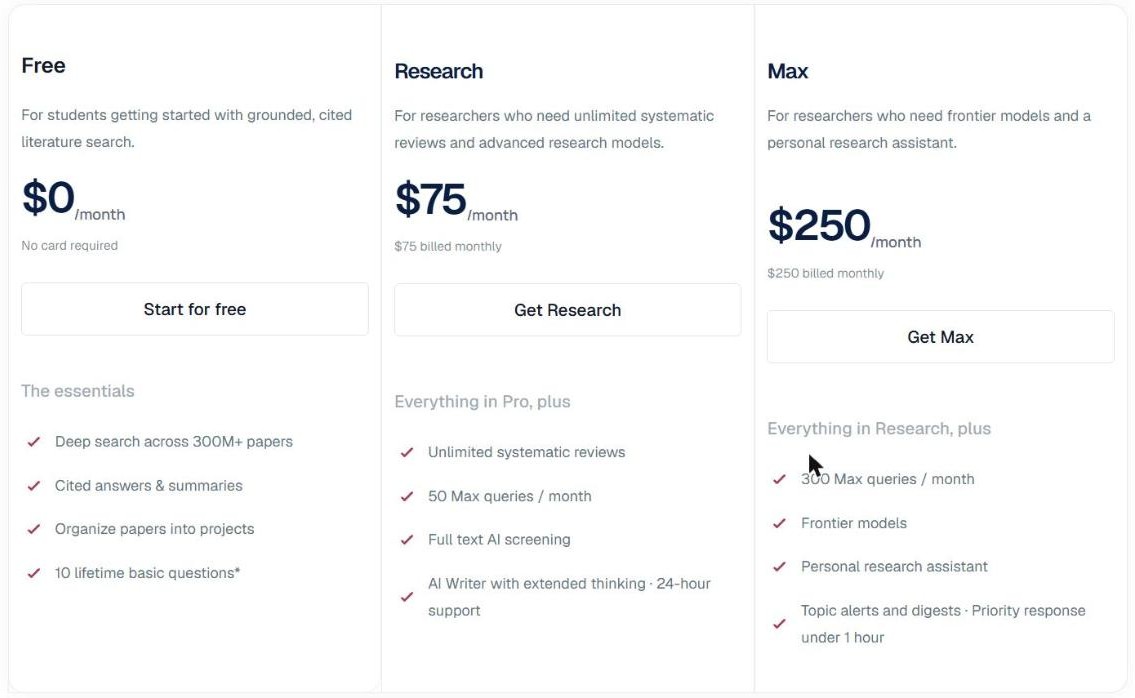
The Academia side of the AnswerThis pricing page runs four tiers. Here is the published monthly pricing with the allowance that actually distinguishes each step.
Three of the four Academia tiers on monthly billing (screenshot from answerthis.io).
Plan
Monthly
Billed yearly
Systematic reviews
Max queries / month
Support
Free
$0
–
None
None
–
Pro
$35
$168 ($14/mo)
2 per month
10
48 hours
Research
$75
$360 ($30/mo)
Unlimited
50
24 hours
Max
$250
$1,200 ($100/mo)
Unlimited
300
Under 1 hour
Published Academia pricing and allowances for AnswerThis, November 2026.
Read down the AnswerThis systematic review column and the real gate becomes obvious. Pro caps you at two a month. Needing a third in the same month is what pushes you to Research, not any shortage of raw search. Everything else on the ladder – Max queries, support speed, model quality – is a refinement on top of that single limit.
The same plan, two prices
The AnswerThis pricing page has two tabs: Academia for students, labs and universities, and Industry for HEOR, pharma and CROs. Flip between them with the billing toggle set to monthly and almost nothing happens. Research is $75 on both. Flip to yearly and a gap opens up.
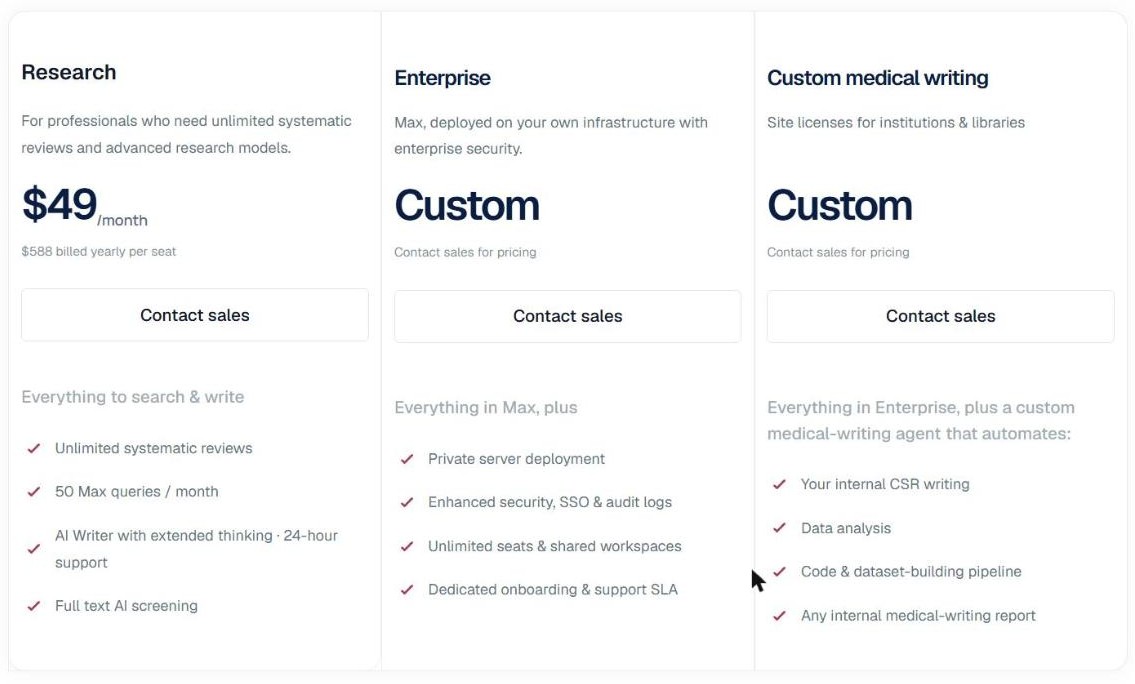
The Industry tier, billed yearly per seat (screenshot from answerthis.io).
Plan
Academia monthly
Academia yearly
Industry monthly
Industry yearly
Yearly gap
Research
$75
$360
$75
$588 per seat
+$228 (+63%)
Max
$250
$1,200
$279
$2,028 per seat
+$828 (+69%)
The two AnswerThis audiences priced side by side. The feature lists for these tiers are identical.
An Industry buyer on the yearly Research plan pays $228 more a year than an Academia buyer for a feature list that reads word for word the same: unlimited systematic reviews, 50 Max queries a month, full-text AI screening, AI Writer with extended thinking, 24-hour support. On Max the gap is $828. Monthly, the same two plans are $75 and $75.
Nothing is hidden here – both tabs are one click apart on the same page. But the gap is created entirely by the discount rate rather than by the product, so it is worth knowing which tab you are standing on before you commit to a year. You can switch between them yourself on the AnswerThis pricing page.
The discount that is exactly what it claims
Advertised savings usually need a pinch of salt, and AnswerThis is an exception. This one does not.
Academia plan
12 months at the monthly rate
Paid yearly
Saved
Discount
Pro
$420
$168
$252
60.0%
Research
$900
$360
$540
60.0%
Max
$3,000
$1,200
$1,800
60.0%
The “Save 60%” badge on the Academia tab is exact on all three paid tiers.
Sixty per cent, to the decimal, on every tier. That is unusual enough to be worth saying out loud, because the Industry tab shows what the more normal version looks like. Its badge reads “Save up to 39%”, and the words “up to” are load-bearing: Max saves 39.4% ($3,348 down to $2,028) while Research saves only 34.7% ($900 down to $588). Both statements are true; one is just more precise than the other.
What a Max query costs on each AnswerThis plan
“Max queries” are the premium-model runs, and they are metered separately from the unlimited basic ones. Divide the price by the allowance and the ladder turns out to reward climbing it, steeply.
Plan
Monthly price
Max queries
Cost per query (monthly)
Cost per query (yearly)
Pro
$35
10
$3.50
$1.40
Research
$75
50
$1.50
$0.60
Max
$250
300
$0.83
$0.33
Headroom on premium models gets 4.2 times cheaper from Pro to Max, on either billing cycle.
A Pro subscriber pays $3.50 of subscription for each unit of premium headroom; a Max subscriber pays 83 cents. The ratio is 4.2 to 1, and it holds identically on the yearly cycle. If you genuinely run premium queries in volume, the expensive plan is the cheap one. If you run two a month, it very much is not.
Support speed follows the same shape. Going from 48-hour to 24-hour response costs an extra $16 a month on the yearly cycle; going from 24-hour to under-one-hour costs an extra $70. The last step on the AnswerThis ladder is priced like a service contract, not like software.
Where the AnswerThis free tier ends
The free AnswerThis plan is real, needs no card, and includes deep search across the full 300 million-source database plus cited answers and project organisation. One line in its feature list deserves a second look: 10 lifetime basic questions.
Lifetime, not monthly. Ten questions is enough to see whether the citations behave and whether the interface suits you, and not nearly enough to finish a piece of work. Read quickly, that line is easy to mistake for a monthly allowance – so plan the ten deliberately rather than burning three of them on test queries.
The pricing page also carries its own caveat in small print under the plan cards, which is more candour than most SaaS pages manage:
Standard offers shown. Existing account prices and allowances may differ; your exact offer is confirmed in the app and at checkout.
In plain terms: the published numbers are the starting point, not a contract. Whatever figure your account shows at checkout is the one that counts, so check it there before you commit. The free tier is the cheapest way to find out what your own account is offered – you can start on the free plan without a card.
Systematic reviews, PRISMA and the audit trail
This is the part that separates AnswerThis from a general AI research tool, and it is also the part the whole plan ladder is built around. The company states that its systematic review workflow follows PRISMA 2020 and Cochrane review steps, with a documented search and screening trail. The pricing page lists what the agent-led version produces: a PRISMA flow diagram tracing records through screening and inclusion, dual or AI reviewers, and living reviews that update as new evidence lands. The top tier adds trial landscape and regulatory connectors.
If those terms are unfamiliar, the reason they matter is that a systematic review is a method, not a literature search with ambition. The Cochrane Handbook for Systematic Reviews of Interventions sets out the standard those steps are measured against, and it is worth reading before you let any tool generate a review you intend to publish.
What AnswerThis is offering here is the documentation, not a shortcut past the method. A screening trail you can export is exactly what a journal reviewer or a regulator will ask to see. We have not run a systematic review through the product, so this section describes what the company documents rather than what we have observed.
How AnswerThis says it checks its own answers
Fabricated citations are the AnswerThis category failure mode that makes researchers distrust AI tools, and AnswerThis devotes a whole section of its homepage to the countermeasure. Three claims, in the company own words.
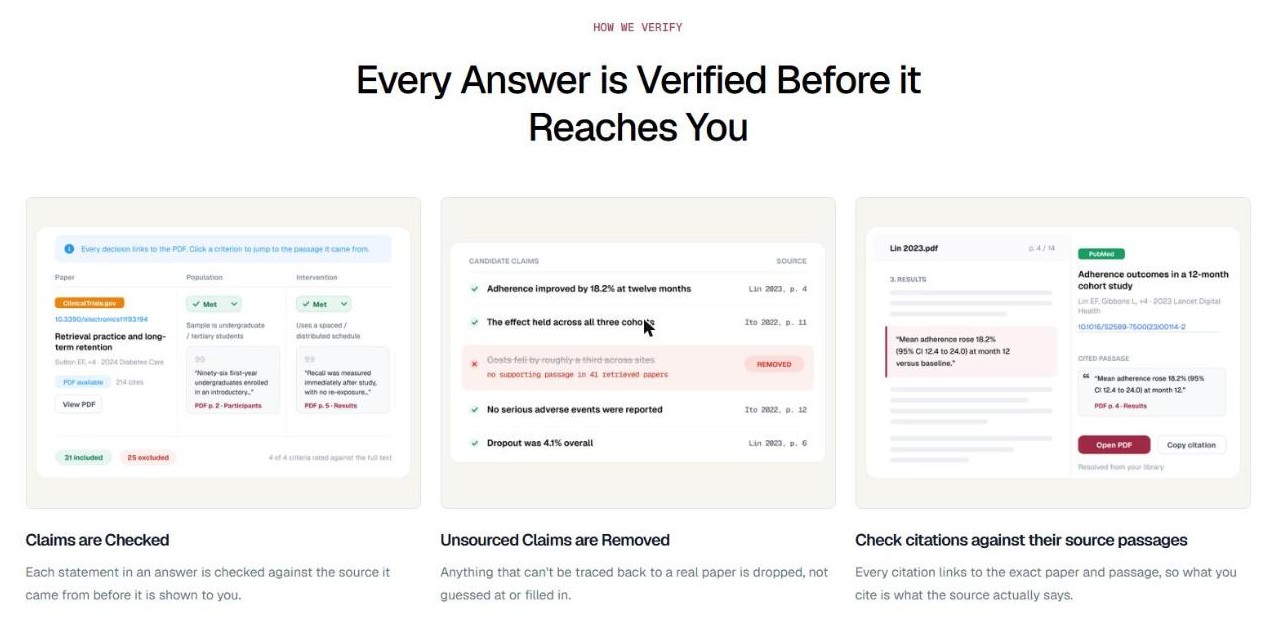
The verification steps AnswerThis describes on its homepage (screenshot from answerthis.io).
Claims are checked – every statement in an answer is checked against the source it came from before it is shown to you.
Unsourced claims are removed – anything that cannot be traced back to a real paper is dropped rather than guessed at.
Citations resolve to passages – each citation links to the exact paper and passage, so what you cite is what the source says.
The screenshots the company uses to illustrate this are specific in a way that is reassuring: a candidate-claims panel with one line struck through and tagged REMOVED, annotated “no supporting passage in 41 retrieved papers”. That is the behaviour you would want. It is still a vendor claim about a vendor process, and the honest advice for any tool in this category is the one the method itself demands – open the cited passage before you rely on it.
The control layer: filters, citation maps and gaps
Where a general chatbot gives you one lever, AnswerThis puts the quality controls in front of the generation step rather than after it. The company lists more than 20 pre-filters, including journal quality, publication date, minimum citation count and source type, applied before the AI writes anything.
Citation Map – trace the lineage of any paper to identify foundational work and the “bridge papers” that connect clusters.
Bibliometric analysis – look at trends and connections across a domain rather than one paper at a time.
Research Gap Finder – surface questions a field has not answered yet.
Diagram – turn findings into a visual rather than another block of prose.
Breadth per search – the company puts a typical search at 150-plus relevant sources you can push straight into your library.
Your library, Zotero, Mendeley and MCP
Nobody starts from an empty library, and AnswerThis does not assume you will. Zotero and Mendeley both import and export, and you can upload PDFs directly. Collections, tags, highlights and full-text search run across everything in there.
The newer route in is the Model Context Protocol. Connect a compatible assistant and you can search papers by topic, DOI, title or author from inside that conversation, browse library folders, save papers, and create or edit a Writer draft with linked citations. Public paper search works without connecting an account at all; anything touching your library needs the account plus approved permissions, and the connection can be revoked from AnswerThis. For anyone who already lives in an AI assistant, that is a meaningful shortening of the loop.
Privacy, encryption and one plan name that does not exist
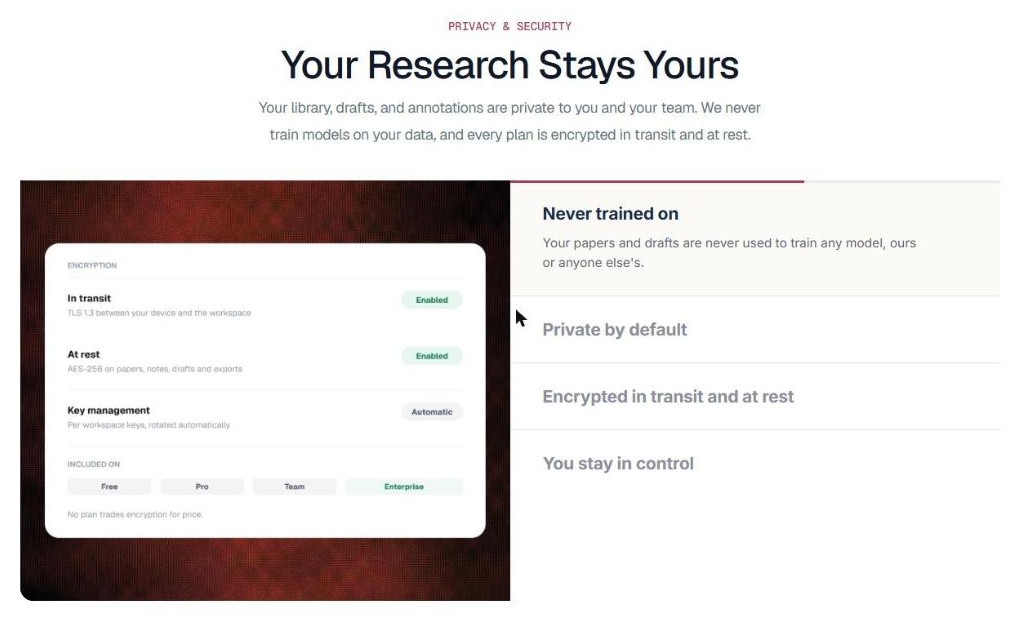
The AnswerThis privacy position is stated plainly: your library, drafts and annotations are private to you and your team, models are never trained on your data, and every plan is encrypted in transit and at rest. The detail panel is more specific than most – TLS 1.3 in transit, AES-256 at rest on papers, notes, drafts and exports, and per-workspace keys rotated automatically.
The encryption panel, with its “included on” row (screenshot from answerthis.io).
The line that earns real credit is at the bottom of that panel: “No plan trades encryption for price.” Security as a paid upgrade is common enough that saying otherwise is worth something.
One oddity, and it is small but checkable in under a minute. The “included on” row of that panel lists four tiers: Free, Pro, Team and Enterprise. Open the pricing page and the Academia tab sells Free, Pro, Research and Max, while the Industry tab sells Research, Max, Enterprise and a custom medical writing licence. There is no Team plan anywhere on the pricing page. It looks like a panel that was not updated when the tiers were renamed rather than anything meaningful – but if you are buying for a group, confirm with AnswerThis which current tier that row is pointing at.
The AnswerThis tools outside the paywall
Five AnswerThis tools sit outside the plan structure entirely, which is a reasonable way to test the underlying search before spending any of those ten lifetime questions.
AI Essay Writer
Literature Review Generator
Research Gap Finder
Citation Generator
Chat with PDF
For the team tier there is more above the published ladder too: an Enterprise plan with private server deployment, SSO and audit logs, unlimited seats and shared workspaces, plus a separate custom medical-writing licence aimed at institutions and libraries that covers internal CSR writing and dataset-building pipelines. Both are quoted rather than listed.
Who AnswerThis fits
This is a specialist tool, and the AnswerThis plan ladder sharpens who it suits rather than blurring it.
A strong fit – anyone who has to produce a defensible review: PhD students, systematic reviewers, HEOR and medical-affairs teams, and anyone whose citations get checked by someone else.
A strong fit – researchers already living in Zotero or Mendeley, or inside an AI assistant that speaks MCP.
Think about the tier – if you need more than two systematic reviews a month, Pro is not your plan and the jump is to $75 monthly or $30 on the yearly cycle.
Think about the tab – if you qualify as Academia, make sure you are buying on that tab. On yearly billing it is $228 a year cheaper for the identical Research feature list.
Probably not for you – if you want a general writing assistant. The whole design is bent toward sourced, screened, exportable evidence, and you pay for that specialisation.
The realistic entry point for one researcher who needs systematic reviews is the Research tier at $30 a month billed yearly, or $75 month to month while you decide. Current terms are on the official AnswerThis pricing page.
How this review was done
This is a desk review of AnswerThis. We did not create an account, run a systematic review, or generate a literature review with the product, and nothing here is a hands-on quality verdict on its output.
Every figure above was read directly off the AnswerThis website in November 2026 – the homepage, the pricing page on both the Academia and Industry tabs and on both billing cycles, the literature review page, the MCP page and the published feature list – and the screenshots are of those pages. The arithmetic is ours: the per-query costs, the discount percentages and the gap between the two audience tabs were worked out from the published prices, with the inputs shown so you can redo any of it.
Claims about what the software does, and all usage statistics, are the company claims and are described as such. We deliberately did not reproduce the named customer testimonials on the homepage or the institutional logos used as trust badges, because neither is something a reader can verify.
The short version
AnswerThis is one of the few tools in this category built for people who get audited. Sourced answers with passage-level citations, a PRISMA-shaped review workflow with an exportable trail, encryption on every tier including the free one, and a stated policy of never training on your data. The free plan is honest about being a taster, and the paid ladder is clearly organised around one thing: how many systematic reviews you need.
Go into AnswerThis knowing three things. The free tier is ten questions for life, not ten a month. The yearly discount is genuinely 60% on the Academia tab and genuinely less on Industry, so pick your tab deliberately. And the premium-query economics reward the expensive plans so steeply that the middle tier is the awkward one if your usage is uneven.
Overall: 4.8/ 5. Marked down for a free tier too small to evaluate the product properly and a pricing page whose two tabs quietly diverge on yearly billing, not for the research workflow, which is the most carefully thought-through part of it.
The iPhone 18 no ports theory is suddenly everywhere. A video making the rounds on TikTok and social media appears to show something startling: an iPhone — labeled as the “iPhone 18” — charging through a small magnetic connector instead…
Hottest fashion trends 2026 reviewed honestly — which trending styles are actually wearable, which are overhyped, and what’s worth buying right now in the US market. Quick Verdict: 2026’s biggest fashion trends fall into two camps: genuinely wearable evolutions of…
PS5 Pro review 2026 — I tested it for 30 days. Here’s the honest verdict on performance, graphics, and whether upgrading from a standard PS5 is actually worth the money. Quick Verdict: The PS5 Pro is the most capable PlayStation…