Every Etsy seller eventually hits the same wall: the listing is good, the photos are fine, and nobody can find it. Search is the whole game on a marketplace that size, and guessing at tags is an expensive way to play it.
eRank exists for that problem. eRank is a keyword and competitor research tool built specifically around Etsy, it says it is trusted by over 2 million sellers, and – unusually for this category – the free plan is not a trial. It carries a line on the pricing page that simply reads “no time limit”.
This review works through the published plans line by line, because the interesting part is not the feature list, it is the arithmetic. Four tiers, two billing cycles, and a set of limits that do not rise in anything like a straight line. The eRank plans page is the source for every number below.
What eRank is for
The company describes the product in one sentence on its home page:
Our powerful suite of tools, designed for keyword research, competitor analysis, trend tracking, and more, help you to optimize your listings, drive traffic to your shop, and boost sales.
Four eRank jobs, then, and they map cleanly onto what the limits actually meter. Keyword research is metered in lookups per day. Competitor analysis is metered in shops you can track. Trend tracking rides on the same keyword data. Listing optimization is metered in audits per day and in how many of your own listings the tool will watch.
That matters when you read the price list, because you are not buying features as you move up the tiers. With one exception at the bottom, every plan has the same tools. You are buying bigger numbers.
What the free eRank plan already includes
The free eRank tier is the part most worth knowing about, because it is genuinely usable rather than a countdown to a card prompt.
Free plan allowance
Amount
Keyword lookups
5 per day
Shops connected
1 shop
Listings tracked
50
Listing audits
5 per day
AI Listing Helper
1 use per day
Keyword lists saved
1
Competitor tracking
not included
The free allowance as printed on the plans page
Five eRank lookups a day is 150 a month, which is enough to research one product properly or to sanity-check the tags on a handful of existing listings. The one real gap is competitor tracking: the comparison table marks it with a cross on the free column, and it is the only row in the key-features block that free users do not get at all.
The four eRank plans and what they cost
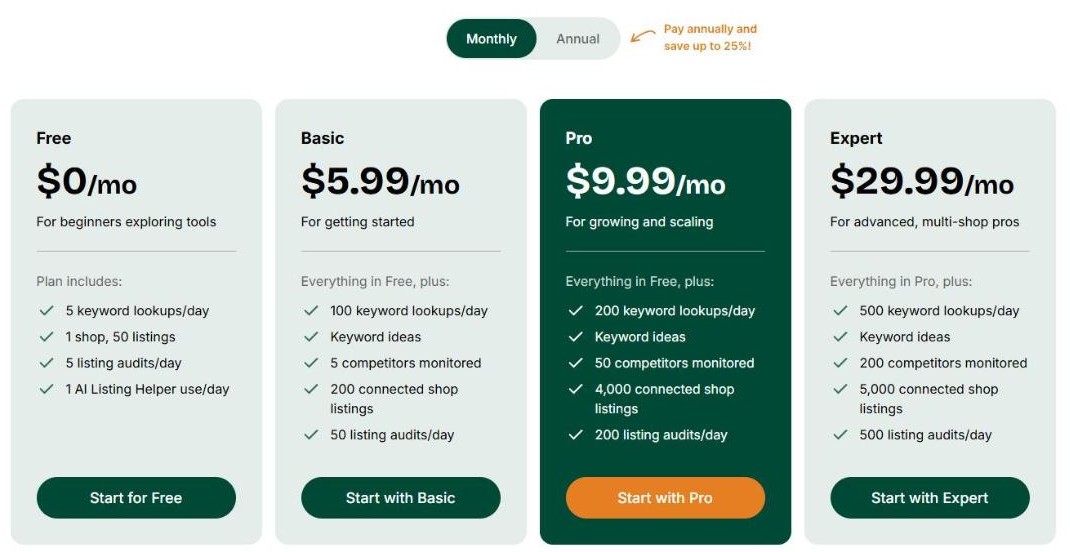
Paid monthly, the eRank ladder runs like this.
The four plans on monthly billing (screenshot from erank.com)
Plan
Per month
Keyword lookups/day
Listing audits/day
Free
$0
5
5
Basic
$5.99
100
50
Pro
$9.99
200
200
Expert
$29.99
500
500
Monthly prices and the two daily allowances printed on each card
Pro is the eRank card the page highlights, and the $4.00 step from Basic to Pro is the cheapest move on the whole page. The step from Pro to Expert costs $20.00, which triples the bill.
One small wording detail is worth noticing on the cards themselves. Basic and Pro both say “Everything in Free, plus” – so Pro is not described as containing Basic. Only Expert says “Everything in Pro, plus”. Nothing on the page suggests Pro is missing anything Basic has, and the limit table confirms Pro is higher on every row, but the ladder’s own copy skips a rung.
The full eRank limit table
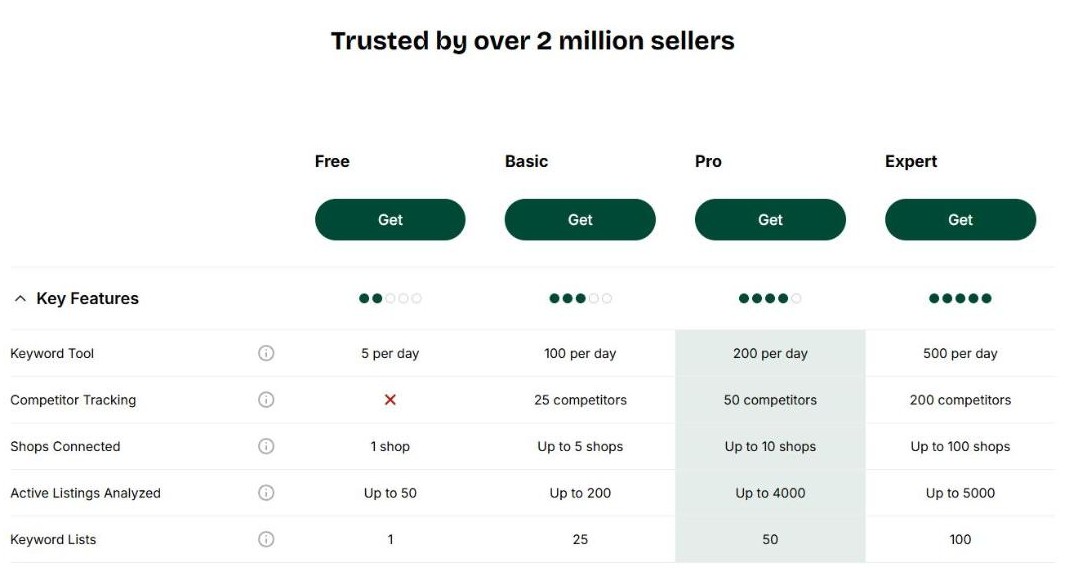
Below the eRank cards sits a detailed comparison block. This is where the real shape of the product shows up.
The key-features comparison block (screenshot from erank.com)
Limit
Free
Basic
Pro
Expert
Keyword Tool
5 per day
100 per day
200 per day
500 per day
Competitor Tracking
not included
25 competitors
50 competitors
200 competitors
Shops Connected
1 shop
Up to 5
Up to 10
Up to 100
Active Listings Analyzed
Up to 50
Up to 200
Up to 4000
Up to 5000
Keyword Lists
1
25
50
100
The key-features rows, transcribed from the comparison block
The eRank keyword tool itself is not Etsy-only. The tooltip on that row says it will “gather trend data for keywords for over a dozen marketplaces, including Etsy, Amazon and eBay”, which makes the same subscription useful to anyone selling the same handmade line in more than one place.
Two different numbers for the same row
Put the Basic eRank card and the Basic column side by side and one line does not match.
Where it appears
What it says for Basic
Pricing card
5 competitors monitored
Comparison table
25 competitors
The same allowance, stated twice on one page
The Pro and Expert eRank figures agree between the two places – 50 and 200 respectively – so the mismatch is confined to the entry paid tier, and it is a factor of five. A reader scrolling from the card to the table on the same screen will see both numbers inside about two seconds.
Both are recorded here exactly as published. Which one governs the account is not something the page settles, and it is not something a desk review should guess at – anyone choosing Basic specifically for competitor tracking would want to ask support before paying.
What one daily keyword lookup actually costs
Since the eRank plans meter the same tool at different rates, the honest way to compare them is price divided by allowance. Doing that to the monthly prices produces a result the page never states.
Plan
Per month
Lookups/day
Cost per daily lookup
Basic
$5.99
100
$0.0599
Pro
$9.99
200
$0.0499
Expert
$29.99
500
$0.0600
Monthly price divided by the daily keyword allowance
Pro is the cheapest plan per lookup, and Expert is the most expensive. Expert costs five times as much as Basic and ends up charging essentially the same rate for the same unit – the two differ by about a hundredth of a cent. Everything you are paying the extra $24 a month for sits in the other rows: competitors, shops and audits.
That is not a criticism of Expert, which is sold explicitly “for advanced, multi-shop pros”. It is just the clearest way to see that the top tier is a multi-shop plan wearing a keyword-tool price tag, and it is a useful check against buying it for keyword volume alone. Compare the current eRank tiers with that division in mind.
The eRank listings ladder is not a ladder
The Active Listings Analyzed row is the most lopsided on the page: 50, then 200, then 4,000, then 5,000.
Step
Extra cost per month
Listings
Change
Free to Basic
$5.99
50 to 200
x4
Basic to Pro
$4.00
200 to 4,000
x20
Pro to Expert
$20.00
4,000 to 5,000
+25%
What each upgrade does to the listing allowance
Four dollars multiplies the eRank allowance by twenty. Twenty dollars adds a quarter. For a seller whose shop has grown past a couple of hundred listings, the Basic-to-Pro step is one of the better-value four dollars in this category, and the Pro-to-Expert step buys almost nothing on this particular row.
The rows that do move properly at the top are the multi-shop ones: shops connected goes from 10 to 100, and competitor tracking from 50 to 200. Expert is priced for someone running a portfolio of shops, not a bigger single shop.
Paying for eRank by the year
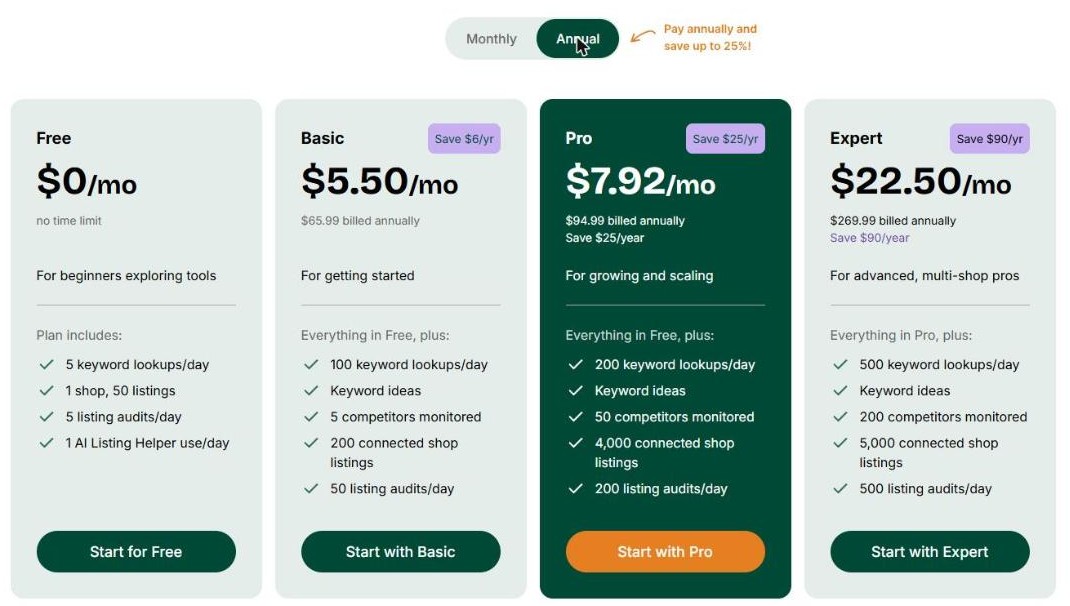
A toggle above the eRank cards switches to annual billing, advertised as “Pay annually and save up to 25%”.
The same plans switched to annual billing (screenshot from erank.com)
Plan
Monthly x 12
Annual price
Effective per month
Actual saving
Basic
$71.88
$65.99
$5.50
$5.89
Pro
$119.88
$94.99
$7.92
$24.89
Expert
$359.88
$269.99
$22.50
$89.89
Annual pricing against twelve monthly payments
The effective monthly figures the eRank page prints check out exactly: $65.99 divided by 12 is $5.4992, shown as $5.50; $94.99 is $7.9158, shown as $7.92; $269.99 is $22.4992, shown as $22.50. The free plan stays free on this tab too, labelled “no time limit”.
Every saving badge rounds up by eleven cents
Each annual eRank card carries a purple badge announcing the yearly saving. Compare the badge to the subtraction and the same gap appears three times.
Plan
Badge says
Subtraction gives
Difference
Basic
Save $6/yr
$71.88 – $65.99 = $5.89
11 cents
Pro
Save $25/yr
$119.88 – $94.99 = $24.89
11 cents
Expert
Save $90/yr
$359.88 – $269.99 = $89.89
11 cents
Advertised saving against the arithmetic, on all three paid plans
The cause is simple, mechanical and nothing to do with eRank itself: twelve monthly payments ending in .99 always total something ending in .88, while the annual prices end in .99. Subtract one from the other and you are always eleven cents short of the round number. The badges round up to the nearest dollar, and they do it consistently rather than selectively.
It is worth a sentence rather than an argument. Eleven cents a year is not a reason to do anything differently – but it is the kind of detail a reader can verify in ten seconds, and the fact that it is the same eleven cents on all three plans tells you the badges are generated, not hand-written.
The eRank annual discount grows with the plan
The eRank toggle promises up to 25%, and “up to” is doing real work there.
Plan
Saving
As a share of twelve monthly payments
Basic
$5.89
8.2%
Pro
$24.89
20.8%
Expert
$89.89
25.0%
Annual discount by plan, from the published prices
The Expert eRank plan hits the advertised 25.0% almost exactly. Basic gets 8.2% – about a third of the headline. So the plan most likely to be bought by someone watching every dollar is the plan with the smallest reason to commit for a year, while the plan bought by established sellers gets the full discount.
Read practically, that makes Basic the tier to keep on monthly billing while you decide whether the tool earns its place, and Pro or Expert the tiers where the annual switch is worth doing once you are sure. Check which billing cycle is showing before you compare prices against anything else, because the cards default to one view.
The data underneath
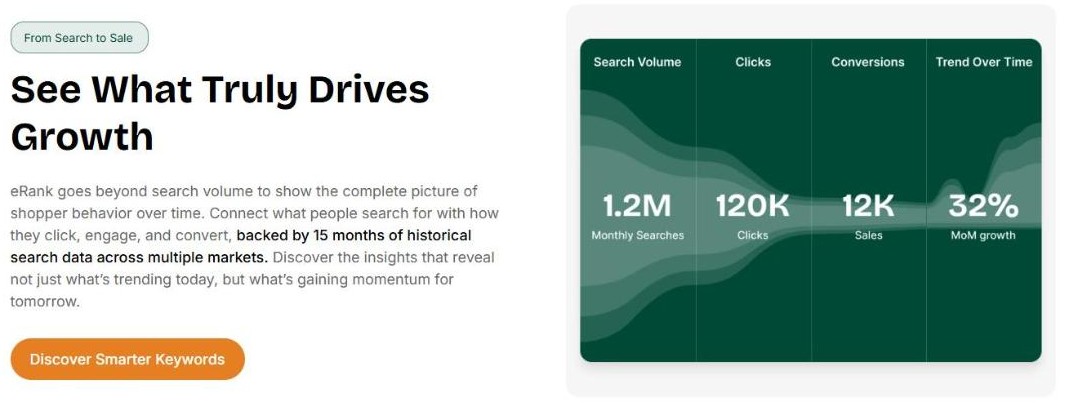
eRank limits are only interesting if the numbers they meter are worth having. The keyword research page is specific about depth.
How the keyword research page describes its data (screenshot from erank.com)
The company states the tool is “backed by 15 months of historical search data across multiple markets”, and that it goes past search volume to cover how shoppers “click, engage, and convert”. Fifteen months is the number that matters for anyone selling seasonal stock, because it is just over a year – enough to see last season and the run-up to this one in the same chart.
On the competitor side, the same page says you can pull the Top 100 listings for any keyword with estimated sales, average price, views, favourites and processing times. Processing time is the quietly useful one: it is a field most sellers never think to benchmark, and on a marketplace where dispatch speed affects conversion it is worth a look.
The panel of figures shown on that page is an illustration of the interface rather than a published statistic, so the numbers in it are not quoted here as facts about any real keyword.
Working inside Etsy with the eRank extension
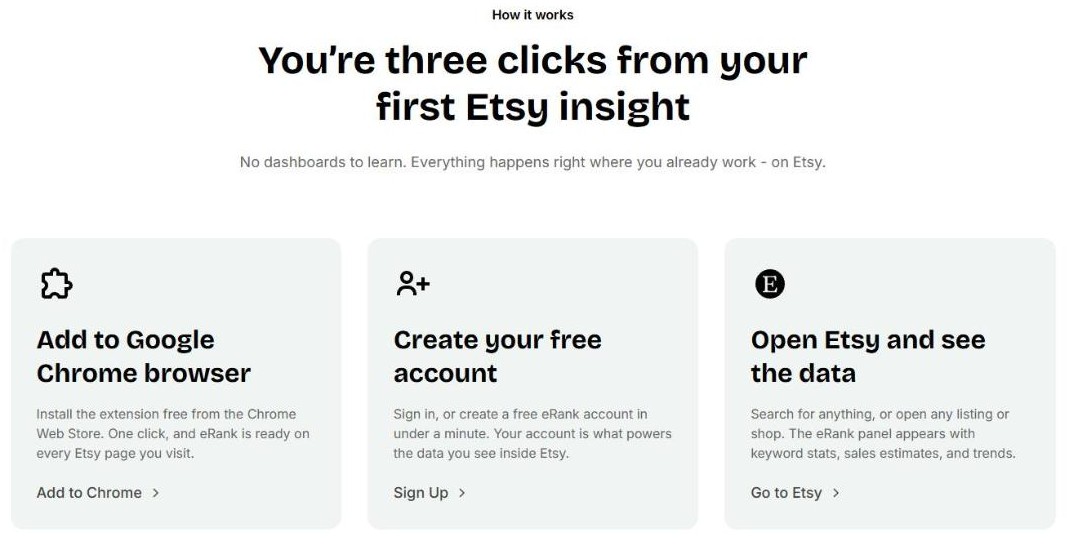
There is an eRank Chrome extension, and the pitch for it is the strongest line on the whole site: “No dashboards to learn. Everything happens right where you already work – on Etsy.”
The three-step setup for the browser extension (screenshot from erank.com)
The eRank setup is described in three steps – install from the Chrome Web Store, sign in to a free account, then open Etsy. From there the panel appears over any search, listing or shop page with keyword stats, sales estimates and trends.
The important detail is that the eRank extension is free and the account it needs can be the free one. Someone can get the overlay running and see real data on real listings without entering a card, and the paid limits only start to bite once five lookups a day stops being enough.
Who eRank fits
A brand new shop – the free plan, permanently. Five lookups a day and 50 tracked listings covers a shop that does not have 50 listings yet.
One shop, growing – Basic at $5.99 lifts lookups to 100 a day and listings to 200, and is the natural first paid step.
A shop past a couple of hundred listings – Pro at $9.99 is the standout: four dollars more than Basic for twenty times the listing allowance and the lowest cost per lookup on the page.
Several shops at once – Expert at $29.99 is the only tier that moves shops connected to 100 and competitors to 200. Buy it for the shop count, not the keyword count.
Selling beyond Etsy too – the keyword tool covers more than a dozen marketplaces including Amazon and eBay, so one subscription can serve several storefronts.
eRank fits least well a seller who wants someone to write the listings for them. This is a research tool: it tells you what people search for and what the winning listings are doing, and the writing and the photography are still yours.
How this review was done
This is a desk review of eRank assembled from what the company publishes: the plans page with both billing tabs, the comparison block beneath it, the keyword research page and the browser extension page. No plan was bought, no account was created and no shop was connected, so there is no claim here about how accurate the sales estimates turn out to be in practice.
Every figure above is quoted in US dollars exactly as printed, and every calculation – the cost per lookup, the eleven-cent rounding, the 8.2% against 25.0% – uses only those printed numbers and can be reproduced from the tables in a couple of minutes. Readers who want a framework for the wider exercise this tool supports can start with the US Small Business Administration guide to market research and competitive analysis, which covers the same questions without the marketplace jargon.
The short version
eRank is a well-priced research tool with an unusually honest free tier – five keyword lookups a day, 50 tracked listings and a browser overlay, with no time limit and no card. For a new Etsy shop that may be the whole answer for months.
Among the paid eRank tiers the arithmetic points one way. Pro at $9.99 is the cheapest plan per keyword lookup, it costs four dollars more than Basic, and it multiplies the listing allowance by twenty. Expert is a multi-shop plan: it triples the price for a quarter more listings, and its value sits entirely in 100 connected shops and 200 tracked competitors.
Two things to check for yourself before paying. The Basic card and the comparison table give different competitor allowances – 5 against 25 – and only support can settle which applies. And the annual discount is 8.2% on Basic against 25.0% on Expert, so the yearly commitment is worth far more at the top of the range than the bottom.
Overall: 4.4 out of 5. Start on the free plan and let your own eRank lookup count tell you which tier you actually need.
The iPhone 18 no ports theory is suddenly everywhere. A video making the rounds on TikTok and social media appears to show something startling: an iPhone — labeled as the “iPhone 18” — charging through a small magnetic connector instead…
Hottest fashion trends 2026 reviewed honestly — which trending styles are actually wearable, which are overhyped, and what’s worth buying right now in the US market. Quick Verdict: 2026’s biggest fashion trends fall into two camps: genuinely wearable evolutions of…
PS5 Pro review 2026 — I tested it for 30 days. Here’s the honest verdict on performance, graphics, and whether upgrading from a standard PS5 is actually worth the money. Quick Verdict: The PS5 Pro is the most capable PlayStation…