Renting a GPU used to mean a quote, a contract and a three-week wait. RunPod replaced that with a sign-up box and a button, and more than a million developers now run their AI work on it. The pitch is simple: experiment, train, fine-tune, deploy and scale on one platform, and pay by the second for exactly the compute you use.
That single-platform idea is what makes RunPod worth a close look in 2026. You can start on a $0.27/hr RTX A5000 while you get a model working, move the same container onto an H100 for a real training run, then push it to a serverless endpoint that scales to zero between requests — without rewriting anything or migrating to a different provider. You can open a free RunPod account here and have a pod running before you finish reading this review.
Below is a full look at what RunPod offers, what the GPUs actually cost, and which kinds of builders get the most out of it.
What RunPod actually gives you
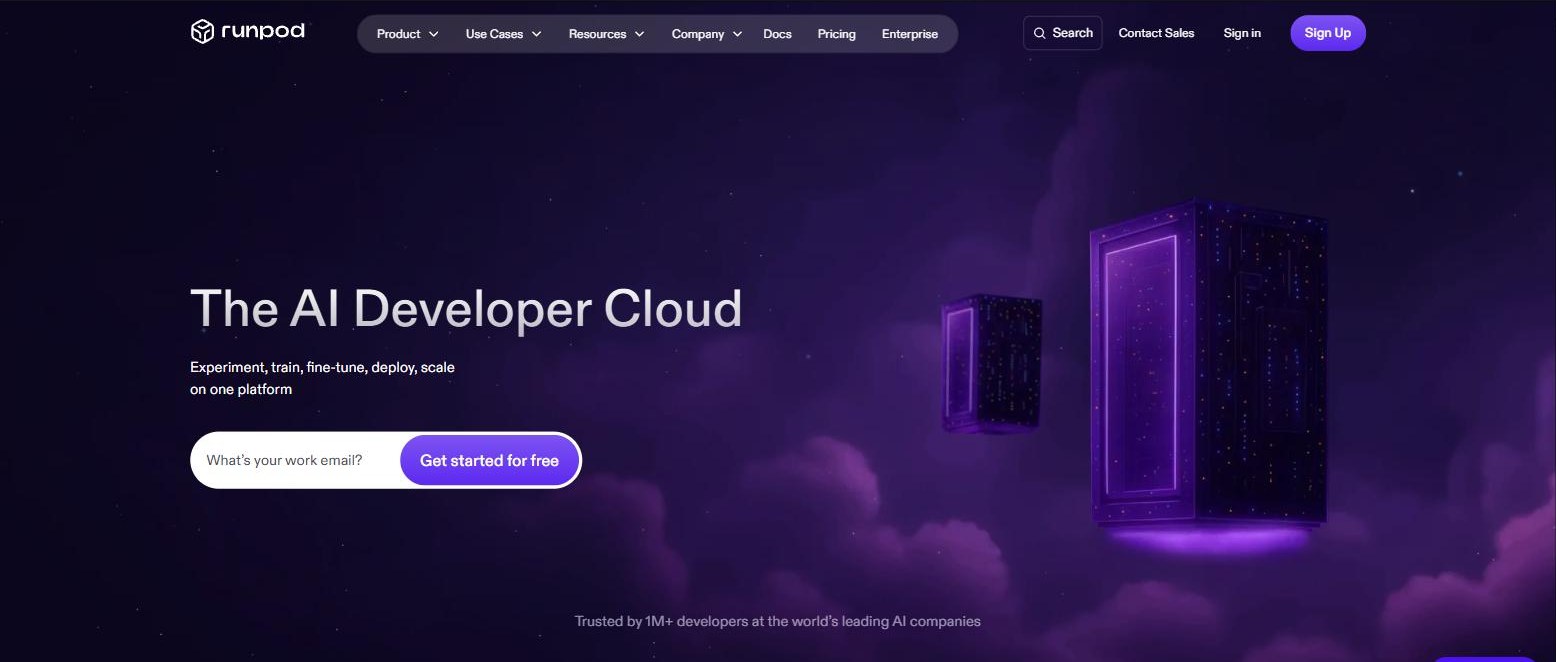
RunPod calls itself the AI Developer Cloud, and the platform breaks into three products that cover the whole lifecycle of an AI project.
RunPod positions itself as one platform for experimenting, training, fine-tuning, deploying and scaling (screenshot from runpod.io)
Pods — on-demand GPU instances spread across 30+ regions. Take a Reserved pod when you need guaranteed capacity, or a Spot pod when you want the cheapest possible rate for interruptible work.
Serverless — autoscaling GPU endpoints that spin up on a request and scale back to zero the moment traffic stops. This is the production side of RunPod.
Clusters — multi-GPU, multi-node capacity for distributed training and large batch jobs, from a handful of GPUs up to enterprise-scale reservations.
All three run your own containers. RunPod is deliberately container-agnostic, so whatever image you already build locally is the image that runs in the cloud — no proprietary SDK to adopt, no rewrite to get in, and nothing to unwind if your needs change.
RunPod pricing: per-second billing across 30+ GPU tiers
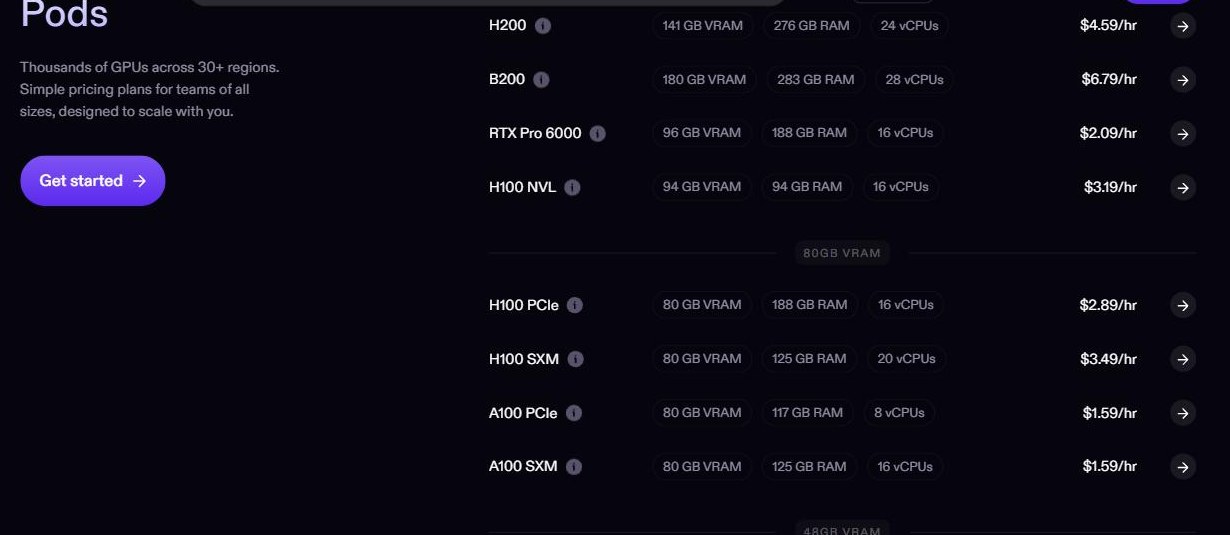
Pricing is where RunPod makes its strongest case. There are more than 30 GPU SKUs on the menu, and the ladder runs from hobby-budget cards all the way to Blackwell-class accelerators, so you can match the hardware to the job instead of overpaying for headroom you will not use.
RunPod pricing is published openly per hour and per second, with Community and Secure Cloud rates side by side (screenshot from runpod.io)
Published Secure Cloud rates at the time of writing:
Two details matter more than the headline numbers. First, billing is metered per second from worker start to full stop — a nine-minute job is charged as nine minutes, not a rounded-up hour. Second, storage is priced separately and cheaply: container disk at $0.10/GB per month, network storage from $0.05–$0.07/GB per month, and high-performance volumes at $0.14/GB per month, with no egress fees on data you pull back out.
There are no contracts and no minimum commitments on the pay-as-you-go tiers, and reservations are available when you want a discount in exchange for a longer commitment. Check the current RunPod rates for the GPU you need before you plan a budget, since new cards land on the list regularly.
RunPod Serverless: sub-200ms cold starts and scale to zero
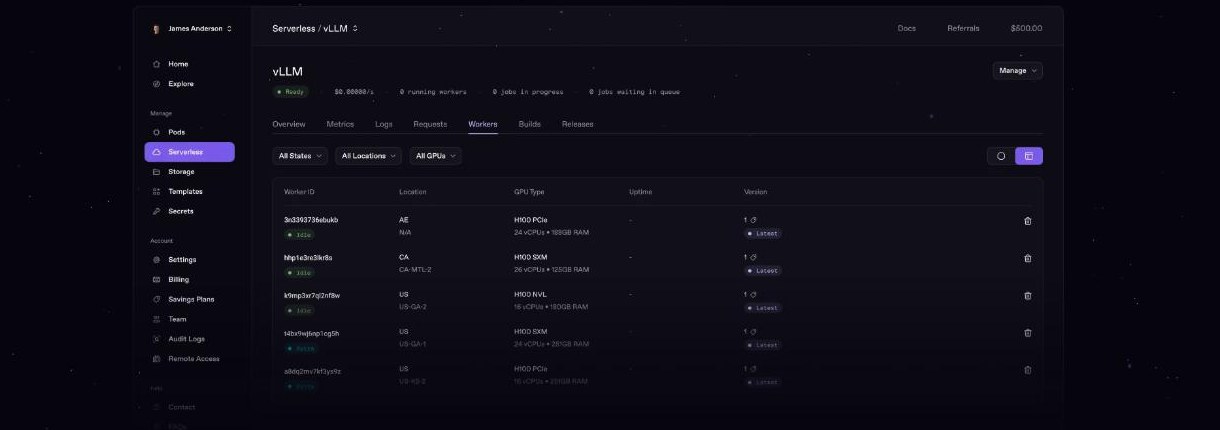
Serverless is the part of RunPod that turns a working model into a product. You point an endpoint at your container, and RunPod handles the queueing, the routing and the autoscaling from zero to hundreds of workers as requests arrive.
A RunPod Serverless endpoint with its workers, GPU types and locations visible in one view (screenshot from runpod.io)
The headline feature is FlashBoot, which brings cold starts down to sub-200ms. In practice that removes the usual reason teams keep expensive GPUs idling: you no longer need a warm fleet just to avoid a slow first response. Flex workers drop to zero when nothing is happening, and you pay nothing for that idle time.
13 GPU tiers on serverless, from 16GB up to 280GB of VRAM, roughly $0.58/hr to $9.98/hr
Per-second metering from worker start to full stop, rounded up to the second
Worker affinity (added July 2026) routes follow-up requests back to a specific worker — useful for chat sessions and cached state
Batch Jobs (beta, August 2026) submit a large set of inference requests as one managed unit
Persistent network volumes so model weights do not have to be downloaded on every start
Real-time logs, metrics and distributed tracing built into the dashboard
Typical workloads people put on RunPod Serverless are image and video generation, LLM inference with vLLM or SGLang, speech and audio models, fine-tuning runs and agent backends. If your traffic is spiky — quiet all night, busy for two hours — this billing model is where the savings become obvious. Deploy your first serverless endpoint on RunPod and it will sit at zero cost until the first request lands.
RunPod Clusters for distributed training
When one GPU stops being enough, Clusters give you coordinated multi-node capacity without leaving the platform.
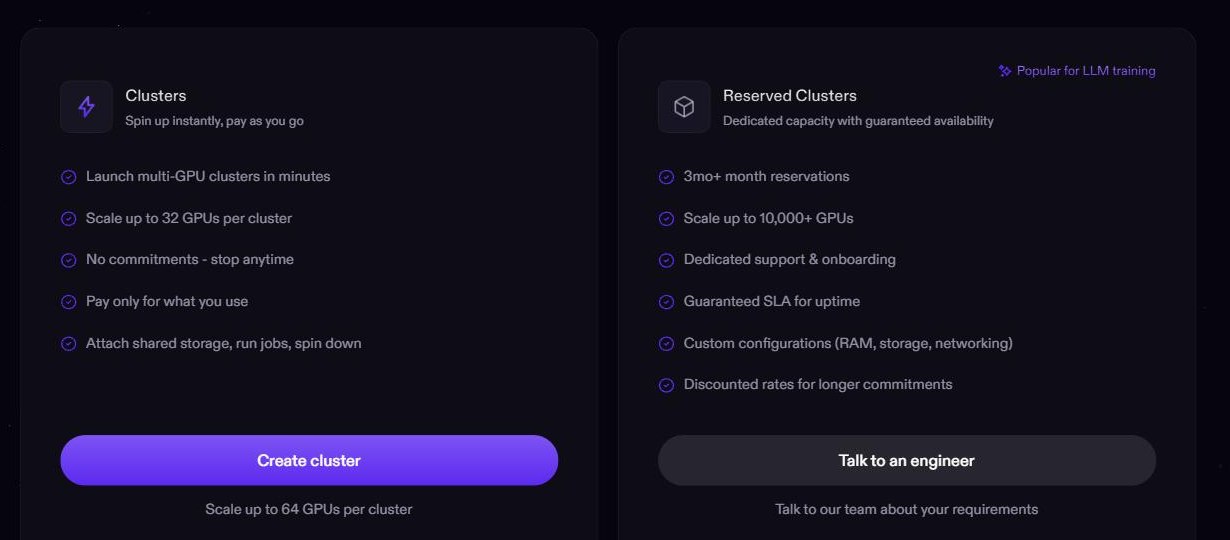
RunPod offers instant pay-as-you-go clusters alongside reserved capacity for large training runs (screenshot from runpod.io)
Clusters — launch multi-GPU clusters in minutes, scale up to 64 GPUs per cluster, stop any time, pay only for what you use, and attach shared storage
Reserved Clusters — 3-month-plus reservations scaling to 10,000+ GPUs, with dedicated onboarding, a guaranteed uptime SLA, custom RAM/storage/networking and discounted rates
Scale Instant Clusters (beta, July 2026) — add pods to a running cluster without tearing it down and rebuilding
Why more than a million developers chose RunPod
The traction behind RunPod is easy to verify. In June 2026 the company raised $100 million led by Summit Partners at a $1 billion valuation, on the back of a developer base that has passed one million and more than 20 billion inference requests served.
The numbers the company shares about onboarding say a lot about how the product is built:
Median time from sign-up to a first running workload: under one hour
90%+ of deployments succeed on the first try
85% of developers who deploy come back to build something else
SOC 2 Type II and ISO 27001 certified
99.9% uptime commitment, rising to 99.99% on enterprise agreements
Zhen Lu, RunPod CEO, framed the goal this way at the funding announcement: “Builders need one place to take an idea from first experiment to production traffic, without stitching together multiple tools.” That is exactly what the three-product structure delivers, and it is the reason teams at companies like Replit, Civitai, Cursor, Magic and Perplexity show up on the RunPod customer wall.
RunPod fits the stack you already have
Nothing about RunPod asks you to change how you build. It runs Python, Node.js, Go, Rust and C++, and supports PyTorch, TensorFlow, JAX and ONNX, plus any custom Docker container you bring.
REST API v2 reached general availability in August 2026, adding catalog endpoints, pod log streaming and serverless observability
Private AWS ECR integration (beta) pulls private images into Pods and Serverless without migrating registries or juggling credentials
Templates and one-click deploys cover the common stacks so you are not writing a Dockerfile to test an idea
Network volumes keep datasets and weights available across pods and endpoints
For teams already running other AI tools, this slots in cleanly alongside them — the same way a focused tool like lemlist handles outbound or ElevenLabs handles voice while your own models run on your own infrastructure. The RunPod documentation is thorough and worth skimming before your first deploy.
Who gets the most out of RunPod
Independent AI developers and researchers
If you are fine-tuning a model or testing an idea at weekends, the low end of the RunPod ladder is remarkable value. An RTX A5000 at $0.27/hr means a full eight-hour experiment costs about $2.16, and per-second billing means an aborted run costs you only the minutes it lived.
Startups shipping AI features to real users
This is the sweet spot. RunPod Serverless gives you production inference with autoscaling, logs and metrics without hiring anyone to run Kubernetes, and the zero-idle billing keeps your burn proportional to actual usage while you are still finding product-market fit.
ML teams running big training jobs
Clusters up to 64 GPUs on demand, and reservations up to 10,000+, cover training runs that would otherwise need a procurement cycle. Being able to scale a running cluster rather than rebuild it saves real time on long jobs.
Creative studios doing image, video and audio generation
Generation workloads are bursty by nature, which is precisely what serverless GPUs are for. A studio can push a batch through a fleet of RTX 4090s at $1.10/hr on serverless and pay nothing between projects.
Getting started with RunPod in under an hour
Create an account — sign-up is free and takes an email address; you only pay for compute you actually run.
Pick your product — a Pod for interactive work and notebooks, Serverless for an API endpoint, a Cluster for distributed training.
Choose a GPU and a template — start smaller than you think you need; you can move the same container to a bigger card later.
Deploy and watch the logs — pods launch in under a minute, and the built-in logs and metrics tell you immediately whether the container is healthy.
The median new user has a workload running in under an hour, and RunPod reports that more than 90% of first deployments succeed without troubleshooting — a good sign that the templates and docs do their job.
Not building your own models? Our Sintra AI review 2026 looks at a ready-made team of 12 AI employees for everyday business work.
Verdict: is RunPod worth it in 2026?
RunPod earns a strong recommendation for anyone building with GPUs. The pricing is public and per-second, the hardware ladder is deep enough to cover a weekend experiment and a production training run, and Serverless removes the single biggest cost in AI infrastructure: paying for idle capacity. Add sub-200ms cold starts, 30+ regions, SOC 2 Type II and ISO 27001 certification and a $1 billion valuation behind the roadmap, and you have infrastructure you can commit to without worrying about what happens at scale.
The strongest argument, though, is the one the company leads with — a single platform from first experiment to production traffic. Not having to migrate providers the day your prototype gets popular is worth a great deal. Start building on RunPod today and see how far an hour of GPU time gets you.
The iPhone 18 no ports theory is suddenly everywhere. A video making the rounds on TikTok and social media appears to show something startling: an iPhone — labeled as the “iPhone 18” — charging through a small magnetic connector instead…
Hottest fashion trends 2026 reviewed honestly — which trending styles are actually wearable, which are overhyped, and what’s worth buying right now in the US market. Quick Verdict: 2026’s biggest fashion trends fall into two camps: genuinely wearable evolutions of…
PS5 Pro review 2026 — I tested it for 30 days. Here’s the honest verdict on performance, graphics, and whether upgrading from a standard PS5 is actually worth the money. Quick Verdict: The PS5 Pro is the most capable PlayStation…