Is Monroe Institute legit, or is it another new-age program charging retreat prices for unproven claims? The fair answer sits between those two extremes.
This check looks at the Institute’s actual legal status, what independent sources and scientific studies say about Hemi-Sync, and the specific red flags worth watching for before you spend money.
QUICK VERDICT
Is it a real organization? Yes, a verifiable nonprofit with a documented history since 1985.
Is the science settled? No, results are mixed, with some positive findings and some studies showing no effect.
Is it a scam? No clear signs of fraud, but it makes exploratory claims that go beyond confirmed science.
Biggest legitimate concern: Retreat pricing and language that can read as new-age to skeptical readers.
Should you trust it? Yes, as a legitimate meditation and consciousness-research organization, not as a medical treatment.
IS THE MONROE INSTITUTE A LEGITIMATE ORGANIZATION
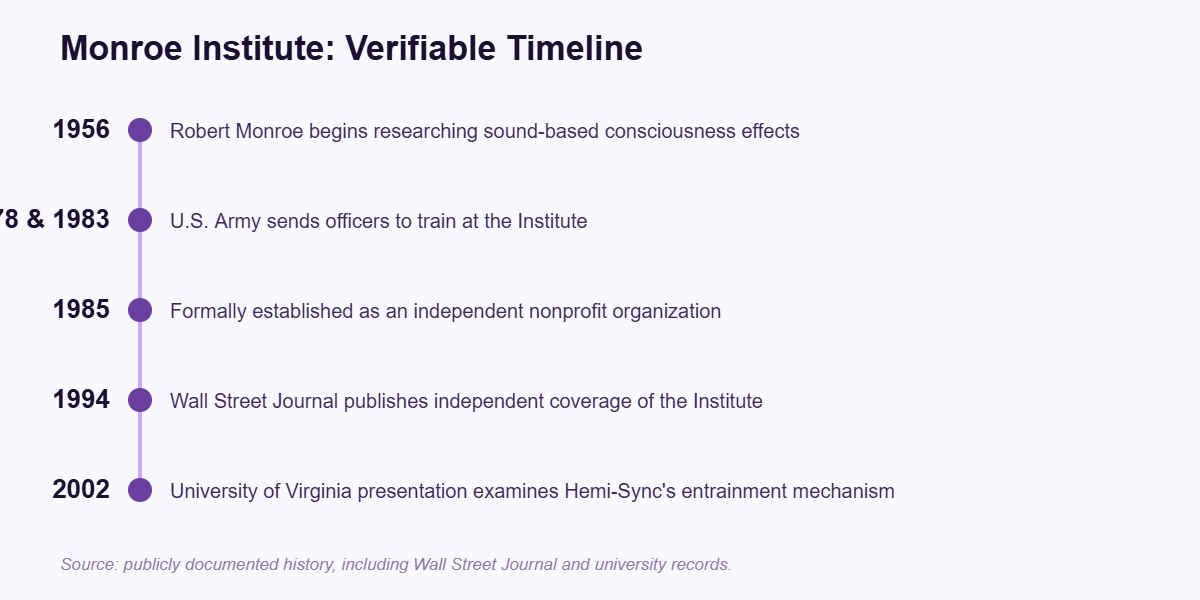
The Monroe Institute was founded by Robert Monroe, who began researching sound-based consciousness effects in 1956, and became an independent nonprofit in 1985.
Its credibility got an unusual boost from outside verification: the U.S. Army sent officers to train there in 1978 and 1983, and a 1994 Wall Street Journal article independently covered the organization.
We covered the full experience of attending in our Monroe Institute review.
WHAT THE SCIENCE ACTUALLY SAYS ABOUT HEMI-SYNC
Research on Hemi-Sync is genuinely mixed rather than uniformly positive or negative, which is normal for consciousness research generally.
One study found it worked as a partial replacement for fentanyl during surgery, while a separate study found no such effect when paired with propofol.
A 2002 University of Virginia presentation went further, suggesting the entrainment effect may work through electromagnetic pathways rather than the acoustic mechanism Monroe originally proposed.
COMMON CONCERNS PEOPLE HAVE
Price: The in-person Gateway Voyage retreat costs thousands of dollars, which feels steep without guaranteed results.
Language: Marketing material sometimes uses consciousness-expansion phrasing that sounds unscientific to skeptical readers.
Claims: Some testimonials describe experiences that go well beyond what any study has measured or confirmed.
We broke down exactly what those retreat costs cover in our Monroe Institute pricing guide.
RED FLAGS VS WHAT’S NORMAL FOR THIS FIELD
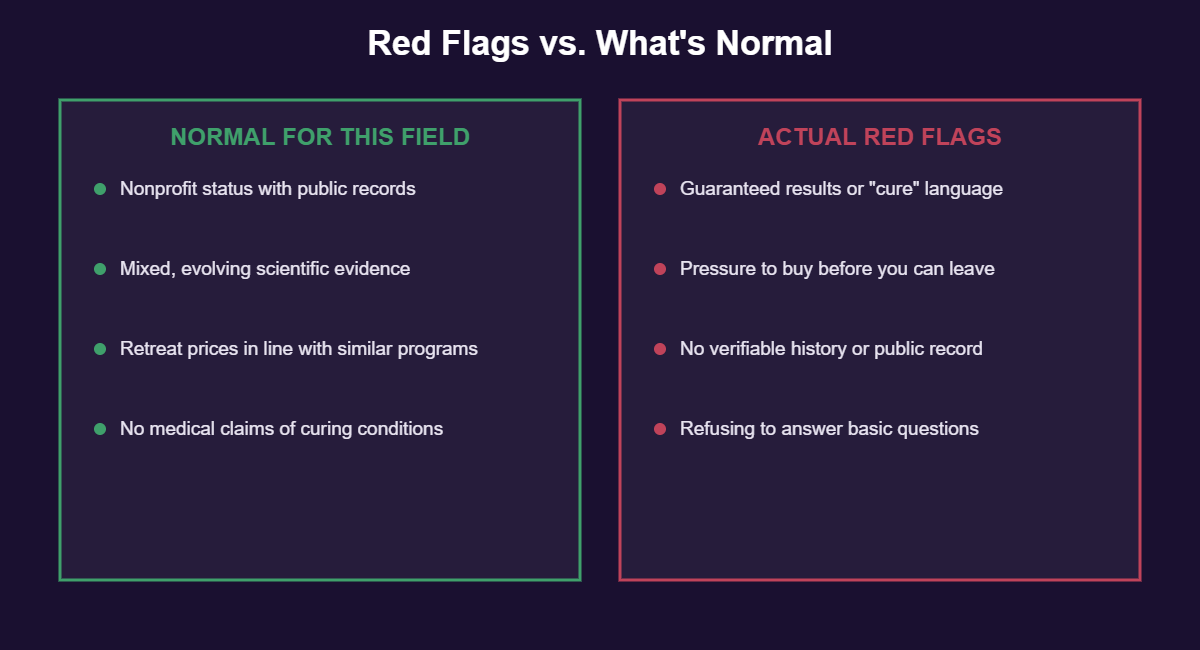
Nonprofit status, mixed scientific evidence, and retreat-level pricing are all normal for organizations in this space, not signs of a scam.
Actual red flags would include guaranteed cure claims, pressure tactics, no public record, or refusal to answer direct questions, none of which are documented here.
IF YOU’D RATHER NOT COMMIT YET
If the legitimacy question alone doesn’t answer whether it’s worth your money, our Monroe Institute alternatives guide covers lower-commitment ways to test similar techniques first.
FINAL VERDICT: IS THE MONROE INSTITUTE LEGIT
Yes, it is a legitimate nonprofit with a real, documented history, but treat it as a meditation and research organization, not a medical provider with guaranteed outcomes.
FAQ
1. Is the Monroe Institute a nonprofit?
Yes, it has operated as an independent nonprofit organization since 1985, after separating from Monroe Industries.
2. Has the U.S. military used the Monroe Institute?
Yes, U.S. Army officers reportedly trained there in 1978 and 1983, which was later referenced in a 1994 Wall Street Journal article.
3. Is Hemi-Sync scientifically proven?
Not conclusively. Some studies show positive effects in specific contexts, while others show no measurable benefit.
4. Is the Monroe Institute safe?
The audio-based techniques carry low physical risk, but it should not replace medical or psychological treatment for existing conditions.