Overall Rating: 9.2 / 10 ⭐⭐⭐⭐☆
Most Businesses Don’t Fail From a Lack of Opportunity
They fail because the founder eventually runs out of bandwidth.
At the beginning, doing everything yourself feels normal.
You answer customer emails.
Write blog posts.
Manage social media.
Book meetings.
Follow up with leads.
Review contracts.
Update your CRM.
Reply to comments.
Somewhere along the way, you realize something uncomfortable.
You’re no longer building the business.
You’re maintaining it.
Every new customer creates more administrative work.
Every marketing campaign creates more follow-up.
Every successful month makes your calendar even busier.
Ironically, growth itself becomes the obstacle.
This is the problem Marblism is trying to solve.
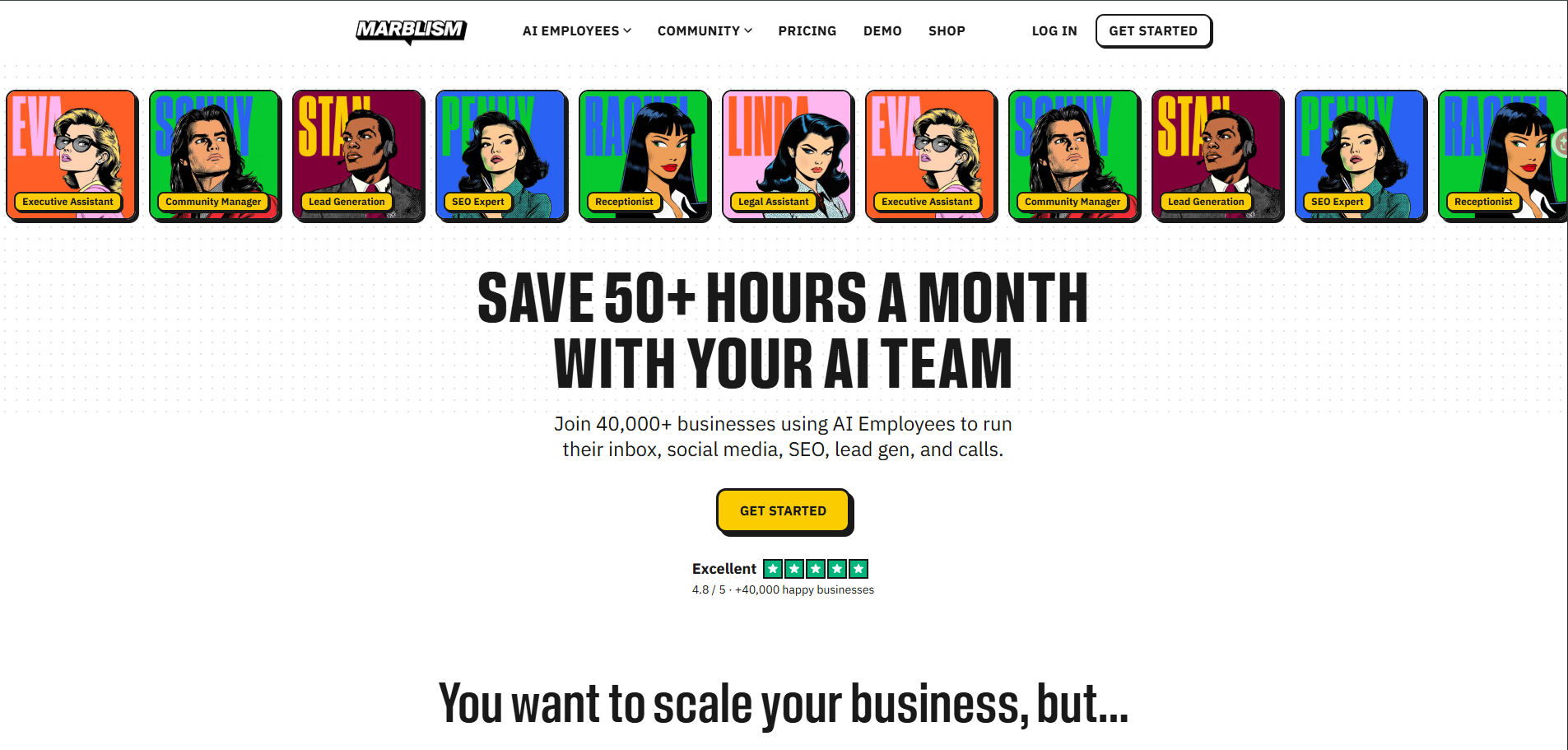
Rather than giving you another AI chatbot that waits for instructions, Marblism introduces the idea of an AI team—specialized assistants responsible for different business functions such as executive assistance, SEO, social media, lead generation, customer communication, and legal drafting.
But can AI really remove the founder from day-to-day operations?
Or does it simply automate a few repetitive tasks?
Let’s take a closer look.
Brand Background
Marblism entered the increasingly crowded AI productivity market with an unusual philosophy.
Instead of creating one assistant capable of doing everything reasonably well, it created multiple AI employees with clearly defined responsibilities.
Each AI focuses on a specific operational role.
Examples include:
- Executive Assistant
- SEO Specialist
- Social Media Manager
- Lead Generation Specialist
- Receptionist
- Legal Assistant
Rather than forcing users to constantly write prompts, Marblism asks businesses to explain how they operate during onboarding.
From there, each AI employee learns its own responsibilities while integrating with common business tools like Gmail, Outlook, LinkedIn, Google Calendar and social platforms.
Product Deep Dive
Delegation Is More Valuable Than Automation
The Problem
Most AI software helps you complete tasks faster.
That’s useful.
But it still requires you to remember every task.
Your brain remains the project manager.
How Marblism Is Different
Marblism attempts to change the workflow entirely.
Instead of asking:
“What should AI help me write today?”
It asks:
“Which employee should own this responsibility permanently?”
That’s a fundamentally different philosophy.
Instead of accelerating your workload, it redistributes it.
Specialized AI Often Produces Better Results
One general-purpose chatbot can certainly answer marketing questions.
But running a marketing department requires much more.
Planning.
Publishing.
Optimization.
Performance tracking.
Content consistency.
Marblism separates these responsibilities across specialized AI employees.
The SEO assistant focuses on long-form content.
The social media assistant transforms that content into platform-specific posts.
The executive assistant manages email and scheduling.
Each AI remains focused on a narrower objective.
That specialization often produces more predictable workflows than relying on a single assistant for everything.

Context Is Built Into the System
One of the biggest frustrations with AI is repetition.
Every conversation begins from zero.
You explain your company.
Explain your customers.
Explain your tone.
Explain your goals.
Again.
And again.
Marblism attempts to reduce this by learning about the business during onboarding so the AI employees can adapt future work to the same context instead of requiring constant prompting.
For growing businesses, reducing repeated explanations saves more time than generating text itself.
The Biggest Productivity Gain Isn’t Content Creation
Many people assume AI saves time by writing faster.
In reality, writing usually isn’t the biggest bottleneck.
Context switching is.
Checking email.
Posting on LinkedIn.
Finding sales leads.
Scheduling meetings.
Reviewing contracts.
Answering calls.
Each interruption resets your attention.
Marblism’s approach is to assign these recurring activities to different AI employees so founders spend more time making strategic decisions instead of bouncing between administrative tasks.
Real-World Performance
Marblism appears particularly well suited to:
- Solo founders
- Small agencies
- Consultants
- Service businesses
- Startup teams
Community feedback frequently highlights that the platform feels more like assigning work to digital teammates than chatting with a generic AI assistant. Users also note that the onboarding process helps each AI employee become more useful over time, although they still recommend reviewing important outputs before sending them to customers.
The platform is less compelling if your workload consists mainly of isolated one-off tasks.
Its strengths become more obvious when repetitive business operations accumulate week after week.

Pricing Analysis
Viewed as a single chatbot, Marblism may appear expensive.
Viewed as six or more specialized AI roles, the pricing becomes easier to understand.
Current plans include all AI employees under one subscription, with pricing starting on an annual plan and including a monthly allocation of AI work hours.
The real calculation isn’t:
“How much does Marblism cost?”
It’s:
“How much founder time does it replace?”
For businesses spending dozens of hours every month on repetitive administrative work, that difference can be significant.
Honest Limitations
1. It Doesn’t Replace Human Judgment
AI can draft.
Organize.
Schedule.
Research.
But major business decisions still require human oversight.
2. Initial Setup Requires Time
Delegating work effectively requires teaching the platform about your business.
That investment pays off later—but it isn’t instant.
3. Best for Businesses With Repeatable Processes
Companies without standardized workflows may struggle to extract the platform’s full value.
4. AI Is Still a Team Member—Not a CEO
Marblism removes operational workload.
It doesn’t replace leadership, creativity, or strategic thinking.
Competitive Comparison
Marblism vs ChatGPT
ChatGPT excels as a conversational assistant.
Marblism focuses on persistent business roles that continue working across multiple operational functions rather than waiting for individual prompts.
Marblism vs Lindy AI
Lindy emphasizes workflow automation between applications.
Marblism emphasizes specialized AI employees that continuously own business responsibilities.
Marblism vs Motion
Motion optimizes scheduling.
Marblism expands into marketing, sales, inbox management, SEO, customer communication, and operational support.
The Bigger Picture
Many AI products promise to make you work faster.
Marblism asks a more interesting question.
What if you simply had fewer things to do?
That shift—from productivity to delegation—is what makes the platform stand out.
Who Should Buy?
Ideal For
- Solo founders
- Small business owners
- Agencies
- Consultants
- Coaches
- SaaS startups
- Teams handling repetitive operational work
Probably Not For
- Large enterprises with established departments
- Businesses needing only occasional AI writing
- Users unwilling to invest time in onboarding
- Individuals looking only for a basic chatbot
Final Verdict
Marblism succeeds because it addresses a problem that most AI tools ignore.
Growing a business isn’t just about creating more content or writing emails faster.
It’s about preventing the founder from becoming the bottleneck.
By dividing operational responsibilities among specialized AI employees, the platform encourages business owners to think less like someone using software and more like someone managing a team.
It won’t replace real employees overnight.
But for founders overwhelmed by repetitive work, it offers something many AI tools don’t:
The feeling that work is finally leaving your desk instead of simply being completed faster.
Detailed Scorecard
| Category |
Score |
Honest Assessment |
| Business Automation |
9.5/10 |
Comprehensive automation across multiple operational areas |
| AI Specialization |
9.4/10 |
Role-based assistants feel more purposeful than a single chatbot |
| Ease of Use |
8.9/10 |
Guided onboarding reduces the need for prompt engineering |
| Integrations |
9.1/10 |
Connects with widely used business tools |
| Time Savings |
9.5/10 |
Particularly valuable for founders juggling many responsibilities |
| Value for Money |
9.0/10 |
Strong ROI if it meaningfully reduces repetitive work |
| Long-Term Scalability |
9.3/10 |
Designed to grow alongside small businesses |
| Overall Rating |
⭐ 9.2 / 10 |
A distinctive AI operations platform that focuses less on helping you work faster and more on helping you stop doing work that shouldn’t require your attention in the first place. |
Disclaimer
This review is based on publicly available information, product documentation, and user feedback available at the time of writing. As with any AI automation platform, results depend on the quality of onboarding, the consistency of your business processes, and the level of human oversight you maintain over important communications and decisions.