Most write-ups about this brand stop at the transmitter. That is a shame, because RadioMaster ExpressLRS hardware is where the company quietly does its most interesting engineering. The radio in your hands is only one end of the link: the receiver in the model, the RF module on the back of the radio, the telemetry sensors on the battery lead and the flight controller in the airframe all decide whether a flight feels rock solid or nervous. RadioMaster now builds every one of those pieces itself, sells them factory direct through its own store, and prices them so that upgrading one link in the chain never costs as much as a new radio.
This guide walks through the full RadioMaster ExpressLRS ecosystem as it stands in 2026 — 34 receivers, four families of RF modules, eight telemetry sensors, three flight controllers, 22 antennas, 29 gimbal options and a spare-parts catalogue 254 items deep. All figures below are taken straight from the official RadioMaster store.
Why RadioMaster ExpressLRS gear matters as much as the radio
ExpressLRS is an open-source radio link protocol built around very low latency and very high packet rates. It is free to use, which is why dozens of manufacturers support it — but support and commitment are different things. RadioMaster went all in: nearly every product it has launched in the last three years either runs ExpressLRS natively or is designed to feed it.
The practical result is that a pilot can buy one radio and then serve a whole hangar of models with receivers that cost less than a takeaway meal. Nothing is locked. Firmware updates come from the ExpressLRS project itself, configuration happens through a browser, and the same transmitter talks to a $7.99 park flyer receiver and a $34.99 dual-band unit without swapping anything on the radio.
RadioMaster ExpressLRS receivers: 34 options starting at $7.99
The receiver catalogue is the strongest argument for the whole ecosystem. Thirty-four models sit side by side, split into five families, and the entry price is genuinely low.
XR series — the current flagship line. XR2 Nano 2.4GHz at $9.99, XR1 Nano multi-frequency at $11.99, XR3 Nano with antenna diversity at $29.99 and the XR4 Gemini Xrossband dual-band receiver at $34.99.
RP series — the workhorse nano receivers for quads. RP1 V2 and RP2 V2 at $18.99, RP3 V2 and RP3-H at $19.99, RP4TD true diversity at $24.99 and the mini RP4TD-M at $19.99.
ER series — PWM receivers for fixed wing, cars and boats, from the four-channel ER4 at $14.99 up to the eight-channel ER8 at $34.99.
BR series — 915MHz long-range units, BR1 at $19.99 and BR3 at $24.99.
R series — classic PWM receivers for the simplest models, R81 V2 at $7.99, R84 V2 at $8.99, R86 V2 at $9.99 and R88 V2 at $10.99.
That spread means a pilot never has to over-buy. A foam glider gets an $8 receiver; the long-range fixed wing gets the dual-band unit. Both bind to the same transmitter.
GEMINI and Xrossband: how RadioMaster ExpressLRS fights interference
The most interesting piece of engineering in the range is Gemini Xrossband. Instead of picking a band and hoping for the best, a Gemini link sends the same control packets on 2.4GHz and Sub-GHz 900MHz at the same time. If one band is being swamped — a crowded flying field, a built-up area, a race day with thirty pilots — the other band carries the packet through.
The XR4 receiver is the neat demonstration of this. It carries two Semtech LR1121 transceivers and two independent RF circuits, runs dual T-type antennas, and can be switched between Gemini single-band and full Xrossband dual-band operation depending on what the flight needs. An onboard Wi-Fi module handles firmware updates and configuration through a WebUI in a phone or laptop browser, so there is no cable and no vendor software to install.
ER-series PWM receivers bring RadioMaster ExpressLRS to planes, cars and boats
ExpressLRS grew up in the FPV racing world, where receivers speak serial protocols to a flight controller. Fixed-wing modellers, surface racers and boat pilots need something different: plain PWM outputs that plug straight into servos. The ER series exists precisely for them, and it is the reason a scale warbird or a crawler can now run the same link as a race quad.
ER4 four-channel at $14.99 and ER6 six-channel at $24.99 for simple models
ER8 eight-channel at $34.99 for larger aircraft
ER6G, ER6GV, ER8G and ER8GV at $29.99 to $34.99, which add a built-in gyro for stabilisation without a separate flight controller
ER5A V2, ER5C V2, ER5A, ER5C, ER5C-i and ER3C-i between $16.99 and $19.99 for compact installs
ER3 PRO, ER12 and ER16 dual-band GEMINI and GEMINI-X receivers at $49.99, $59.99 and $79.99, currently on pre-order
An ER16 safety switch kit at $14.99 for larger petrol models
The gyro variants deserve a special mention. For a modeller who wants a windy-day stabilised wing but has no interest in learning flight-controller software, a $29.99 receiver that does both jobs is a genuinely elegant answer.
RadioMaster ExpressLRS modules keep older radios current
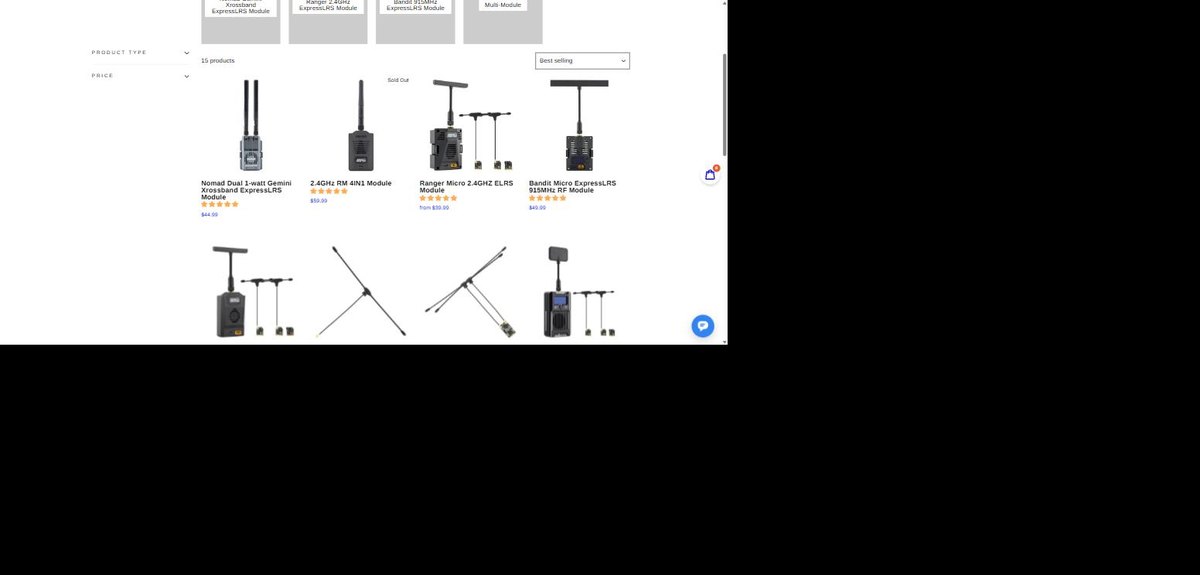
The external module range on the official RadioMaster store, fifteen products covering 2.4GHz, 915MHz and dual-band operation.
Not everybody wants to replace a transmitter they already like. External modules are RadioMaster answer to that, and they slot into the standard JR-style bay on almost any radio — including radios from other brands.
Ranger 2.4GHz family — Ranger Micro and Ranger Nano at $39.99, and the full-size 1-watt Ranger at $99.99 for maximum range.
Bandit 915MHz family — Bandit Micro and Bandit Nano at $49.99, full-size Bandit at $99.99, for the Sub-GHz band where obstacles matter more than bandwidth.
Nomad at $44.99 — dual 1-watt third-generation Semtech LR1121 transceivers running Gemini Xrossband across 2.4GHz and 868/900MHz simultaneously. It ships with both micro and nano adapters so it fits most radios on the market.
4-in-1 multi-protocol module at $59.99 — for anyone with a drawer of legacy receivers from other brands still worth flying.
The Nomad is the standout value here. A $44.99 module that transmits on two bands at once, at a full watt on each, is not something that existed at this price a few years ago. Paired with the matching DBR4 dual-band receiver at $29.99, it gives a complete Xrossband link for well under $80. The module range is listed here.
ERS telemetry sensors turn a RadioMaster ExpressLRS receiver into a data link
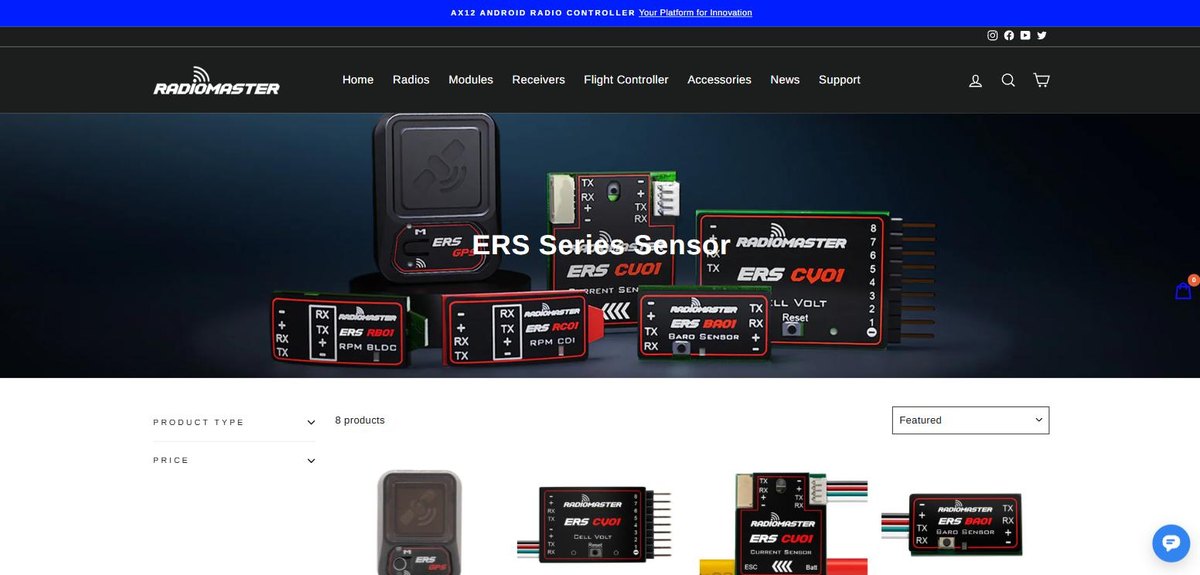
The ERS sensor family plugs into compatible ExpressLRS PWM receivers and streams data back to the radio screen.
This is the part of the range most newcomers miss. ExpressLRS is a two-way link, which means the receiver can send data back to the transmitter. The ERS sensor family exists to give it something worth sending, and every one of the eight products costs less than a set of propellers.
ERS-GPS at $26.99 — position, speed and distance home on the radio screen
ERS-CV01 at $19.99 — per-cell voltage monitoring, the single most useful warning a modeller can have
ERS-CU01 at $19.99 — real-time current draw
ERS-BA01 at $16.99 — barometric altitude
ERS-RB01 at $16.99 — brushless motor tachometer
ERS-RC01 at $16.99 — CDI tachometer for petrol engines
UART to dual PWM adapter and extension cables at $1.99 each
A pilot who adds a $19.99 cell-voltage sensor to a model has bought cheap insurance against the most common way a flight ends badly. Being able to buy that sensor from the same store as the radio, knowing it will simply work, is the kind of convenience that keeps people inside one ecosystem.
NEXUS flight controllers with RadioMaster ExpressLRS built in
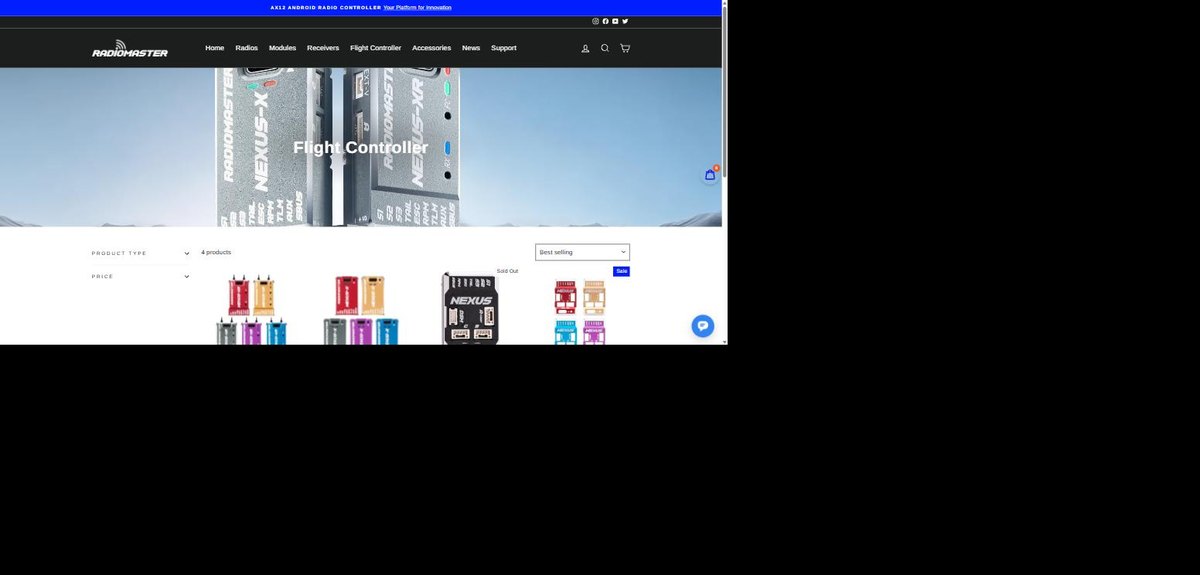
Three NEXUS flight controllers, including a version with the ExpressLRS receiver already integrated.
The newest branch of the range takes the logic one step further: if the company already makes the radio, the module and the receiver, why not the flight controller too?
NEXUS at $49.99 — the entry board
NEXUS-X at $79.99 — STM32F722 processor, ICM42688P six-axis motion tracker, 256MB of onboard blackbox memory for long logging sessions, multi-function UART ports, and support for solder-free plug-and-play RP3-H ELRS receivers as well as traditional S.BUS
NEXUS-XR at $99.99 — the same board with a 2.4GHz ExpressLRS receiver integrated, so there is no separate receiver to mount or wire
Aluminium cases at $4.99 in a range of colours
The NEXUS-XR is the interesting one for anybody tired of fiddly receiver installs. One board, one bind, no antenna routing headaches around a separate receiver.
Antennas and gimbals that change how a RadioMaster ExpressLRS setup feels
Two categories sit slightly outside the RF chain but change the experience more than their price suggests.
The antenna catalogue runs to 22 items and starts at $3.49 for a UFL 2.4GHz T antenna. A 2.4GHz Moxon directional antenna costs $14.99 and a 915/868MHz Moxon $19.99 — both are the cheapest meaningful range upgrade available, because pointing energy where the model actually is beats adding power. Dual-band antennas for Gemini setups start at $4.99 for the IPEX1 T type and $15.99 for the full 2.4GHz / 900MHz unit.
Gimbals are the other lever, with 29 options in the store. AG01 CNC hall gimbals for the TX16S and Boxer are $129.99 a set, AG02 hall gimbals covering GX15, TX15, TX16S and Boxer are $89.99, and the AG01 NANO set for the Pocket radio is $59.99. Smaller touches are cheap: replacement V5 hall gimbals for the TX15 at $19.99, V6 hall gimbals at $24.99, Sticky360 stick ends at $9.99 and Pocket stick extenders at $2.99. Swapping potentiometer gimbals for hall-effect units on an older radio costs a fraction of a new transmitter and removes the one part that genuinely wears out.
254 spare parts: the RadioMaster habit of selling the fix, not a new radio
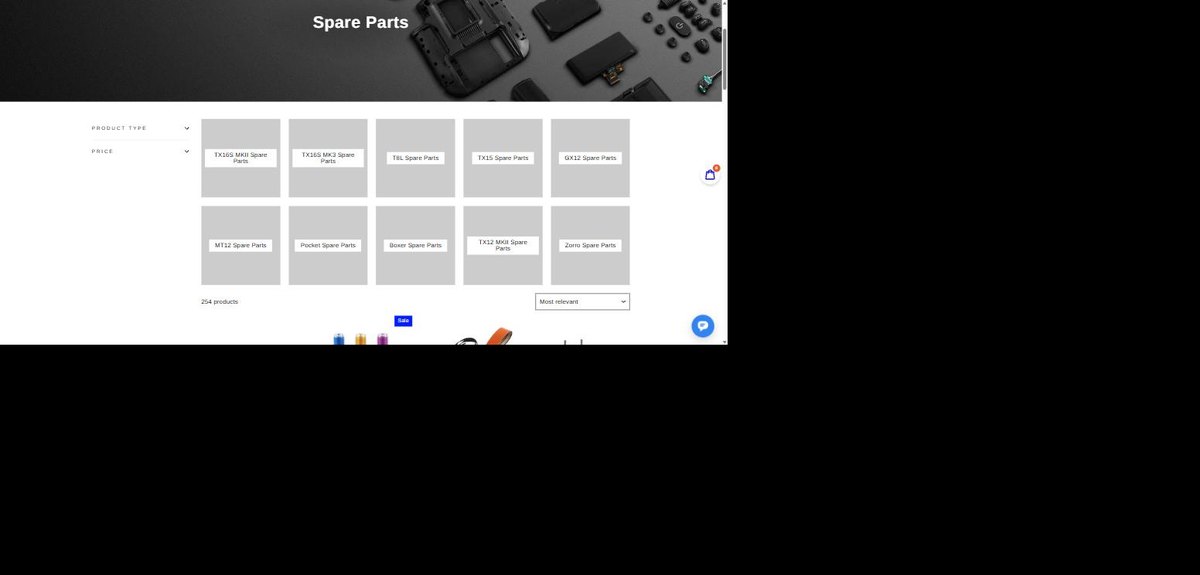
The spare-parts section carries 254 items, organised into a dedicated sub-catalogue for each radio model.
This is the quietest and, for long-term owners, the most valuable part of the operation. The spare-parts section holds 254 individual products, and it is organised by model rather than dumped into one list: TX16S MKII and TX16S MK3 each have their own catalogue, and so do the Boxer, Pocket, TX12 MKII, Zorro, MT12, GX12, GX15, TX15, T8L and AX12.
Batteries are a good illustration of how far this goes. A two-pack of 18650 3200mAh cells that fits the TX16S, Boxer, TX12, Pocket and MT12 is $11.99; a 21700 5000mAh pack for the TX16S and TX12 MKII is $16.99; an AX12 battery assembly is $18.99; a 2S 7.4V 6200mAh lipo is $29.99; the Zorro 18350 pair is $9.99; and a T8 Pro battery is $1.29. Shells, buttons, switches, ribbon cables, antenna assemblies and gimbal parts are all listed the same way.
The effect on ownership cost is real. A cracked case or a worn switch is a $5 order and an evening with a screwdriver, not a reason to shop for a new radio. It is also the reason second-hand RadioMaster gear holds value: a buyer knows the parts will still be there. The spare-parts catalogue is worth a browse before assuming any fault is terminal.
Which RadioMaster ExpressLRS setup fits your models
Four combinations cover almost everybody:
Park flyers and trainers — an R81 V2 or R84 V2 at $7.99 to $8.99 per model. Cheap enough to leave one in every airframe.
FPV quads — an RP3 V2 at $19.99 for most builds, or the RP4TD true diversity at $24.99 for racing. Add a NEXUS-XR at $99.99 if a fresh build is on the bench.
Fixed wing and scale models — an ER6 or ER8 for the servo channels, a gyro-equipped ER6GV if stabilisation is wanted, plus an ERS-CV01 cell-voltage sensor and an ERS-GPS.
Long range and crowded sites — the Nomad module at $44.99 with XR4 or DBR4 receivers, and a Moxon antenna on the transmitter.
None of those choices requires abandoning the others. That is the whole point of the RadioMaster ExpressLRS approach: one transmitter, an open protocol, a receiver for every budget, and a parts bin deep enough that gear bought today is still serviceable years from now. For a full look at the transmitters these links run from, see our RadioMaster radio controller guide for 2026, and for the story of how the brand got here, our RadioMasterRC.com review covers the open-source philosophy behind it.
Everything listed above is available direct from the official RadioMaster store, where firmware support, warranty handling and the spare-parts catalogue all sit in one place.
The iPhone 18 no ports theory is suddenly everywhere. A video making the rounds on TikTok and social media appears to show something startling: an iPhone — labeled as the “iPhone 18” — charging through a small magnetic connector instead…
Hottest fashion trends 2026 reviewed honestly — which trending styles are actually wearable, which are overhyped, and what’s worth buying right now in the US market. Quick Verdict: 2026’s biggest fashion trends fall into two camps: genuinely wearable evolutions of…
PS5 Pro review 2026 — I tested it for 30 days. Here’s the honest verdict on performance, graphics, and whether upgrading from a standard PS5 is actually worth the money. Quick Verdict: The PS5 Pro is the most capable PlayStation…