Quick Verdict
Does AirOps actually move the needle, or is it another AI tool with impressive marketing and thin results? We dug into the platform’s published case studies, G2 reviews, and public statements from real customers to find out. The short answer: the results are real and independently verifiable, but they cluster around mid-market and enterprise teams with existing content operations — not solo creators looking for a shortcut. AirOps customers report measurable gains in AI search citations, conversion rate, and content output, but only after a real ramp-up period.
Best for: teams who want proof before they buy, not just feature lists.
Should you buy? If your team already publishes content at volume and needs to prove ROI on AI search visibility specifically, the case study data below should give you enough to decide. See AirOps’ current plans here.
WHY WE LOOKED AT AIROPS’ RESULTS INSTEAD OF ITS FEATURE LIST
Most AirOps coverage online focuses on what the platform does: Quill, Playbooks, Power Agents, MCP integrations. That’s useful, but it doesn’t answer the question that actually matters before a purchase — does using it change any numbers a business cares about? AirOps has published named case studies with specific customers, which is unusual in a category where “AI visibility” claims are often vague. We cross-checked those claims against what’s publicly available: G2 reviews, LinkedIn posts from named customers, and AirOps’ own case study pages.
THE RESULTS, TEAM BY TEAM
Angi: Conversion Rate
Angi, the home-services marketplace, is cited as seeing a 79% higher conversion rate on content produced and managed through AirOps compared to their prior process. This is the kind of metric that’s harder to fake than a traffic number, since it ties directly to revenue rather than vanity visibility metrics.
Chime: AI Search Citations
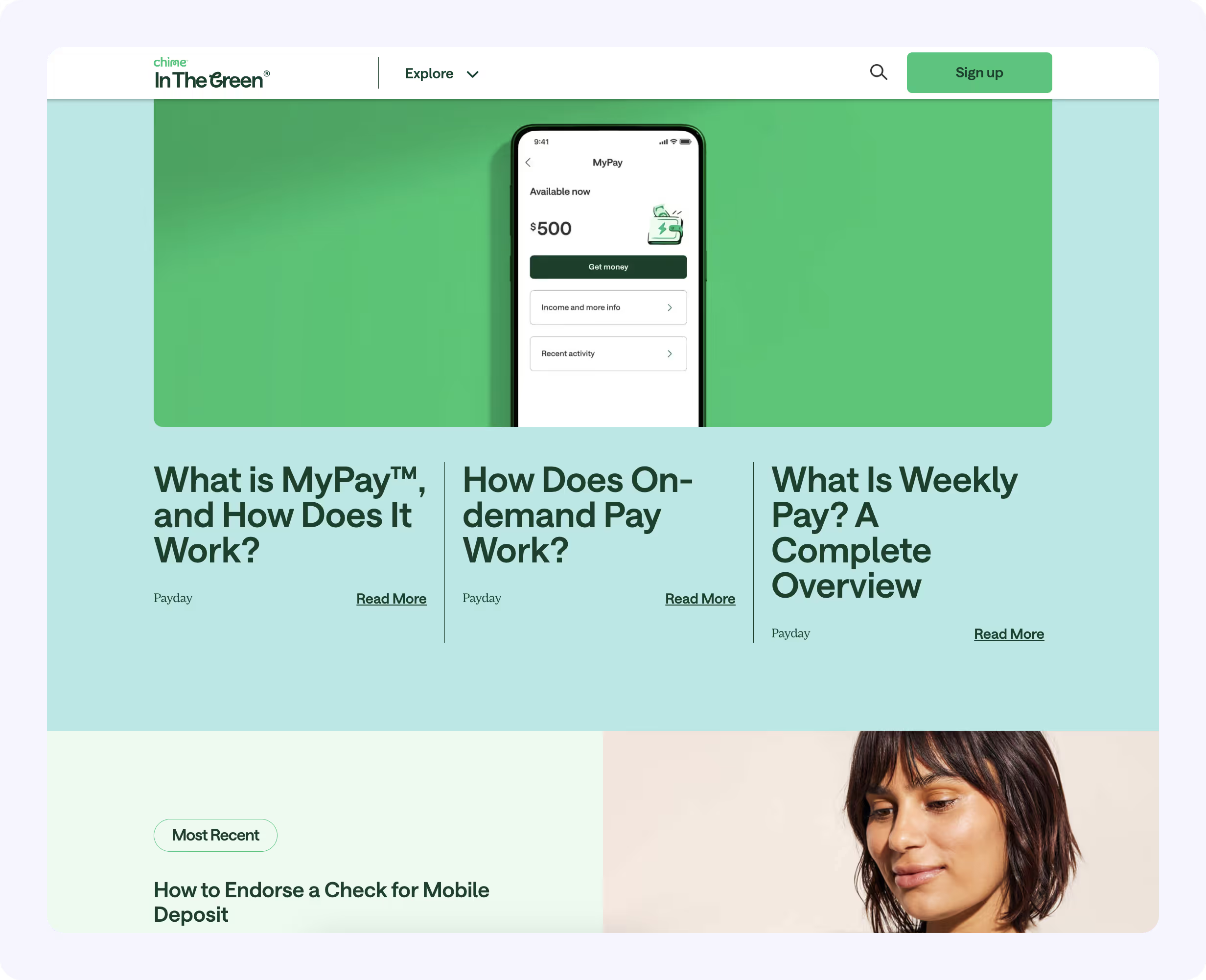
Chime, the fintech company, reports a 3x increase in AI search citations — meaning their brand and content are being surfaced more often when people ask ChatGPT, Perplexity, or similar tools questions in their category. Nick Fairbairn, VP of Growth Marketing at Chime, is quoted saying the team has been able to “drop our agency and focus on the highest value initiatives in weeks,” which points to a workflow change as much as a visibility change.
Webflow: AI-Attributed Signups
Webflow’s case study cites a 500% increase in AI-attributed signups. Josh Grant at Webflow is one of the named voices behind this result. A 500% increase sounds dramatic, but it’s worth remembering this is a relative jump — if AI-attributed signups started from a very small base, the absolute numbers may still be modest. The direction is still a meaningful signal.
Carta: AI Search Citations
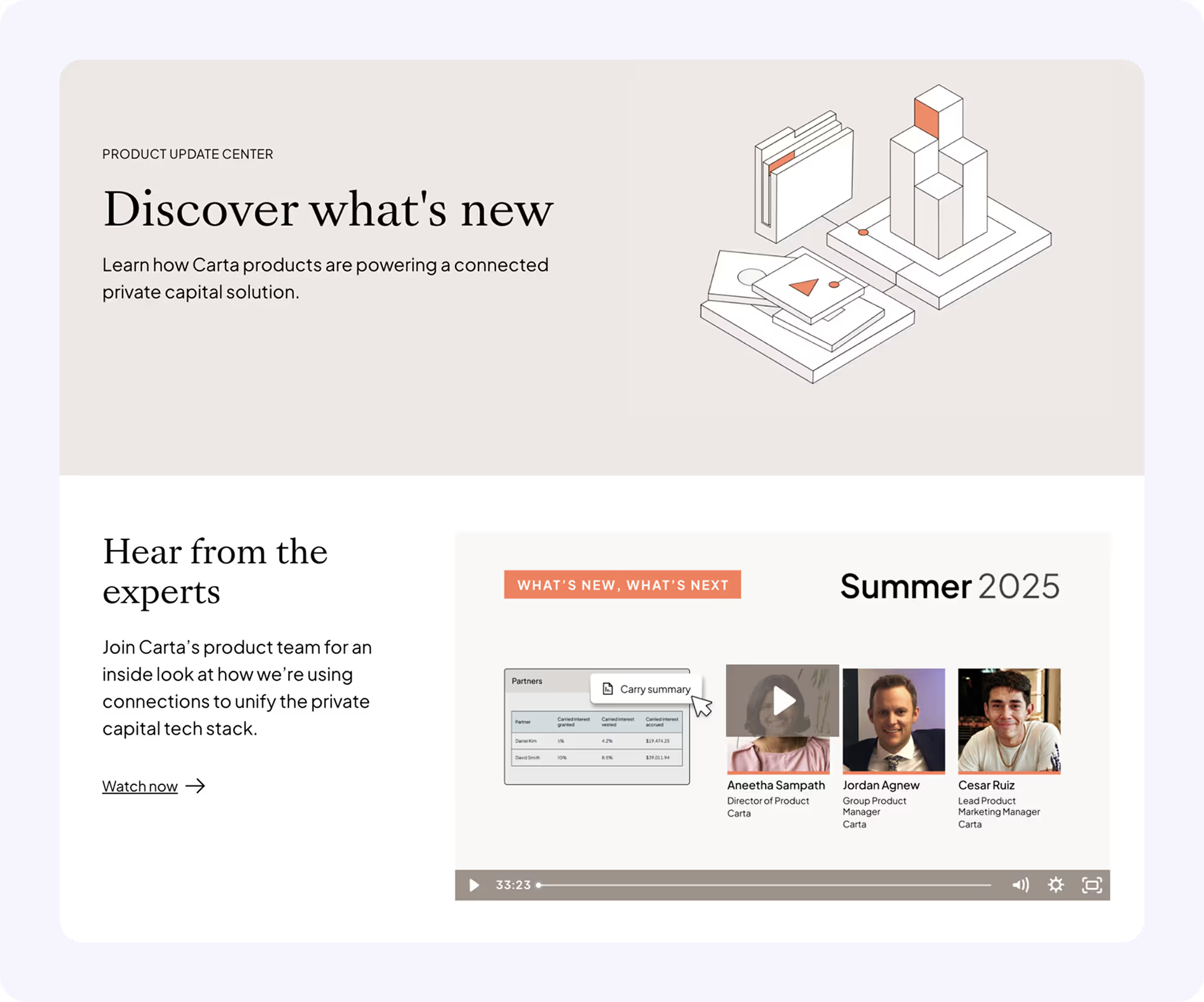
Carta reports a 7x increase in AI search citations, one of the larger multiples in AirOps’ published results. Carta operates in a technical, high-trust category (cap table management and equity), which suggests the gains aren’t limited to consumer-facing brands.
Ramp: Team Feedback
George Bonaci at Ramp is quoted describing improved visibility into how the team’s content is performing across AI answer engines, which lines up with AirOps’ stated focus on tracking share-of-voice rather than just producing content.
WHAT THE G2 REVIEWS ADD TO THE PICTURE
AirOps holds a 4.7/5 rating on G2 from 134 reviews and carries a “Leader” badge in the Answer Engine Optimization (AEO) Tools category, with an average reported time-to-implement of one month and an average reported ROI timeline of eight months. That eight-month ROI window matters — it tells you this isn’t a tool that pays for itself in the first billing cycle. One detailed, verified G2 review we read described the platform as genuinely changing how the reviewer’s team approached content strategy, but also flagged a real learning curve before that value showed up, and a specific incident where a Notion integration required a support ticket to resolve an authentication issue. That kind of specific, mixed detail is a stronger signal than a purely five-star review with no friction mentioned at all.
Kevin Indig, a well-known voice in SEO and content strategy circles, has also referenced AirOps’ approach to AI search tracking in his public commentary, which adds a degree of third-party credibility beyond AirOps’ own customer quotes.
WHERE THE RESULTS DON’T TRANSFER
Team Size and Maturity
Every named case study — Angi, Chime, Webflow, Carta, Ramp — is a company with an existing, sizable content operation. None of the public results are from a solo creator or a two-person startup marketing team. That’s consistent with AirOps’ own positioning: the platform is built for teams managing volume, not for someone publishing a handful of posts a month.
Time to Value
An average eight-month ROI timeline and one-month implementation window means this is not a quick win. Teams evaluating AirOps on the strength of these case studies should budget for a real ramp-up period rather than expecting an immediate jump in citations or conversions.
Category Fit
All of the strongest results come from companies already running structured, frequent content programs (fintech, SaaS, home services marketplace, cap table software). If your content operation is inconsistent or thin to begin with, AirOps’ tracking and execution tools have less existing output to work with, which likely limits how quickly comparable results would show up.
PROS AND CONS OF THE RESULTS AIROPS PUBLISHES
Pros
- Named customers, not anonymous stats — every major result is attributed to a real person and company, which is easy to cross-check on LinkedIn or G2.
- Metrics tied to revenue, not just visibility — Angi’s 79% conversion rate lift is a business outcome, not a vanity traffic number.
- Results span multiple industries — fintech (Chime), home services (Angi), SaaS (Webflow), and equity management (Carta) all show gains, suggesting the platform isn’t a one-industry fluke.
- Third-party G2 data backs the timeline claims — the one-month implementation and eight-month ROI figures come from aggregated reviewer data, not AirOps’ own marketing copy.
- A free trial lets you test the claims directly — you don’t have to take the case studies on faith before running your own content through the platform.
Cons
- No public results from small teams — every named case study is a company with an established content operation, so smaller teams are extrapolating, not seeing a direct precedent.
- Eight-month average ROI window — teams expecting a fast payback on AI search visibility may find this timeline longer than they budgeted for.
- Percentage gains lack absolute numbers in most public case studies — a 500% increase in AI-attributed signups doesn’t tell you the starting baseline, which makes it harder to judge the real-world scale of the win.
- Results depend on existing content volume — AirOps optimizes and tracks content that already exists at some scale; thin content libraries have less for the platform to work with.
- Setup can require support intervention — the G2 review referencing a Notion authentication issue shows that realizing these results isn’t always a frictionless rollout.
PRICING: WHAT IT COSTS TO CHASE THESE RESULTS
AirOps’ pricing is tiered around tracked prompts and answer-engine coverage rather than a flat seat price. The free Solo plan tracks 100 prompts per page using ChatGPT-only insights — enough to test the workflow but not to replicate the case study results above. The Starter tier expands to 50 tracked prompts with ChatGPT-only tracking at a paid rate, while Pro adds multi-engine insight tracking. Enterprise plans move to custom or unlimited tracked prompts across up to nine answer engines, including ChatGPT, Perplexity, Copilot, Grok, DeepSeek, Claude, and Google AI Overviews — which is the tier closest to what Chime, Webflow, Carta, and Angi would realistically need to produce the results cited above. Paid tiers are billed yearly with roughly two months free compared to monthly billing, and AirOps doesn’t publish exact Enterprise pricing, so teams sized like the named case studies should expect a custom quote rather than a self-serve checkout.
HOW TO VERIFY THIS YOURSELF BEFORE BUYING
| What to check |
Where to find it |
| Independent reviews with specifics, not just star ratings |
G2’s AirOps review page — filter for verified, detailed reviews |
| Named customer results, not anonymous stats |
AirOps’ own case studies page — check for named people and titles |
| Realistic timeline expectations |
G2’s reported average time-to-implement and time-to-ROI data |
| Whether your team resembles the case studies |
Compare your content volume and team size to Angi, Chime, Webflow, Carta |
None of this replaces a free trial. AirOps offers a free Solo plan plus a 14-day trial with full premium-tier access, which is enough time to test the platform against a real piece of your own content calendar. Start a free AirOps trial here.
FINAL VERDICT
The case study data behind AirOps holds up better than most AI-tool marketing claims we’ve checked — the customers are named, the metrics are specific, and the third-party G2 data confirms a real (if slow) path to ROI. Our advice: treat the published results as a realistic best case for teams that already publish content at volume, not a guarantee for every buyer. If your team matches that profile, the evidence supports giving AirOps a real trial run rather than dismissing it as unproven hype. Check AirOps’ current pricing and trial here.
FREQUENTLY ASKED QUESTIONS
Are AirOps’ case study results independently verified?
The named customers and quoted individuals (Nick Fairbairn at Chime, George Bonaci at Ramp, Josh Grant at Webflow) are real, identifiable people at real companies, which is more verifiable than anonymized statistics. The specific percentage figures themselves come from AirOps’ own case study pages and haven’t been independently audited by a third party.
How long does it actually take to see results?
G2’s aggregated data points to roughly one month to implement and about eight months to see full ROI, based on reported customer averages. That’s a meaningfully longer runway than many AI tools promise.
Do these results apply to small businesses or solo creators?
Not directly. Every public case study comes from a company with an established content team and publishing cadence. Smaller operations may see slower or smaller gains simply because there’s less existing content and traffic for AirOps to optimize.
What’s the best way to test if AirOps will work for my team?
Use the free Solo plan or the 14-day full-access trial to run a real piece of your content calendar through the platform before committing to a paid tier, rather than relying on case studies from companies much larger than your own.