Host Havoc has been selling game servers, VPS instances and dedicated hardware since 2013 (screenshot from hosthavoc.com).
Disclosure: Some links in this article are affiliate links. If you sign up or buy through them, Review King may earn a commission at no extra cost to you. This does not change how we review or score a product.
Every game host promises your server will stay up. Almost none tell you what happens when it does not. That second half is the interesting one, because it is the only part written into a contract you can read before you pay, and it is where the Host Havoc uptime story actually lives.
So this review asks a narrow question about Host Havoc uptime: what exactly is promised, in which document, and what is Host Havoc uptime worth in dollars when it is broken? The answer involves three different percentages published on three different pages, a credit formula with four carve-outs, and a refund clock that does not start when you think it does. All of it comes from pages the company publishes itself.
Host Havoc uptime: three numbers on three pages
Start with the headline figure, except that there is no single headline figure. The company publishes three different ones for Host Havoc uptime, and they do not agree.
Where
What it says
Document type
About page
“HISTORICAL UPTIME >99.9%”
Marketing claim about the past
Ryzen VPS page
“99.9%+ Uptime Guarantee”
Marketing claim about the future
Dedicated servers page
“All on owned hardware with a 100% uptime SLA.”
Marketing claim about the future
Service Level Agreement
Credit is owed “when 100% service uptime is not met”
The binding document
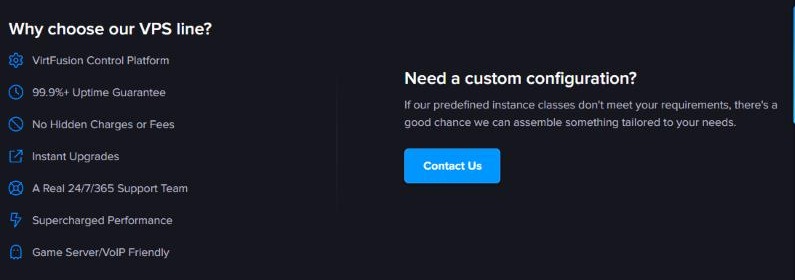
The VPS page lists a 99.9%+ guarantee among its selling points (screenshot from hosthavoc.com).
Two of those say 99.9% and two say 100%, and the split does not follow product lines cleanly. The useful detail is which document controls: the Service Level Agreement is the one you agree to, and it sets the bar at 100%. That is the more generous reading, so the Host Havoc uptime story starts in the buyer favour rather than against it. A host that wrote “99.9%” into its SLA would owe you nothing until roughly 44 minutes of downtime had accumulated in a month. This one, on paper, owes you from the first hour.
The Host Havoc uptime credit formula, converted into money
The SLA does not hide behind vague language. It states the Host Havoc uptime arithmetic directly.
Host Havoc will credit the customer 5% of its monthly (pro-rated to monthly if on a term other than monthly) service fee for each 1 hour of service downtime incurred up to 100% of the client monthly service (rental) fee.
Five per cent an hour, capped at the whole month. Twenty hours of qualifying downtime in a calendar month therefore wipes out the bill entirely. Here is what the Host Havoc uptime credit is worth on real prices taken from the site.
Downtime in a month
Credit rate
On a $12.00 server
On a $41.00 server
On a $80.00 VPS
1 hour
5%
$0.60
$2.05
$4.00
5 hours
25%
$3.00
$10.25
$20.00
10 hours
50%
$6.00
$20.50
$40.00
20 hours or more
100% (capped)
$12.00
$41.00
$80.00
Twenty hours is a long outage by any standard, so in practice the cap is generous rather than restrictive. The honest framing is that this is a refund of the rent, not compensation for a lost weekend of raiding. No host offers the latter, and the Host Havoc uptime SLA is clearer than most about which one it is offering.
Four situations where the Host Havoc uptime credit does not apply
This is the paragraph worth reading twice before you rely on the Host Havoc uptime guarantee. The SLA names its exclusions plainly.
Performance credit, or SLA credit, is issued entirely at the discretion of Host Havoc and is only applicable should the service downtime be a result of a direct fault of Host Havoc. Performance credit is NOT applicable in the case of any sort of service attack (DDoS), hardware failure, software failure, or a failure/issue induced by the client themselves.
So the Host Havoc uptime credit covers network and infrastructure faults the company causes, and not attacks, dead hardware, broken software, or anything you changed yourself. The company also reserves discretion over issuing it at all.
There is a tension here worth stating neutrally, because both halves are the company own words. The home page sells DDoS protection as a headline feature included with every service. The SLA then lists DDoS among the events that do not earn credit. Both can be true at once: mitigation is the product, and the credit scheme simply is not an insurance policy against attacks. But a reader who buys partly for the DDoS protection should know the guarantee and the protection are separate promises.
Scheduled maintenance sits outside the Host Havoc uptime calculation and is handled reasonably: the SLA defines a maintenance window with one hour of notice by email, and commits to scheduling it when clients are least affected.
The hardware and network behind the Host Havoc uptime number
A guarantee is only as good as the infrastructure under it, and Host Havoc uptime rests on the company strongest claim: it owns and operates its own hardware rather than reselling someone else capacity. The About page puts the operation at 100,000-plus clients since 2013, run from a head office in Ottawa, Ontario, under the registered entity Host Havoc Ltd.
Fourteen datacenter locations across North America, Europe and Asia Pacific (screenshot from hosthavoc.com).
Region
Locations
North America
New York, Montreal, Miami, Atlanta, Chicago, Dallas, Los Angeles, Seattle
Europe
London, Amsterdam, Frankfurt, Nuremberg
Asia Pacific
Singapore, Sydney
Fourteen in total, which matches the figure printed above the map and sets the geographic limit on what Host Havoc uptime can mean for your players. Eight of them sit in North America, which tells you where the customer base is; a player base spread across Europe and Asia gets four and two respectively. Latency is the thing Host Havoc uptime cannot fix, so picking the right one of those fourteen at checkout matters more to your players than any percentage in the SLA.
On the hardware itself, the product pages list Xeon and Ryzen CPUs, DDR4 and DDR5 memory, NVMe SSD storage and uplinks up to 10 Gbps. Game servers run on a modified TCAdmin v2 control panel with a web console, file manager, Workshop installer, log viewer, offsite backups and data restores, and the VPS line uses VirtFusion instead. Offsite backups matter to Host Havoc uptime in a way the SLA does not cover, since hardware failure is one of the excluded causes.
DDoS mitigation: the numbers printed beside the Host Havoc uptime claim
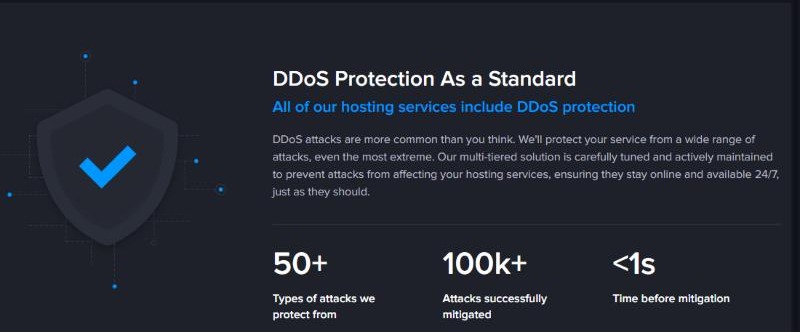
The three figures Host Havoc publishes for its mitigation platform (screenshot from hosthavoc.com).
Three figures sit under the DDoS section: protection against 50-plus types of attack, more than 100,000 attacks successfully mitigated, and under one second before mitigation kicks in. The company describes the platform as multi-tiered and actively maintained, including against attacks that exploit vulnerabilities inside specific games, which is the category that threatens Host Havoc uptime most directly.
None of those three numbers can be independently verified from outside, and the company does not say over what period the 100,000 figure accumulated. What can be checked is the taxonomy: the volumetric, protocol and application-layer attack classes that providers mitigate are documented publicly, and CISA publishes guidance on how organisations should prepare for and respond to each. Reading that first makes the marketing claims much easier to interpret.
For the reader the practical point is the one from the previous section: mitigation is included on every service, and it is excluded from the Host Havoc uptime credit scheme. The protection is the product; the credit is for something else.
Support response time, and what the Host Havoc uptime promise covers
The company advertises an average ticket response time of under ten minutes, 24 hours a day, and repeats the claim on individual game pages. Ten minutes would be fast for any host, and after Host Havoc uptime it is the most quoted number in the company own marketing.
The SLA then scopes what that support is obliged to cover. It commits the team to assisting with anything that is a direct fault inside the company infrastructure, explicitly including game control panel configuration. Beyond that line it is explicit:
Any support offered past what involves issues directed at Host Havoc infrastructure is provided entirely under the discretion of Host Havoc itself. Generally, this applies to issues with modded/third party content which clients tend to add onto their rented services.
That is a fair boundary and an unusually honest one to write down. If your Arma or Minecraft server breaks because of a mod you installed, help is a courtesy rather than an entitlement. Anyone running a heavily modded community should read that as the real limit of the Host Havoc uptime support promise.
What the Host Havoc uptime guarantee costs to buy into: the slot curve
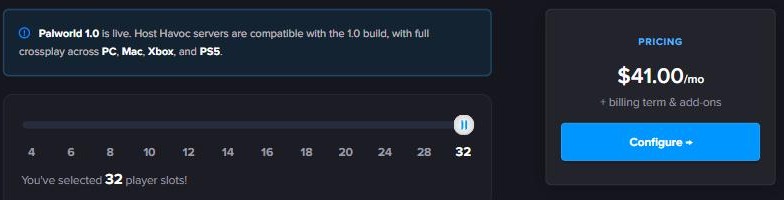
Because the Host Havoc uptime credit is a percentage of your monthly fee, the fee is part of the story. Game servers are sold per player slot, and the per-slot rate is not flat. We stepped through all twelve slot options on the Palworld product page and recorded the quoted price at each.
The Palworld configurator at its top setting: 32 slots for $41.00 a month (screenshot from hosthavoc.com).
Player slots
Monthly price
Cost per slot
Credit value per hour of downtime
4
$12.00
$3.00
$0.60
8
$20.00
$2.50
$1.00
12
$24.00
$2.00
$1.20
16
$28.00
$1.75
$1.40
20
$32.00
$1.60
$1.60
24
$35.00
$1.46
$1.75
32
$41.00
$1.28
$2.05
The curve is steep at the bottom and flattens as it climbs. Going from 4 slots to 8 doubles your capacity for $8; going from 20 to 32 adds twelve more slots for $9. In marginal terms the first four extra slots cost $2.00 each and the last twelve cost $0.75 each, and the Host Havoc uptime credit scales with the fee in the final column.
That has a direct consequence for how the catalogue reads. The games index lists Palworld “From $1.28/slot”, and $1.28 is exactly the 32-slot rate, which is the cheapest point on the curve rather than the entry point. At the four-slot minimum you are paying $3.00 per slot, or 2.34 times the advertised figure. The quoted rate is real; it is simply the best case, and the product page shows you the actual number before you commit.
Sixty-two games, not thirty, under the same Host Havoc uptime terms
The home page says “30+ Games Supported”. The catalogue at the games index lists 62 titles, which is one of the few times a hosting company undersells itself on its own front page. The same Host Havoc uptime terms cover every one of them.
Pricing model
Examples
Range
Per player slot
Over The Top: WW1, ARK, Terraria, Rust, Squad, SCUM
$0.15 to $10.00 per slot
Per GB of RAM
Minecraft, Hytale, BeamMP
$3.75 per GB
Per GB of RAM (premium)
Eco
$10.00 per GB
The per-slot spread is the striking part: Over The Top: WW1 starts at $0.15 a slot and StarRupture at $10.00, a factor of sixty-six between the cheapest and dearest titles in the same catalogue. Minecraft, the title most people arrive looking for, is billed by memory rather than players at $3.75 per GB. The catalogue also carries recent and upcoming releases including Arma 4, Hytale, Subnautica 2, Space Engineers 2 and Wreckfest 2, which is a sign the game list is maintained rather than left to rot.
Ryzen VPS: five dollars a gigabyte, all the way up
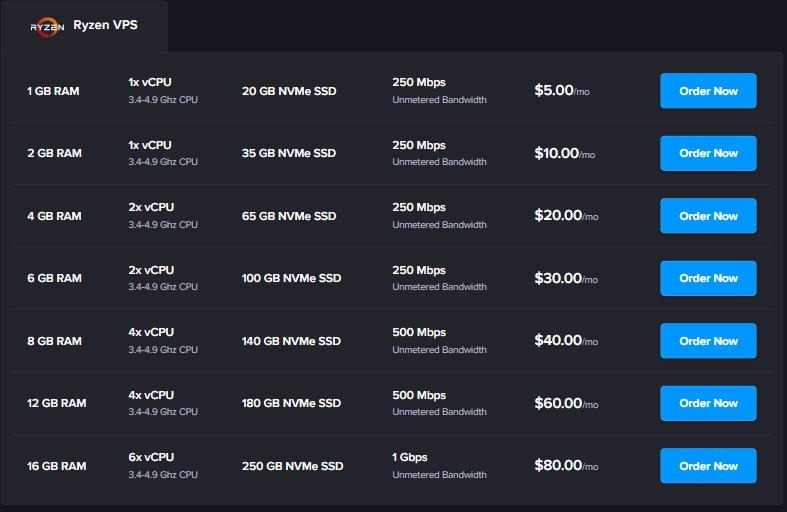
Seven Ryzen VPS tiers, from 1 GB to 16 GB of RAM (screenshot from hosthavoc.com).
The VPS line carries the cleanest pricing on the site, and the page where the Host Havoc uptime figure reads 99.9%. Run the division on all seven tiers and the RAM price never moves.
Plan
RAM
vCPU
NVMe SSD
Port
Price
Per GB RAM
SSD per GB RAM
VPS-1
1 GB
1x
20 GB
250 Mbps
$5.00
$5.00
20.0 GB
VPS-2
2 GB
1x
35 GB
250 Mbps
$10.00
$5.00
17.5 GB
VPS-4
4 GB
2x
65 GB
250 Mbps
$20.00
$5.00
16.3 GB
VPS-6
6 GB
2x
100 GB
250 Mbps
$30.00
$5.00
16.7 GB
VPS-8
8 GB
4x
140 GB
500 Mbps
$40.00
$5.00
17.5 GB
VPS-12
12 GB
4x
180 GB
500 Mbps
$60.00
$5.00
15.0 GB
VPS-16
16 GB
6x
250 GB
1 Gbps
$80.00
$5.00
15.6 GB
Exactly $5.00 per gigabyte at every single tier, with no volume discount at all. That is unusual, and it cuts both ways: there is no reward for buying a bigger instance, but there is also no penalty for starting at the bottom and growing, since upgrading never costs you a worse rate. Bandwidth is unmetered on every tier and the port speed steps up at 8 GB and again at 16 GB, so the larger instances do get something extra for the same per-gigabyte money.
What does shrink is disk headroom per gigabyte of memory, from 20 GB on the smallest instance to around 15 GB on the largest. If your workload is storage-hungry rather than memory-hungry, the small tiers are proportionally the better deal, and they carry the same Host Havoc uptime terms as the large ones.
Dedicated servers: where Host Havoc uptime is stated as 100% outright
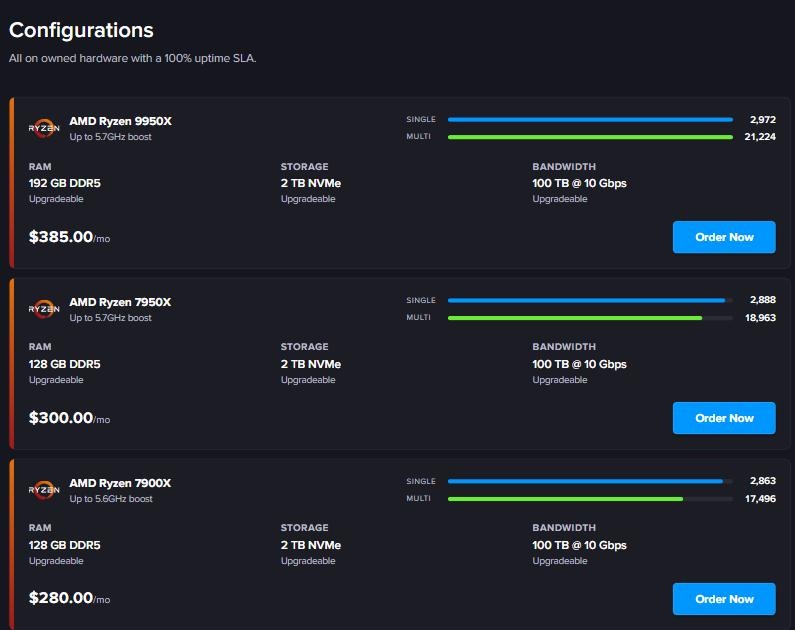
Dedicated configurations, sold under a stated 100% uptime SLA (screenshot from hosthavoc.com).
The dedicated line is where the Host Havoc uptime claim is stated most boldly, directly under the Configurations heading: all on owned hardware with a 100% uptime SLA. The machines are listed with published single and multi-core benchmark scores, which is a transparency most hosts skip.
Configuration
RAM
Storage
Bandwidth
Benchmark (single / multi)
Price
AMD Ryzen 9950X
192 GB DDR5
2 TB NVMe
100 TB @ 10 Gbps
2,972 / 21,224
$385.00/mo
AMD Ryzen 7950X
128 GB DDR5
2 TB NVMe
100 TB @ 10 Gbps
2,888 / 18,963
$300.00/mo
AMD Ryzen 7900X
128 GB DDR5
2 TB NVMe
100 TB @ 10 Gbps
2,863 / 17,496
$280.00/mo
Comparing the top two: the 9950X costs 28.3% more than the 7950X and returns 11.9% more multi-core throughput plus 50% more memory. Whether that trade is worth it depends on whether your bottleneck is cores or RAM, and the published benchmarks let you work that out before ordering. The Host Havoc uptime wording on this page is the firmest on the site.
The 72-hour refund window beside the Host Havoc uptime promise
Alongside the Host Havoc uptime guarantee sits a money-back window, and its mechanics are specific enough to change how you should test a new server.
All hosting service orders placed by newly registered customers are eligible for refunds within 72 hours of the creation of the server in our database, this point is not marked by the time at which your initial payment is processed and may differ by several hours or days.
Three details follow from that sentence. The clock starts at server creation, not at payment, and the company says the gap between the two can be hours or days. The window is 72 hours, which is shorter than the 30-day guarantees common in shared web hosting but normal for game hosting. And it is explicitly limited to a new client first order.
Terms longer than monthly are non-refundable, so a discounted annual commitment trades the refund right away.
Add-ons and domains are not eligible for a refund at all.
Refunds are not issued automatically: you open a support ticket stating the reason, and a team member issues it if you qualify.
Refunds go back through the original payment gateway.
None of that is unusual, and writing it down this precisely beats the vague wording many hosts use. The actionable version: if you want the safety net behind the Host Havoc uptime promise, take a monthly term for the first cycle and test the server hard inside three days of it appearing, not three days of paying.
No contracts, cancellation and tax
The company states plainly that it holds customers to no contracts or commitments and that you can cancel at any point in a subscription period without a penalty or cancellation fee. The Terms add the mechanics: cancellation goes through the WHMCS billing area using the cancellation request form, and an account with a card on file will keep attempting to renew until that request is filed. Canadian residents pay HST at 13% on the service rate and any add-ons; customers outside Canada pay no additional sales tax.
Put together with the refund rules, the shape of the commitment is easy to summarise: month to month, cancel whenever, and the only way to lose flexibility is to prepay a longer term for the discount. Nothing about Host Havoc uptime changes with the term you pick.
Who Host Havoc uptime and this setup fits
A group of four to eight friends starting a server. The $12 entry point is low, the 72-hour window covers a first weekend of testing, and no contract means a dead project costs you one month.
A growing community. The slot curve rewards scaling, and the jump from 20 to 32 slots costs less per slot than any step below it.
Anyone who cares about latency. Fourteen locations, eight of them in North America, is the practical lever on player experience that no SLA percentage can substitute for.
A workload that needs steady, predictable VPS pricing. Flat $5.00 per GB means upgrading never puts you on a worse rate.
Heavily modded communities, with eyes open. Support for third-party mod problems is discretionary by the SLA own wording, so budget your own troubleshooting time.
Anyone counting on compensation for attacks. DDoS is excluded from the credit scheme, so treat the mitigation as the protection and the Host Havoc uptime credit as something separate.
How this review was done
This is a desk review. We did not rent a server, run a load test, file a support ticket, trigger an outage or request a refund, and nothing above should be read as hands-on measurement. Every figure and quotation comes from pages the company publishes: the home page, the About page, the games index, the Palworld product page, the Ryzen VPS and dedicated server pages, the Service Level Agreement and the Terms of Service.
The slot price table was built by stepping through each of the twelve slot settings in the Palworld configurator and recording the price the page quoted. The per-slot, per-gigabyte, credit-value and benchmark comparisons are our arithmetic on the company own published numbers. Where two company pages state different figures for Host Havoc uptime, we have quoted both and named the document each came from. Two further notes for context: the Service Level Agreement carries “Last updated: May 5th, 2018” and the Terms of Service “June 13th, 2019”, while the home page is currently selling servers for a 2024 game at its 1.0 release. Prices and terms change, so check the current pages before ordering.
The short version
Measured on what is actually written down, Host Havoc uptime is better documented than most of the market. The SLA states a formula instead of a vibe, names its exclusions instead of burying them, scopes what support will and will not cover, and sets its own bar at 100% rather than the softer 99.9% the marketing pages use. You can work out exactly what a bad month would be worth to you before you spend anything.
The things to read twice are the four carve-outs on the Host Havoc uptime credit, the fact that the refund clock starts at server creation rather than payment, and the gap between the catalogue per-slot rate and the price at the smallest configuration. None of those are hidden; all three sit on the company own pages, which is rather the point.
Overall: 4.26 / 5. Owned hardware across fourteen locations, a published Host Havoc uptime credit formula, flat and predictable VPS pricing, a 62-title catalogue that is clearly maintained, and no contract to escape from. Check the current Host Havoc plans and locations if a documented guarantee matters more to you than a bigger percentage on a banner.
For a small group, the decision is mostly about the entry configuration. Four slots at $12 a month, a 72-hour window, no commitment and the same Host Havoc uptime terms as every other tier is a cheap way to find out whether the server survives contact with your friends. See what the smallest game server costs in your region before you size it any bigger.
For a community that has outgrown a four-slot box, the slot curve is the whole argument: twelve extra slots between 20 and 32 cost less per slot than the first four did. Price a larger slot count on the configurator rather than paying twice for two small servers.
And if you need raw hardware rather than a managed game panel, the dedicated line publishes benchmark scores next to prices and states Host Havoc uptime as 100%, which makes the comparison a matter of arithmetic rather than faith. Compare the dedicated configurations and their benchmarks if cores and memory are your real constraint.
related products
[rk_latest_products]
// latest news
Stay up to date with the freshest latest industry news from the Review King.
The iPhone 18 no ports theory is suddenly everywhere. A video making the rounds on TikTok and social media appears to show something startling: an iPhone — labeled as the “iPhone 18” — charging through a small magnetic connector instead…
Hottest fashion trends 2026 reviewed honestly — which trending styles are actually wearable, which are overhyped, and what’s worth buying right now in the US market. Quick Verdict: 2026’s biggest fashion trends fall into two camps: genuinely wearable evolutions of…
PS5 Pro review 2026 — I tested it for 30 days. Here’s the honest verdict on performance, graphics, and whether upgrading from a standard PS5 is actually worth the money. Quick Verdict: The PS5 Pro is the most capable PlayStation…