Quick Verdict
Sharetribe is marketplace-building software for founders who want to launch a rental, service, or product marketplace without writing code, then extend it with code as the business grows. It’s been running for more than a decade, is funded by its own customers (over 1,000 marketplace founders across 70+ countries), and carries a strong 4.7/5 rating on G2 from 40 reviews. If you have a marketplace idea — a platform like Airbnb, Turo, Etsy, or Upwork — and want to test it fast without hiring a development team, Sharetribe is one of the most credible places to start.
What Is Sharetribe & Who Is It For
Sharetribe is a no-code-first, code-extensible platform for building two-sided marketplaces: places where sellers and buyers (or hosts and guests, or providers and clients) transact. Rather than a single rigid template, it supports four broad marketplace types — rental marketplaces (property, equipment, vehicles, B2B/B2C rentals, similar to Airbnb or Turo), service marketplaces (local services, negotiation and bidding, virtual services, events and experiences, similar to UrbanSitter, Upwork, or ClassPass), product marketplaces (used goods, digital products, B2B, new products, similar to Depop, eBay, or Etsy), and other formats like classifieds, matchmaking, and bartering platforms.
The pitch is “start at 90% done”: launch a fully working marketplace in a day with no code, customize the design and content, then bring in a developer to extend the transaction flow, integrate third-party services, or build custom features once the idea is validated. That makes Sharetribe a strong fit for non-technical founders who want to test a marketplace concept quickly and cheaply, and for technical founders or agencies who want a hosted, scalable foundation instead of building marketplace infrastructure from zero. It’s a weaker fit for anyone who needs a single-vendor storefront rather than a true multi-seller marketplace, since the whole product is built around two-sided transactions.
Real-World Experience
The best way to judge a marketplace-building platform is to look at what founders have actually built and grown on it.
Drive lah, a peer-to-peer car rental marketplace, was built on Sharetribe and went on to raise millions of dollars in venture capital while scaling internationally — a concrete example of a rental marketplace (the same category as Turo) growing well past its initial launch. Swimmy, a marketplace for renting private pools, grew to hundreds of thousands of users and generated millions of dollars in bookings, showing that a niche rental idea can scale meaningfully on the platform. GearSource, a marketplace for buying and selling event and production equipment, is a longevity story: after surviving three separate platform re-builds over two decades in business, its founder found lasting technical stability by moving to Sharetribe. And socialbnb, a marketplace connecting travelers with social-impact projects, has connected users across 45 countries, illustrating how the same underlying software supports a mission-driven, non-traditional marketplace just as well as a commercial one.
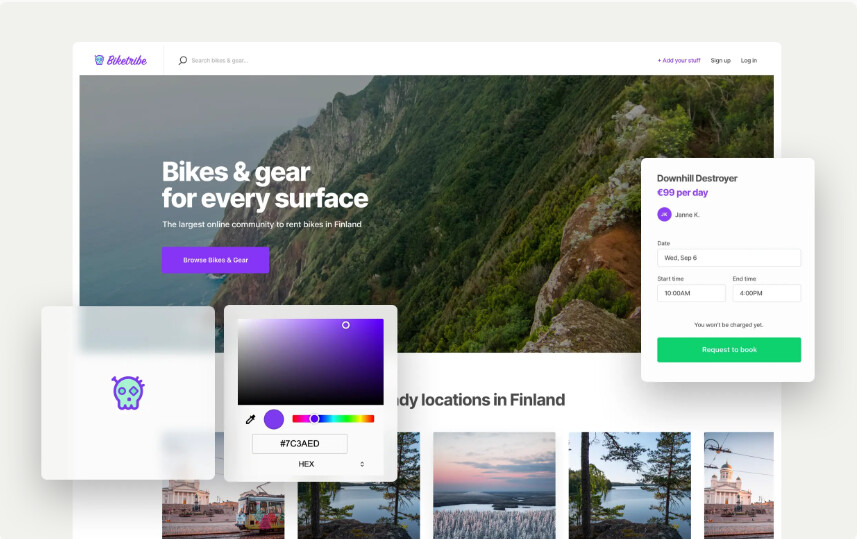
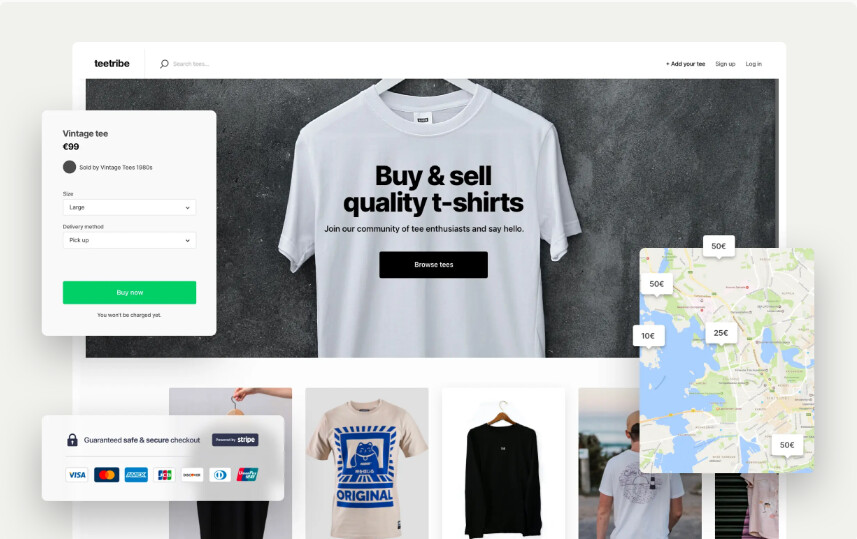
Sharetribe also publishes a gallery of marketplaces built on the platform, spanning more than 100 countries, alongside ready-made demo marketplaces like a bike-and-gear rental site and a t-shirt resale marketplace that show what a launched storefront looks like out of the box — complete with listings, search, checkout, and secure payment processing via Stripe.
Pros & Cons
Pros: launch a working marketplace in a day without writing code; extend infinitely with code once you’re ready to customize further; hosted cloud infrastructure that scales from 10 users to 10 million without extra setup; supports a wide range of marketplace types (rental, service, product, classifieds, matchmaking, bartering); backed by real founder success stories across different niches and countries; transparent, published pricing with no “contact sales” black box; strong 4.7/5 rating on G2 (40 reviews); 14-day free trial with no credit card required; company has been operating for over a decade and is funded by its own customer base rather than outside investors.
Cons: monthly plan costs add up alongside payment-processing fees as transaction volume grows; the three higher-tier plans (Lite, Pro, Extend) require annual billing to get the listed monthly rate; deep customization still requires hiring or being a developer, since the no-code layer has real limits; as with any marketplace, success depends heavily on the founder’s ability to solve the classic “chicken-and-egg” problem of attracting both sides of the market, which no software can fully solve on its own.
How Sharetribe Compares
Against building a marketplace from scratch with custom development, Sharetribe is dramatically faster and cheaper to get to a working launch — a day of no-code setup versus months of engineering work before a single transaction happens. Against pure no-code website builders that aren’t built for marketplaces specifically, Sharetribe has a real advantage in built-in two-sided functionality: listings, search, messaging, booking or ordering flows, and payment processing are already there, rather than needing to be bolted together. Compared with rigid, code-only marketplace templates or older marketplace-in-a-box products, Sharetribe’s ability to extend with real code as the business grows — rather than being permanently boxed in by a no-code ceiling — is its clearest differentiator.
Price & Value
Sharetribe’s pricing is published openly in four tiers: Build at $39/month, Lite at $99/month, Pro at $199/month, and Extend at $299/month, with the Lite, Pro, and Extend tiers billed yearly to get that monthly rate. Higher tiers unlock higher transaction limits, a custom domain, more third-party integrations, and deeper code-level customization of the transaction flow. Every plan starts with a 14-day free trial that requires no credit card, so founders can test the no-code builder against their specific marketplace idea before committing to a paid tier. For the value to make sense, weigh the monthly software cost against what a custom-built marketplace platform would cost in developer time alone — typically many multiples of even the top Sharetribe tier just to reach the same starting point.
Our Verdict
Sharetribe earns its reputation as marketplace software built specifically for founders, not a general-purpose website builder stretched to fit. The combination of a genuine no-code launch path, real code-level extensibility for later, hosted infrastructure that scales without extra work, and a decade-plus track record with founders who have gone on to raise venture capital, reach hundreds of thousands of users, or simply find long-term technical stability, makes it a credible first choice for anyone serious about building a two-sided marketplace. It won’t solve the hard business problem of attracting buyers and sellers, but as the technical foundation for a marketplace idea, Sharetribe is hard to beat on speed, flexibility, and price transparency.
Rating: 4.5/5
FAQ
Do I need to know how to code to use Sharetribe?
No. Sharetribe is designed to let you launch a fully working marketplace without writing any code, and code is only needed later if you want deeper customization.
How long does it take to launch a marketplace on Sharetribe?
Sharetribe is built around launching a working marketplace in as little as a day using its no-code tools, though customizing branding and content typically takes longer.
Can Sharetribe handle a large marketplace with millions of users?
Yes — it runs on hosted cloud infrastructure designed to scale from a handful of early users up to millions without requiring you to manage servers yourself.
What kinds of marketplaces can I build with Sharetribe?
Rental marketplaces (like Airbnb or Turo), service marketplaces (like Upwork or ClassPass), product marketplaces (like Etsy or Depop), and other formats such as classifieds, matchmaking, and bartering platforms.