Amazon sellers have spent a decade optimising for one shelf: the search results page. In 2026 there is a second one, and SmartScout AI Visibility is the first tool that puts a number on it. Shoppers now open ChatGPT, type “what is the best zero sugar energy drink?”, and buy whatever comes back. That recommendation is a shelf position, and until recently nobody could measure it.
This is the second look at SmartScout on Review King. The first review covered the market data platform — brands, sellers, subcategories, pricing. This one goes into the three AI tools that sit on top of that data and are, for a lot of brands, the most interesting thing SmartScout has shipped.
Why SmartScout AI Visibility exists now
LLM answers are non-deterministic. Ask ChatGPT the same shopping question five times and you can get five different product line-ups. That single property is what made AI shelf position impossible to measure by hand: a screenshot of one answer tells you nothing, and running the prompt yourself twice a week tells you barely more.
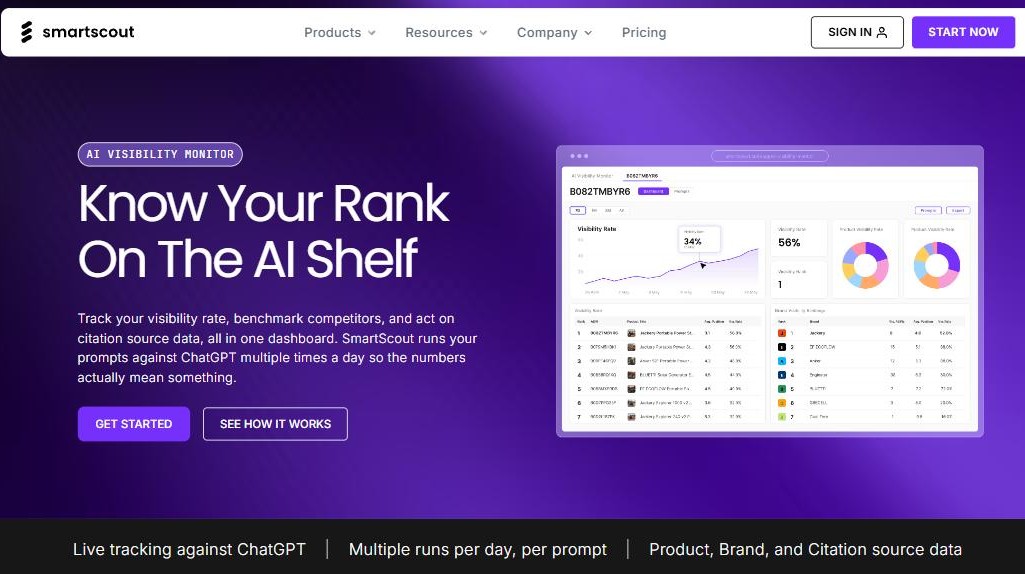
SmartScout solved it the only way it can be solved — with volume. The tool fires your chosen prompts at ChatGPT multiple times every day and aggregates the results over time, so the percentages settle into something you can actually act on. Get that right and a blind spot turns into a dashboard.
The AI Visibility Monitor runs your prompts against ChatGPT continuously (real screenshot of smartscout.com)
How the AI Visibility Monitor gets set up
Setup is five steps and takes minutes rather than an onboarding call:
Enter your product by ASIN or keyword and SmartScout prepares it for monitoring
Choose topics — shopper personas or niches such as “natural caffeine” or “zero sugar”
Add prompts under each topic: the real questions shoppers type. SmartScout can suggest them, or you write your own from keywords you already know convert
Let it run — each prompt fires several times a day, and the more runs accumulate the sharper the data gets
Act on citation sources, which is where the tool stops being a report and starts being a plan
The prompt list is the decision that matters most. Broad prompts capture wide visibility, specific ones reveal where you are genuinely strong, and grouping them by topic means you see performance by buyer intent instead of one blended number. SmartScout is explicit about this in its own guidance, and it is good advice: pull the prompts from the PPC and SEO keywords that already earn money for you.
The five numbers on the dashboard
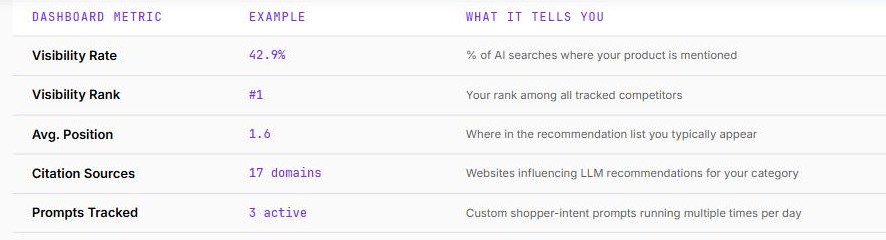
Everything the monitor collects rolls up into five figures, each one answering a different question:
Five metrics, each mapped to a decision (real screenshot of smartscout.com)
Visibility Rate — the percentage of relevant AI searches that mention your product. One clear number to move
Visibility Rank — where you sit among every competitor you track
Avg. Position — how high in the recommendation list you usually land, because third on the list is not first
Citation Sources — how many domains are shaping recommendations in your category
Prompts Tracked — how many shopper-intent questions are running right now
Visibility rate is charted historically, so you can tell whether a listing rewrite or a PR push actually moved anything. Rankings come at both product and brand level, prompt-level filtering isolates one topic at a time, and everything exports — which is what makes the tool usable by agencies reporting to clients.
Citation sources: the part you can act on
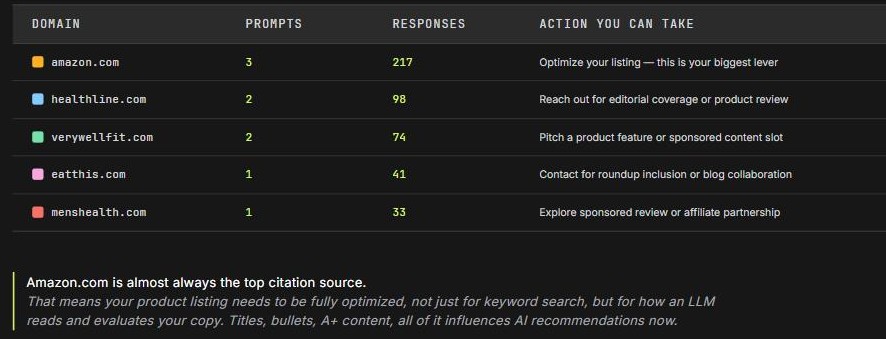
This is the feature that separates the monitor from a vanity metric. When ChatGPT recommends a product it cites the sources that informed the answer, and SmartScout aggregates those citations into a ranked table of domains.
Every domain comes with a suggested next move (real screenshot of smartscout.com)
Once you know which publishers the model trusts in your category, outreach stops being guesswork: editorial coverage, product round-ups, blog collaborations, affiliate partnerships. SmartScout even pairs each domain with the move that fits it. And the table makes one point loudly — amazon.com is almost always the top citation source, which means your own listing is the single biggest lever you control.
Amazon AI Scorecard: how your listing reads to AI
That last point is exactly what the Amazon AI Scorecard exists for. Amazon ranking has moved past keyword matching; the algorithm now tries to understand intent, context and product fit. A listing can contain every search term and still be vague about what the product is, who it helps and why anyone should choose it.
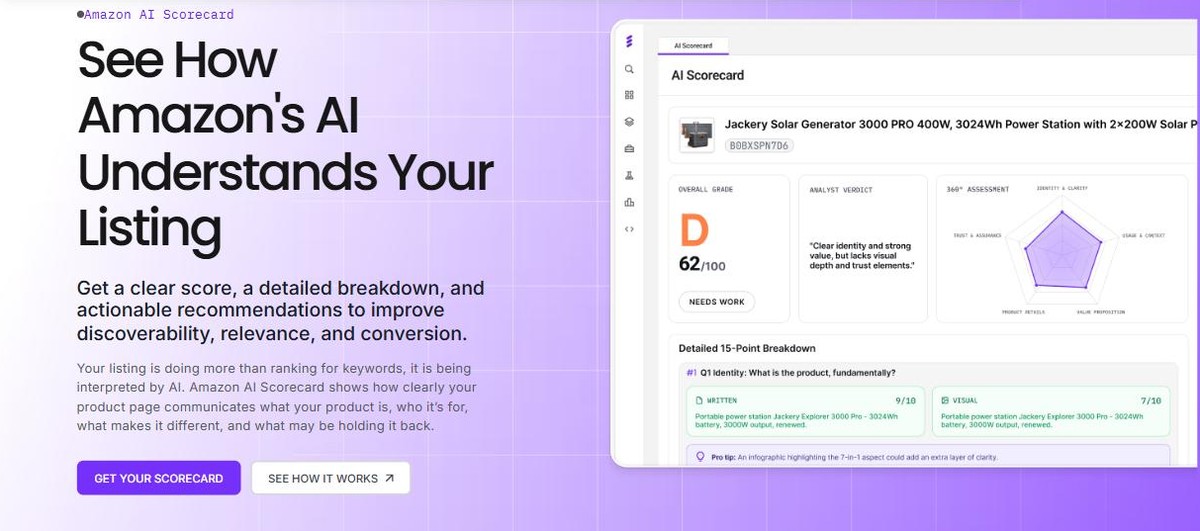
A score out of 100 plus a 15-point breakdown with written and visual grades (real screenshot of smartscout.com)
The scorecard grades a page from 1 to 100, adds a question-by-question breakdown across problem–solution fit, audience, differentiation, use case and completeness, and returns prioritised fixes. Because it is a single number, it also works as a benchmark across a whole catalogue — you can sort by score and start with the weakest pages instead of auditing on instinct.
AI Listing Architect: building the page from data
The third tool closes the loop. AI Listing Architect generates titles, bullet points, descriptions and backend keywords using Amazon keyword data and competitor performance rather than generic copywriting prompts. For sellers who have lost afternoons to keyword research and rewriting, it turns hours into minutes, and it needs no SEO background to operate.
Used together the three make a tidy cycle: the Scorecard tells you where a listing is unclear, Listing Architect rewrites it from the data, and the AI Visibility Monitor shows whether the AI shelf noticed.
What SmartScout AI Visibility costs
The generous part is that all three AI tools appear on every plan, including the entry tier — what scales is volume, not access:
Essentials — $99/mo: 10 audits, 10 dashboards, 10 ASINs, plus brand and keyword level data
Business (the most popular tier): 25 audits, 25 dashboards, 25 ASINs
Enterprise: 60 audits, 60 dashboards, 60 ASINs and custom team seats
Extra Listing Architect ASINs run $3–$4 each, and every plan carries a 7-day money-back guarantee
Starting at $29 a month to find out whether ChatGPT recommends you is a low bar to clear, and the yearly toggle on the pricing page brings it down further.
Who gets the most from it
Brands monitoring AI visibility across a catalogue and watching how recommendations shift over time
Agencies that need a hard answer to “how are we doing in AI search?” — with exports built for client decks
Sellers who want to know which prompts surface their product and which publishers to pitch
Sellers already running keyword tooling will find this sits alongside it rather than replacing it — our Helium 10 review covers that side of the workflow.
Verdict
SmartScout has done something genuinely early here. AI shopping is growing, the data compounds the longer you collect it, and right now very few brands in any category are measuring it at all — which makes the citation-source table a list of opportunities competitors have not pitched yet. Coverage starts with ChatGPT, with Gemini and other assistants being added as their shopping audiences mature.
If you sell on Amazon and you have never checked whether the AI shelf knows you exist, this is the cheapest way to find out. Rating: 4.7/5.
The iPhone 18 no ports theory is suddenly everywhere. A video making the rounds on TikTok and social media appears to show something startling: an iPhone — labeled as the “iPhone 18” — charging through a small magnetic connector instead…
Hottest fashion trends 2026 reviewed honestly — which trending styles are actually wearable, which are overhyped, and what’s worth buying right now in the US market. Quick Verdict: 2026’s biggest fashion trends fall into two camps: genuinely wearable evolutions of…
PS5 Pro review 2026 — I tested it for 30 days. Here’s the honest verdict on performance, graphics, and whether upgrading from a standard PS5 is actually worth the money. Quick Verdict: The PS5 Pro is the most capable PlayStation…