Our Planify Pro review covered what the tool costs and what its paperwork leaves out. This article answers the question that comes next: if you subscribe, what actually happens on the other side? An Etsy planner shop has its own arithmetic — a listing fee, a transaction cut, payment processing, and possibly an advertising levy you cannot always refuse. Here are the real numbers, worked out on a real median price, before you spend anything.
The Short Answer for Etsy Planner Sellers
Tool cost: $179.40 a year for Planify Pro Business, the cheapest tier that lets you sell an Etsy planner at all.
Etsy’s cut on a digital sale: roughly 13% at a typical price, or about 28% if the sale is attributed to Offsite Ads.
Break-even: about 16 sales a year at the median price without ad attribution, about 20 with it.
Market reality: around 13,200 listings compete for “custom digital planner” alone, and 39% of them are priced under $10.
Seasonality: demand peaks in September and roughly a third of that by June.
Verdict on the tool: 4.6 out of 5 — good software, thin policy documentation.
Sixteen Etsy planner sales a year is a low bar. That is the encouraging half of this article. The discouraging half is everything standing between you and those sixteen sales, and it is worth looking at honestly before you subscribe to anything.
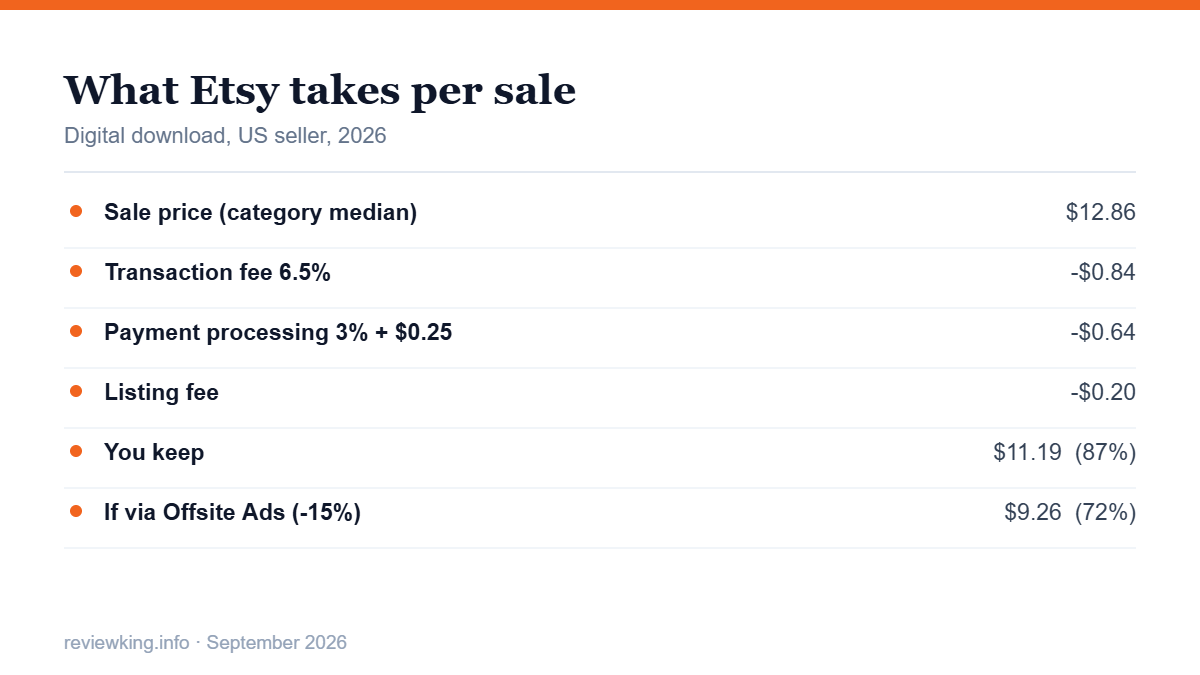
What Etsy takes from one digital planner sale.
What Etsy Takes From an Etsy Planner Sale
An Etsy planner is a digital download, and digital downloads carry the same fee stack as physical goods minus shipping. For a US seller in 2026:
Listing fee: $0.20 per listing, covering four months or until the item sells. With auto-renew on, each sale triggers another $0.20.
Transaction fee: 6.5% of the total sale price.
Payment processing: 3% + $0.25 in the US. The UK pays 4% + £0.20, and rates differ across other countries.
Offsite Ads: 15% of any sale Etsy attributes to its external advertising, dropping to 12% once you pass $10,000 a year — at which point participation becomes mandatory.
Currency conversion: 2.5% if your listing currency differs from your payment account currency.
Shop setup: $15–$29 one-off for new shops.
Regulatory operating fee: 0.29%–2.24% depending on country, outside the US.
Run that on the median price for the category, $12.86. Etsy takes $0.84 in transaction fee, $0.64 in processing and $0.20 for the listing — $1.68 in total, leaving you $11.19, or 87% of the sale. If that same sale came through Offsite Ads, add $1.93 and you keep $9.26, or 72%.
At the $10 price point where 39% of the category sits, the maths is tighter: $8.60 net on a clean sale. That is still a healthy margin on a file that costs nothing to reproduce — the constraint on an Etsy planner business is never manufacturing cost, it is attention.
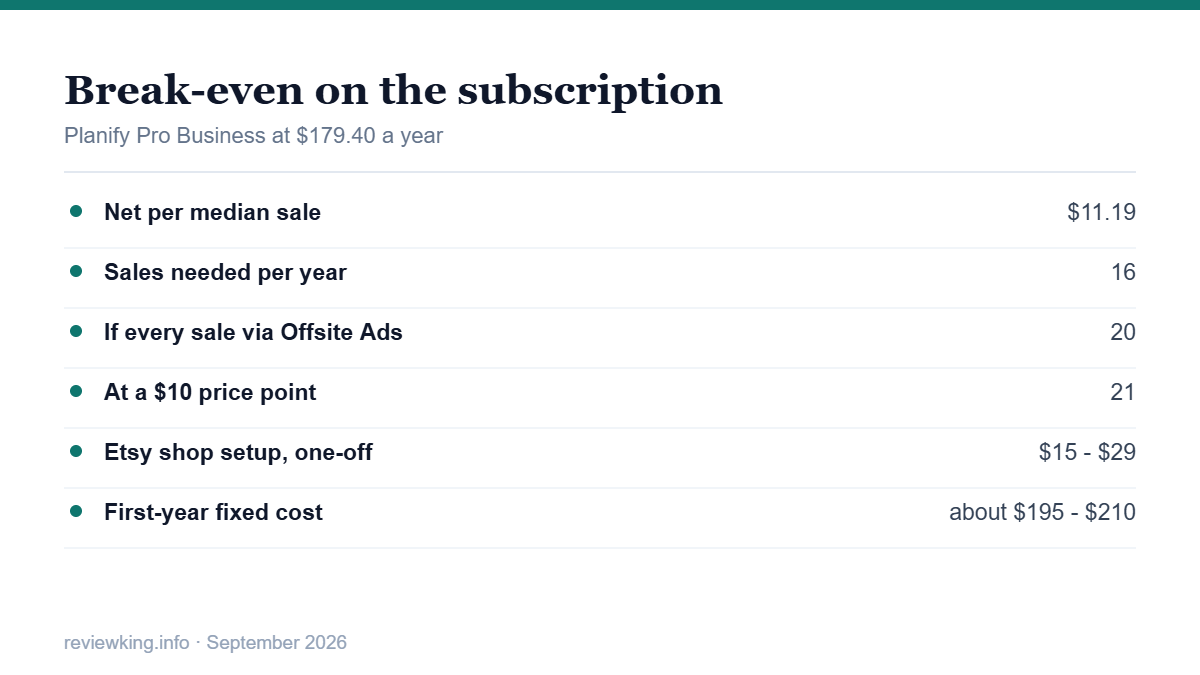
How many sales the subscription actually needs.
The Etsy Planner Break-Even, Properly Calculated
Planify Pro Business costs $179.40 a year. Divide that by $11.19 of net revenue per median-priced Etsy planner sale and you need 16 sales across the whole year to cover the tool. If every sale arrives via Offsite Ads at the 15% rate, it becomes roughly 20. At the $10 price point, about 21.
Add the one-off Etsy shop setup fee of $15–$29 and a first year looks like roughly $195–$210 of fixed cost — two or three sales more. Nobody should be scared off by that. A single planner design that sells twice a month clears it comfortably.
What the break-even does not capture is time. If it takes you thirty hours to design, list, photograph and describe your first five products, the subscription is the cheapest input in the business by a wide margin. That is the honest case for paying for a tool that generates dated pages and hyperlinks automatically rather than doing it by hand — and you can try the free tier before paying to judge how much time it really saves you.
What the Etsy Planner Market Looks Like
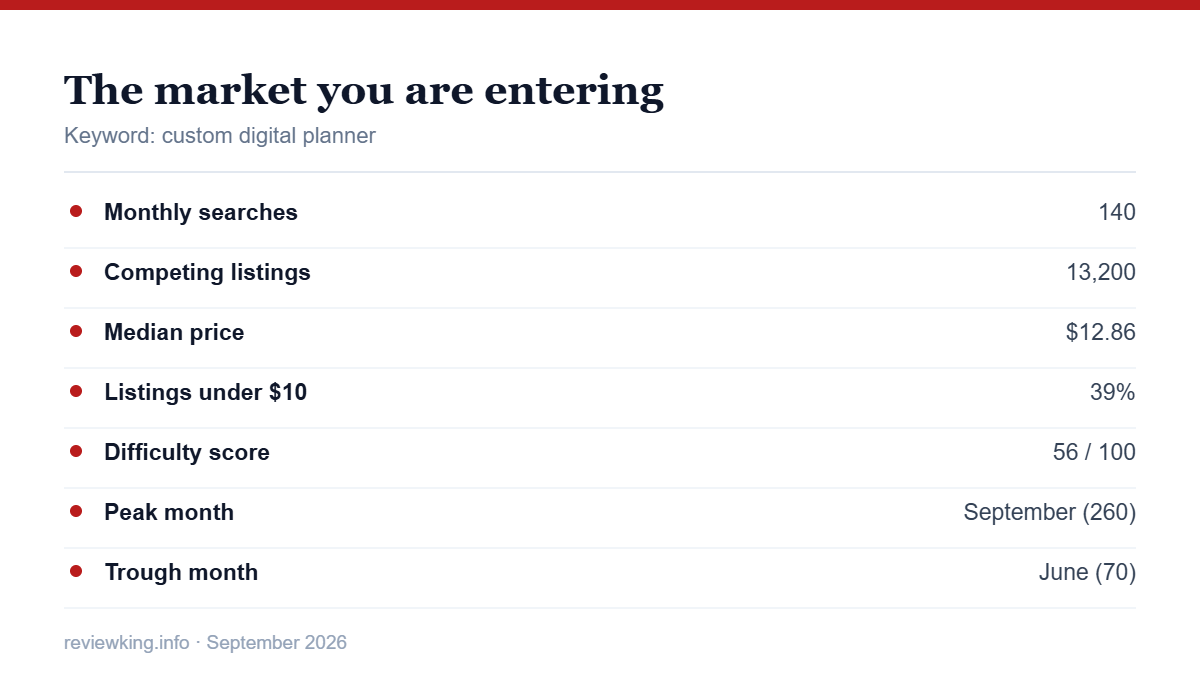
Now the part most tool reviews skip. Keyword data for one Etsy planner term, “custom digital planner”, shows the shape of the problem:
140 monthly searches globally for that exact phrase, against 13,200 competing listings.
Median price $12.86, mean $19.56, with the full range running from $0.99 to $145.
39% of listings sit under $10, which is where the price pressure comes from.
Cost per click $1.33 — high for the category, indicating sellers are actively bidding for these buyers.
The United States is 79% of demand and 95% of the competition.
Difficulty 56 out of 100 — competitive but not closed.
Read that honestly and it says two things at once. Thirteen thousand listings for 140 monthly searches on one keyword is a brutal ratio, and anyone promising an easy six-figure Etsy planner business is selling you something. But a difficulty score of 56 is genuinely mid-range, and the price spread from $0.99 to $145 shows buyers will pay well above the median for something they actually want.
Seasonality matters as much as competition. Searches peaked at 260 in September and fell to 70 by June — roughly a quarter of the peak. If you launch an Etsy planner shop in early summer and judge it by six weeks of results, you will conclude the niche is dead when you have simply arrived in the trough.
The market you are entering, in numbers.
Where the Tool Actually Helps an Etsy Planner Shop
Against that backdrop, two Planify Pro features matter more than the template count.
Catalogue speed. With 13,200 competing Etsy planner listings, one listing is a lottery ticket and twenty is a strategy. One-click dated planner generation is what makes twenty realistic — every product needs a fresh set of correct dates, and doing that by hand is the bottleneck that stops most people at three listings.
Working hyperlinks. A digital planner that does not navigate gets returned and reviewed badly, and on Etsy a handful of one-star reviews on a new shop is close to fatal. Automatic hyperlinking removes the single most common way a first-time seller ships a broken product.
The commercial licence on Business tiers is also unusually permissive for an Etsy planner seller: unlimited sales, no impression caps, graphics usable as-is without modification, and Amazon KDP, Redbubble, Zazzle and Printful all allowed alongside Etsy. What you may not do is resell the raw files, claim ownership, or use the graphics in apps, games or AI training. If you want to see whether the styles suit your shop, browse the template collections first.
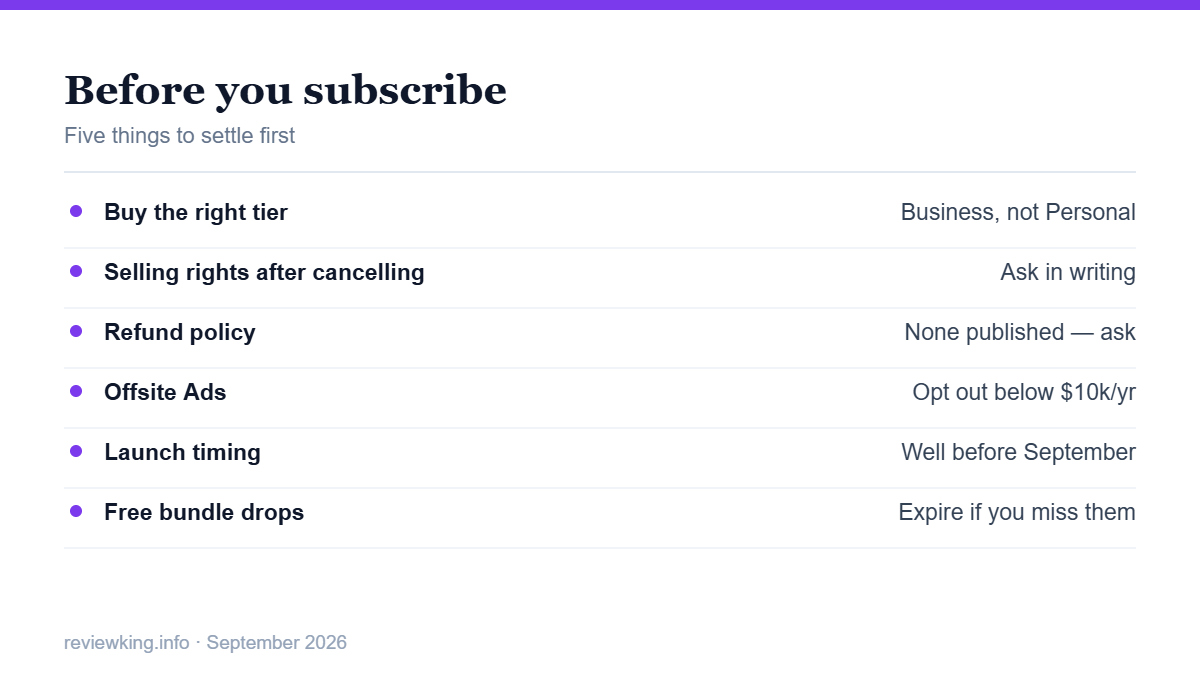
Five Things Every Etsy Planner Seller Should Settle First
Buy the right tier. The $99.99 Personal plan cannot be used commercially. Selling starts at $179.40. Do not discover this after designing your catalogue.
Ask about cancellation in writing. Planify Pro’s licence documentation does not state whether you may keep selling listings already published if your subscription lapses. Get that answer by email before you build twenty products on it.
Ask about refunds. We found no published refund policy in the pricing page, cancellation guide or terms of service.
Decide on Offsite Ads early. Below $10,000 a year you can opt out and keep 87% instead of 72%. Above it, participation is mandatory — a good problem, but plan for it.
Launch before September. Listings need time to gather views and reviews before the seasonal peak. Arriving in September with a brand-new shop means competing at the busiest moment with no history.
One more practical note for an Etsy planner shop: the free bi-weekly graphic bundles included with Business tiers can only be downloaded while their window is open. Miss a fortnight and that bundle is gone unless you hold Bundle Credits, which start at Business Plus ($349). If the bundles are the reason you are subscribing, price that in.
Bottom Line
The tool is not the risk in an Etsy planner business. At $179.40 a year it pays for itself at sixteen sales, and it removes the two failure modes — a catalogue too small to be found, and files whose links do not work — that stop most new shops. The risk is the market: 13,200 competing listings, a third of them under $10, and demand that swings by a factor of nearly four across the year.
Our rating for Planify Pro stays at 3.5 out of 5 — strong software, thin policy documentation. If the numbers above work for you, compare the four plans and start on Business rather than Personal, or open the editor on the free tier and design one planner end to end before you commit a year’s fee.
The pre-launch checklist in one card.
Want the design side rather than the numbers? Our Planify Pro templates guide covers the 7,000-template library, one-click dated planners and automatic GoodNotes hyperlinking.
Etsy Planner FAQ
How much does Etsy take from a digital planner sale?
A $0.20 listing fee, 6.5% transaction fee and 3% + $0.25 payment processing in the US — about 13% of a $12.86 sale. Add 15% if Etsy attributes the sale to Offsite Ads.
How many sales cover the Planify Pro subscription?
About 16 a year at the $12.86 median price, roughly 20 if every sale carries the Offsite Ads fee, and about 21 at a $10 price point.
Is the Etsy planner market too saturated to enter?
It is crowded — around 13,200 listings compete for “custom digital planner” against 140 monthly searches — but the difficulty score is a mid-range 56, and prices reach $145, so differentiated products still find buyers.
Can I opt out of Etsy Offsite Ads?
Yes, while your shop makes under $10,000 a year. Above that threshold participation becomes mandatory, though the rate drops from 15% to 12%.
When is the best time to launch an Etsy planner shop?
Well before September. Search demand peaks then and falls to roughly a quarter of that by June, so listings need months beforehand to accumulate views and reviews.
Can I sell Planify Pro planners outside Etsy?
Yes. The Business commercial licence covers Amazon KDP, your own store and print-on-demand platforms including Redbubble, Zazzle and Printful, with no cap on sales.
The iPhone 18 no ports theory is suddenly everywhere. A video making the rounds on TikTok and social media appears to show something startling: an iPhone — labeled as the “iPhone 18” — charging through a small magnetic connector instead…
Hottest fashion trends 2026 reviewed honestly — which trending styles are actually wearable, which are overhyped, and what’s worth buying right now in the US market. Quick Verdict: 2026’s biggest fashion trends fall into two camps: genuinely wearable evolutions of…
PS5 Pro review 2026 — I tested it for 30 days. Here’s the honest verdict on performance, graphics, and whether upgrading from a standard PS5 is actually worth the money. Quick Verdict: The PS5 Pro is the most capable PlayStation…