Most hosting reviews stop at the price column. That is the easy part. The decision that actually shapes how your site feels to a visitor in Frankfurt or a customer in Singapore is the one you make in a dropdown at checkout, and it is the one almost nobody researches. This guide is about the RackNerd datacenter locations – all twenty of them – what each facility is actually built on, which products you can order in each one, and how to measure a location yourself before you spend a cent.
Everything below is taken from RackNerd’s own datacenter pages and product pages in September 2026. Figures such as floor space, carrier lists and certifications are the company’s published claims about its facilities, not measurements we took ourselves. The one thing you can verify independently is latency, and RackNerd hands you the tools to do it – we will get to that.
Why RackNerd datacenter locations matter more than the spec sheet
Two servers with identical CPU, RAM and disk can behave completely differently for your users. The variable is distance. Light in fibre travels roughly 200 km per millisecond, and every router hop adds more. A visitor in Dublin hitting a Los Angeles server pays for that round trip on every request – the TLS handshake alone can cost four crossings before a single byte of your page arrives.
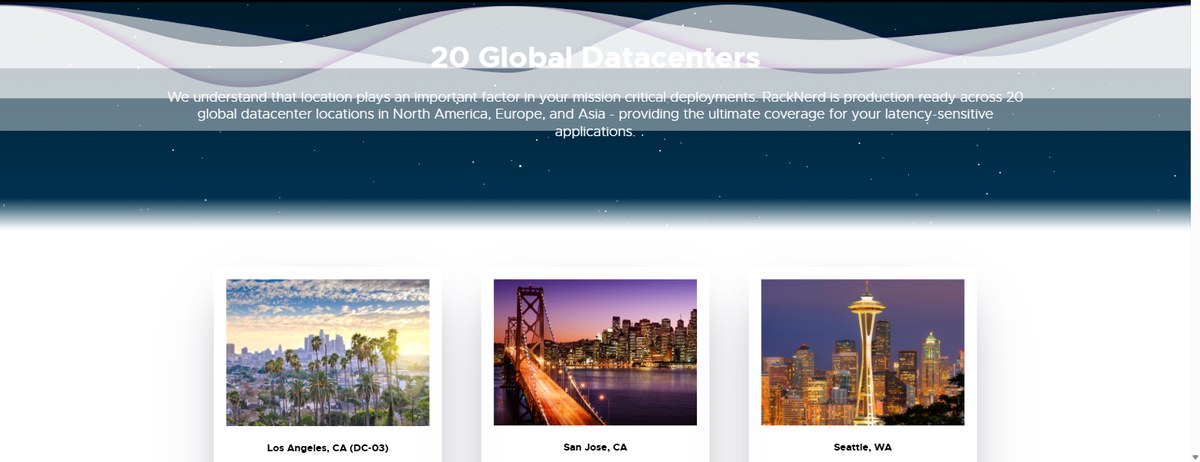
This is why the spread of RackNerd datacenter locations is a genuine feature rather than marketing garnish. The company describes itself as “production ready across 20 global datacenter locations in North America, Europe, and Asia – providing the ultimate coverage for your latency-sensitive applications.” That is a company claim, but it is one you can hold to account, because each location page publishes a test IP address.
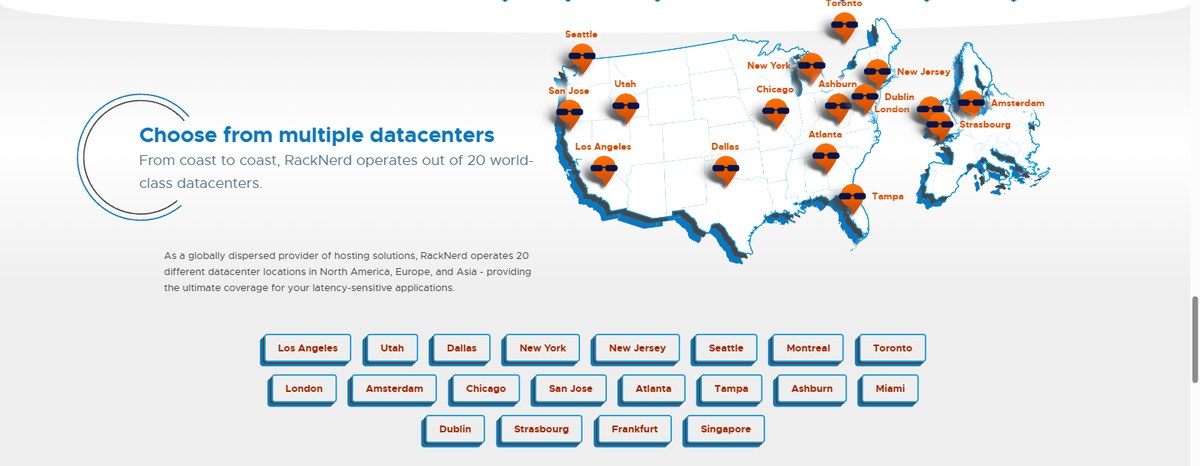
RackNerd currently lists 20 datacenter locations across three continents. Source: racknerd.com/datacenters
The second reason location matters is legal rather than technical. If you handle EU personal data, hosting in Amsterdam, Dublin, Strasbourg or Frankfurt keeps that data inside the EU. If a client contract specifies Canadian residency, Toronto and Montreal are the only two answers on this list. Latency you can optimise around with a CDN; jurisdiction you cannot.
All 20 RackNerd datacenter locations at a glance
Here is the full list, with the floor space and carrier mix RackNerd publishes for each site. Size is a rough proxy for how much room the facility has to grow into; the carrier list tells you how many independent paths your traffic can take out of the building.
Location
Country
Facility size
Network carriers
Los Angeles, CA (DC-03)
United States
733,000 sq. ft
Cogent, Arelion, Lumen
San Jose, CA
United States
71,000 sq. ft
NTT, Telia, HE, GTT, Cogent
Seattle, WA
United States
18,000 sq. ft
Cogent, Telia
Utah
United States
120,000 sq. ft
Noction BGP optimised network
Chicago, IL
United States
460,000 sq. ft
GTT, NTT, Telia, CenturyLink, Zayo
Dallas, TX
United States
68,000 sq. ft
TeliaSonera, XO
New York
United States
13,000 sq. ft
Cogent, Arelion, GTT
New Jersey
United States
360,000 sq. ft
Zayo, NTT, GTT, Cogent
Atlanta, GA
United States
73,000 sq. ft
GTT, Zayo, Cogent
Tampa, FL
United States
8,000 sq. ft
HE, Cogent, GTT
Miami, FL
United States
134,000 sq. ft
Telia, GTT
Ashburn, VA
United States
95,440 sq. ft
NTT, GTT, Comcast
Toronto
Canada
205,000 sq. ft
Cogent, Arelion
Montreal, QC
Canada
12,000 sq. ft
Zayo, Cogent
London
United Kingdom
22,000 sq. ft
Zayo, GTT, Cogent, NTT, LINX
Amsterdam
Netherlands
64,583 sq. ft
Cogent, Arelion
Dublin
Ireland
119,996 sq. ft
Cogent, GTT, Zayo
Strasbourg
France
80,202 sq. ft
Deutsche Telekom, Level 3, Telia, Cogent, DE-CIX, LINX
Frankfurt
Germany
269,098 sq. ft
Deutsche Telekom, Level 3, Telia, Cogent, DE-CIX, LINX
Singapore
Singapore
95,865 sq. ft
GCX, NTT, TATA, Equinix Peering
Twelve of the twenty RackNerd datacenter locations sit in the United States, two in Canada, five in Europe and one in Asia. If your audience is in Latin America, Africa, the Middle East, India or Oceania, there is no local site – Miami is the closest hop for South America, Singapore for South and Southeast Asia. That is worth knowing before you order rather than after. You can see the live list on the RackNerd datacenter and product pages.
Every location has its own page with facility specs – and, for most of them, a test IP. Source: racknerd.com/datacenters
Which RackNerd datacenter locations actually sell a VPS
This is the part that catches people out. Every one of the twenty sites offers dedicated servers, DRaaS and private cloud, but the cheaper products are not everywhere. Read the “Services Available” line on each location page and the map changes shape.
Product
Locations where RackNerd lists it
VPS
Los Angeles DC-03, San Jose, Seattle, Chicago, Atlanta, Ashburn, Toronto, Amsterdam, Dublin, Strasbourg
Shared and reseller hosting
Miami, Strasbourg, Frankfurt, Singapore
Colocation
Los Angeles DC-03, San Jose, Seattle, Utah, Chicago, Dallas, New York, New Jersey, Atlanta, Tampa, Miami, Montreal, London, Amsterdam
10 – 40 Gbps unmetered dedicated
New Jersey
Dedicated servers, DRaaS, private cloud
All 20 locations
So if you want a VPS, ten of the twenty RackNerd datacenter locations are on the table. If you want shared or reseller hosting, only four are – and three of those four are outside the United States, which is unusual and genuinely useful if your clients are European or Asian.
The order page tells a slightly different story
One honest caveat. The KVM VPS product page lists its own set of locations: “KVM VPS in Los Angeles, San Jose, Seattle, Dallas, Atlanta, Chicago, New York, Ashburn, Amsterdam, France, Dublin, and Toronto.” That is twelve, and it includes Dallas and New York, which the individual facility pages do not flag as VPS sites.
We are recording both sources rather than picking one. The two lists disagree, and the page that matters at the moment of purchase is the order form – so treat the product page as the working list and confirm the dropdown before you pay. If a specific city is mission-critical for you, ask support to confirm stock in that location first; it costs one ticket and saves a migration.
Test a RackNerd datacenter location before you pay
This is the feature that makes the whole list actionable, and it is the reason we rate the network pages as highly as we do. Most of the location pages publish a test IP. Ping it, run a traceroute to it, and you have a real latency number from your own connection – or from your customers’ country, if you run the test through a looking-glass service – before you have given anyone a card number.
Location
Test IP published by RackNerd
Los Angeles, CA (DC-03)
107.174.51.158
San Jose, CA
192.210.207.88
Seattle, WA
192.3.253.2
Utah
104.156.142.1
Chicago, IL
198.23.228.15
Dallas, TX
198.23.249.100
New York
192.3.81.8
New Jersey
23.227.136.11
Atlanta, GA
107.173.164.160
Tampa, FL
209.216.90.1
Miami, FL
192.155.106.1
Ashburn, VA
192.3.254.158
Toronto
167.160.186.8
Montreal, QC
38.153.100.129
London
185.239.172.14
Amsterdam
23.94.101.88
Dublin
23.95.225.2
Strasbourg
45.95.173.2
Frankfurt and Singapore are the two RackNerd datacenter locations that do not publish a test IP on their pages at the time of writing, so for those two you are relying on the carrier list instead.
A practical routine that takes about five minutes: run ping to three candidate IPs for sixty seconds each and write down the average and the jitter, then run traceroute (or tracert on Windows) to see which carrier your traffic hands off to. A site that looks 15 ms further away on paper can win easily if the path is cleaner. When you have a winner, order in that city from the RackNerd order pages.
Los Angeles DC-03: the flagship of the RackNerd datacenter locations
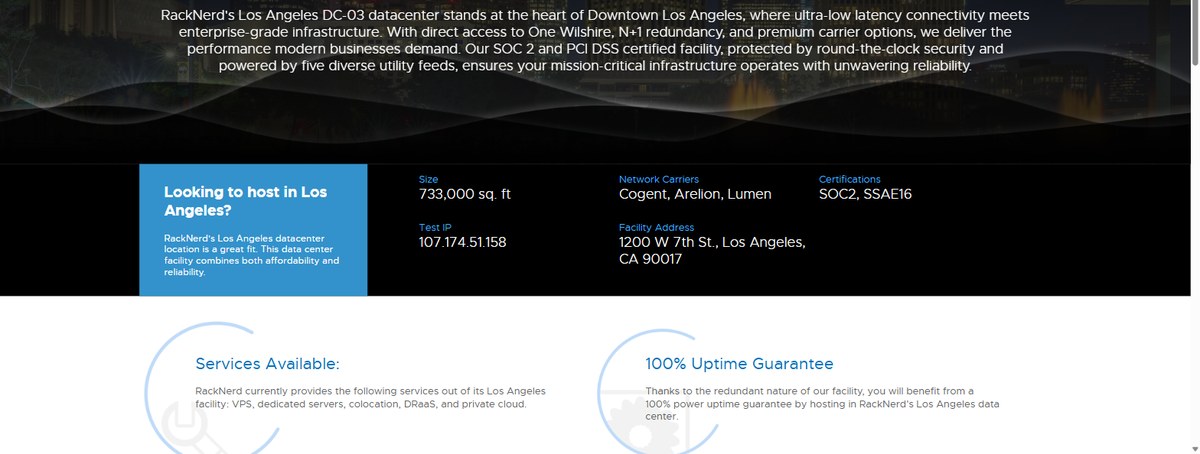
If RackNerd has a home field, this is it. DC-03 sits at 1200 W 7th St. in Downtown Los Angeles, a 733,000 sq. ft facility – by far the largest on the list – carried by Cogent, Arelion and Lumen and certified to SOC 2 and SSAE16.
The facility panel each location page publishes: size, carriers, certifications, test IP and street address. Source: racknerd.com
RackNerd describes the building as having “direct access to One Wilshire, N+1 redundancy, and premium carrier options”, with “five diverse utility feeds” and 22.5 MW of utility power capacity, plus round-the-clock on-site security, CCTV and biometric card access. One Wilshire is the interconnection hub that most trans-Pacific traffic to the US West Coast passes through, so proximity to it is a real advantage for anyone serving Asia from North America.
Practically: LA is the default choice if your audience is on the US West Coast, in Mexico, or in East Asia and you want a US-billed server. It is also where the cheapest promotional stock usually lands.
Singapore: the only Asian entry, and it is not a VPS site
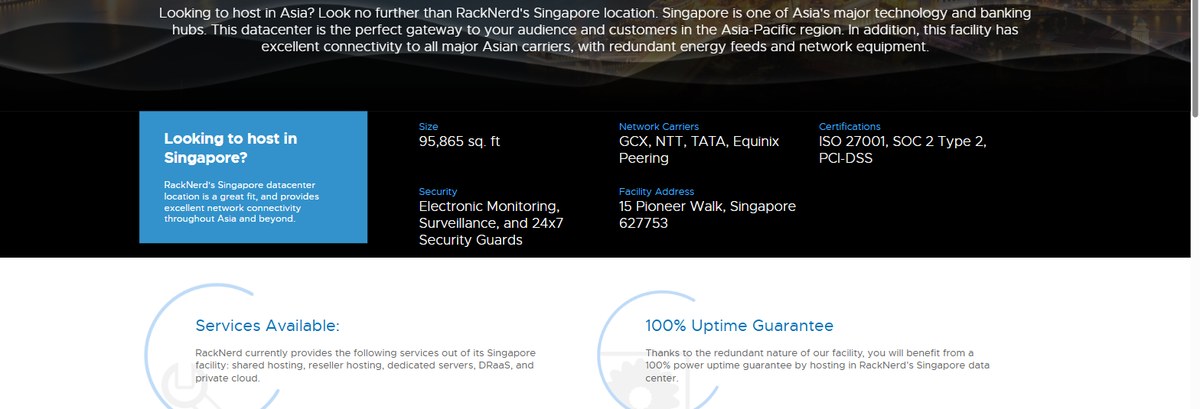
Singapore is a 95,865 sq. ft facility at 15 Pioneer Walk, carried by GCX, NTT, TATA and Equinix Peering, certified to ISO 27001, SOC 2 Type 2 and PCI-DSS, with electronic monitoring, surveillance and 24×7 security guards. RackNerd calls it “the perfect gateway to your audience and customers in the Asia-Pacific region”.
Singapore offers shared hosting, reseller hosting, dedicated servers, DRaaS and private cloud – but no VPS. Source: racknerd.com
The catch worth planning around: the services listed for Singapore are shared hosting, reseller hosting, dedicated servers, DRaaS and private cloud. There is no VPS line here. If you need a cheap Asian VPS specifically, the honest answer is that these RackNerd datacenter locations do not offer one – you would be looking at shared hosting in Singapore, or a Los Angeles VPS on an Asia-optimised route.
The five European RackNerd datacenter locations, compared
Europe is where this list is unexpectedly deep for a provider at this price point. Five sites, four countries, and two of them plugged into both DE-CIX and LINX.
Amsterdam – 64,583 sq. ft, Cogent and Arelion, ISO 50001:2011, ISO 9001:2015, ISO 14001:2015 and SOC 2 Type II. Offers VPS. The default EU pick for most people.
Dublin – 119,996 sq. ft, Cogent, GTT and Zayo, with the longest certification list of any site here: ISO 9001, 27001, 14001, 50001, PCI-DSS, SOC1, SOC2 and SOC3. Offers VPS, no colocation.
Strasbourg – 80,202 sq. ft, carried by Deutsche Telekom, Level 3, Telia, Cogent, DE-CIX and LINX, certified DCSA and ISO 27001. The only site that offers VPS and shared and reseller hosting.
Frankfurt – 269,098 sq. ft, the same six-carrier mix as Strasbourg, ISO 27001, ISAE 3402/SAS70 and PCI-DSS. Shared, reseller and dedicated – no VPS.
London – 22,000 sq. ft, Zayo, GTT, Cogent, NTT and LINX, ISO 9001 and ISO 27001. Dedicated and colocation only.
If you need an EU VPS, that narrows to Amsterdam, Dublin or Strasbourg. If you are reselling hosting to European clients, Strasbourg and Frankfurt are the two that carry the cPanel-style products.
Canada, and the one site built for unmetered bandwidth
Toronto is 205,000 sq. ft on Cogent and Arelion, certified ISO 27001, PCI-DSS, SOC1 and SOC2, and it does offer VPS. Montreal is much smaller at 12,000 sq. ft on Zayo and Cogent, certified ISO 27001, SOC 1 Type II and SOC 2 Type II with keycard plus biometric access – dedicated and colocation only. For Canadian data-residency clauses, those are your two options.
New Jersey deserves its own note. At 360,000 sq. ft on Zayo, NTT, GTT and Cogent, and certified to SOC 1, SOC 2, SOC 2-HIPAA, PCI, ISO 27001 and HITRUST, it is the only facility page that lists 10 Gbps to 40 Gbps unmetered dedicated servers among its services. The unmetered product pages themselves offer those machines in four cities – Los Angeles, New Jersey, London and Montreal – so the facility pages and the product pages disagree here too; we break the whole unmetered line down in our RackNerd dedicated servers guide.
Compliance: which certifications sit where
Certifications are audits of the building and the operator, not of your application – but if you are the one signing a data-processing agreement, the auditor will ask. These are the certifications RackNerd publishes per site.
Location
Certifications as published
Los Angeles DC-03
SOC 2, SSAE16 (page text also cites PCI DSS)
Seattle
SOC-1 and SSAE 16 Type II audited
Dallas
SSAE 18 SOC 2 Type II, PCI-DSS, GLBA, HIPAA
New York
SAS70 Type II
New Jersey
SOC 1, SOC 2, SOC 2-HIPAA, PCI, ISO 27001, HITRUST
Atlanta
SSAE-16 Type 2
Tampa
SSAE-16, HITRUST
Miami
SOC 2, SOC 3, PCI-DSS, HIPAA
Toronto
ISO 27001, PCI-DSS, SOC1, SOC2
Montreal
ISO 27001, SOC 1 Type II, SOC 2 Type II
London
ISO 9001, ISO 27001
Amsterdam
ISO 50001:2011, ISO 9001:2015, ISO 14001:2015, SOC 2 Type II
Dublin
ISO 9001, 27001, 14001, 50001, PCI-DSS, SOC1, SOC2, SOC3
Strasbourg
DCSA, ISO 27001
Frankfurt
ISO 27001, ISAE 3402/SAS70, PCI-DSS
Singapore
ISO 27001, SOC 2 Type 2, PCI-DSS
ISO/IEC 27001 shows up most often, which is the information-security management standard maintained by the International Organization for Standardization – the scope and requirements are published on the official ISO/IEC 27001 standard page. San Jose, Utah, Chicago and Ashburn do not list certifications on their pages; that is an absence of published information rather than evidence of an absence of certification, and support is the place to settle it if it matters to a contract.
What a location actually costs you
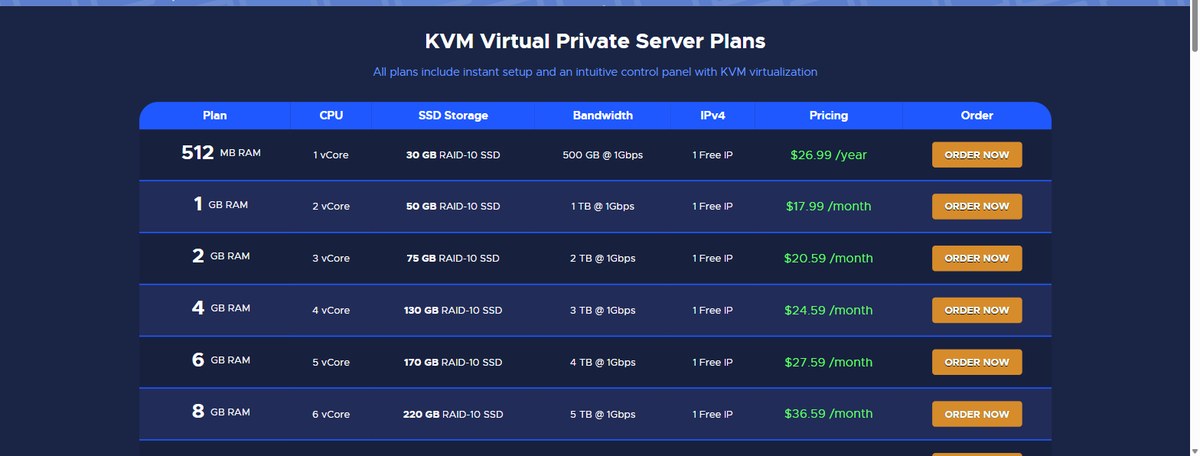
Choosing between RackNerd datacenter locations does not change the sticker price of a KVM VPS – the plan table is the same wherever you deploy. Here is what the KVM line looks like today.
Every KVM plan ships on RAID-10 SSD with a 1 Gbps port and one free IPv4. Source: racknerd.com/kvm-vps
Plan
vCore
SSD (RAID-10)
Bandwidth
Price
512 MB RAM
1
30 GB
500 GB @ 1 Gbps
$26.99 per year
1 GB RAM
2
50 GB
1 TB @ 1 Gbps
$17.99 per month
2 GB RAM
3
75 GB
2 TB @ 1 Gbps
$20.59 per month
4 GB RAM
4
130 GB
3 TB @ 1 Gbps
$24.59 per month
6 GB RAM
5
170 GB
4 TB @ 1 Gbps
$27.59 per month
8 GB RAM
6
220 GB
5 TB @ 1 Gbps
$36.59 per month
12 GB RAM
7
300 GB
6 TB @ 1 Gbps
$55.99 per month
Every plan includes instant setup, one free IPv4 and a 1 Gbps port, and RackNerd states that its servers run on Intel Xeon processors. Current pricing and stock per city are on the live KVM VPS plan page.
The uptime promise that comes with every location
Each facility page carries the same line: “Thanks to the redundant nature of our facility, you will benefit from a 100% power uptime guarantee by hosting in RackNerd’s [city] data center.” Read that precisely – it is a power uptime guarantee, tied to the redundancy of the building, not a blanket promise that your instance will never reboot. It is a company commitment, and like any SLA the remedy is defined in the service level agreement rather than in the marketing copy, so read that document before you rely on it.
What genuinely supports the claim across the RackNerd datacenter locations is the engineering the company describes: RAID-10 protected pure SSD storage, 1 Gbps ports as standard, Noction IRP route optimisation on the network, and Intel Xeon hardware. Those are the same building blocks behind the company’s other product lines.
How to choose between RackNerd datacenter locations
A short decision path that covers most real cases:
Audience on the US West Coast, in Mexico or in East Asia – Los Angeles DC-03. Largest facility, One Wilshire adjacency, deepest stock.
Audience on the US East Coast – Ashburn or New York for VPS; New Jersey if you need unmetered bandwidth.
EU personal data – Amsterdam, Dublin or Strasbourg for a VPS; Frankfurt if you are reselling hosting.
UK-facing, dedicated hardware – London.
Canadian data residency – Toronto for VPS, Montreal for dedicated or colocation.
Asia-Pacific audience – Singapore for shared, reseller or dedicated; Los Angeles if you specifically need a VPS.
Budget above all, location irrelevant – take whichever city the current promotion is running in and verify it with the test IP afterwards.
Whatever you choose, do the ping first. It is the one number in this entire article that nobody has to take on trust.
Where this fits with RackNerd’s other products
If your plan is to run AI agents or self-hosted tooling rather than a website, the location question interacts with the one-click app catalogue – we covered that line separately in our RackNerd AI VPS review. For the wider picture of how the pricing compares against the rest of the budget hosting market, see our main RackNerd review.
Verdict on the RackNerd datacenter locations: 4.5 out of 5
Twenty sites is a serious footprint for a provider whose entry VPS costs less than a takeaway coffee per month, and the transparency around those sites is better than the price bracket would lead you to expect. Floor space, carrier mix, certifications, street addresses and – for eighteen of the twenty – a test IP you can ping right now. Very few budget hosts publish that much.
The half point comes off for two things you should know going in: the product availability per city is uneven, and the facility pages and the order pages do not agree on which cities sell a VPS. Neither is a dealbreaker, but both are reasons to check the dropdown rather than the map before you pay.
Taken together, the RackNerd datacenter locations turn a cheap VPS into something you can actually plan around – pick the city closest to your users, verify the route yourself, and pay budget-tier prices for it. Browse the current RackNerd plans and locations and start with a ping.
The iPhone 18 no ports theory is suddenly everywhere. A video making the rounds on TikTok and social media appears to show something startling: an iPhone — labeled as the “iPhone 18” — charging through a small magnetic connector instead…
Hottest fashion trends 2026 reviewed honestly — which trending styles are actually wearable, which are overhyped, and what’s worth buying right now in the US market. Quick Verdict: 2026’s biggest fashion trends fall into two camps: genuinely wearable evolutions of…
PS5 Pro review 2026 — I tested it for 30 days. Here’s the honest verdict on performance, graphics, and whether upgrading from a standard PS5 is actually worth the money. Quick Verdict: The PS5 Pro is the most capable PlayStation…