Bare metal is the part of a hosting catalogue where the numbers stop being decorative. A VPS can hide a lot behind a hypervisor; a dedicated server is a specific machine in a specific rack, and you are paying for every component in it. RackNerd dedicated servers span an unusually wide range – from a $39 hybrid box to a $5,099 unmetered 40 Gbps EPYC – and the tiers are easy to confuse because the marketing pages look almost identical.
This guide separates the tiers of RackNerd dedicated servers properly. Every price, specification and deployment time below is taken from RackNerd’s own product pages in September 2026. Prices move, promotions rotate, and inventory varies by city, so treat the tables as a map of the range rather than a quote.
What every RackNerd dedicated server includes
Whichever tier you land on, the same baseline applies, and it is a generous one for this price bracket. RackNerd states that all of the following ship with every bare metal machine it provisions:
Full root access – no managed-panel lock-in unless you ask for one
IPMI / KVM console – out-of-band access, so you can fix a broken boot yourself instead of raising a ticket
Remote power reboot from the server management interface
Your choice of operating system, including Linux, Windows and FreeBSD, or a custom ISO the company will mount for you
Custom partitioning on request
Noction IRP route optimisation on the network, with a multi-carrier Tier 1 BGP blend
24×7 support
The IPMI point is the one worth dwelling on. Plenty of budget providers charge extra for out-of-band access or simply do not offer it. Having it included means a kernel panic at 3 a.m. is something you can resolve yourself, which is exactly the kind of control you are buying bare metal for in the first place.
The five tiers of RackNerd dedicated servers at a glance
Classic single-tenant Xeon boxes, 35-200 TB transfer
Typically under 48 hours
AMD Ryzen
$219 / month
Highest single-thread performance per dollar, NVMe, DDR5
24 – 36 hours
Unmetered 10 / 20 / 40 Gbps
$599 / month
Sustained high-volume transfer with no overage
Quote on order
SEO dedicated
$229 / month
Large, diverse IPv4 allocations
24 hours, often same day
Colocation sits alongside these as a sixth option for people who already own hardware – more on that later. The whole range is visible from the RackNerd dedicated server catalogue, and the tier you want is rarely the one the homepage pushes.
Tier one: hybrid dedicated servers from $39
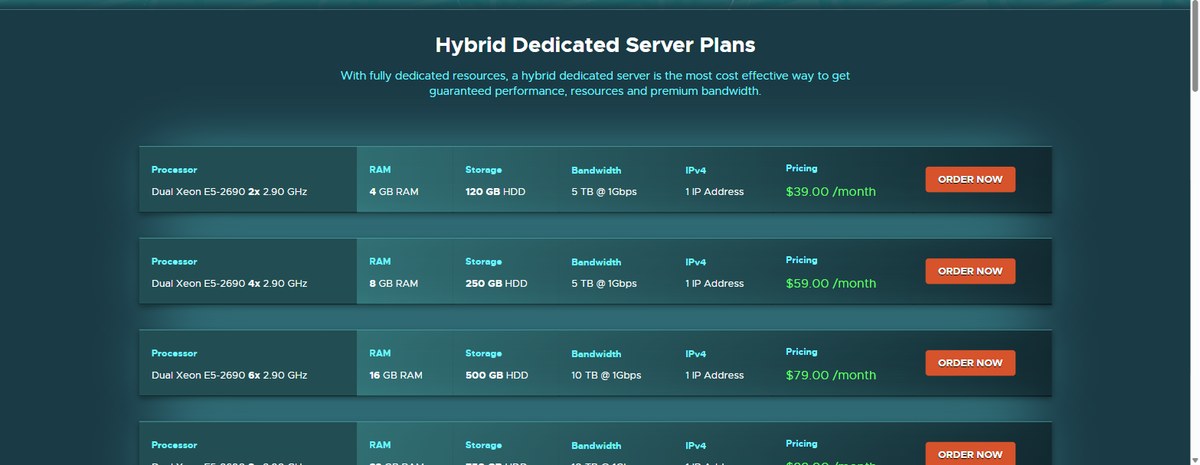
The cheapest way into the range. RackNerd describes hybrid dedicated servers as giving you “the power of dedicated resources with the flexibility and convenience of instant deployment” – the resources are fully allocated to you, but the machine is provisioned instantly rather than racked to order.
Four hybrid tiers, all on dual Xeon E5-2690 with 1 Gbps ports. Source: racknerd.com/hybrid-dedicated-servers
Processor
RAM
Storage
Bandwidth
IPv4
Price
Dual Xeon E5-2690, 2x 2.90 GHz
4 GB
120 GB HDD
5 TB @ 1 Gbps
1
$39.00 / month
Dual Xeon E5-2690, 4x 2.90 GHz
8 GB
250 GB HDD
5 TB @ 1 Gbps
1
$59.00 / month
Dual Xeon E5-2690, 6x 2.90 GHz
16 GB
500 GB HDD
10 TB @ 1 Gbps
1
$79.00 / month
Dual Xeon E5-2690, 8x 2.90 GHz
32 GB
750 GB HDD
10 TB @ 1 Gbps
1
$99.00 / month
Note the storage: spinning HDD throughout, and a single IPv4 address rather than the five you get higher up the range. At $39 for 4 GB of dedicated RAM this is still the cheapest of the RackNerd dedicated servers with guaranteed resources, and the instant deployment makes it the obvious pick when you need something today.
Tier two: Intel bare metal, the core of the range
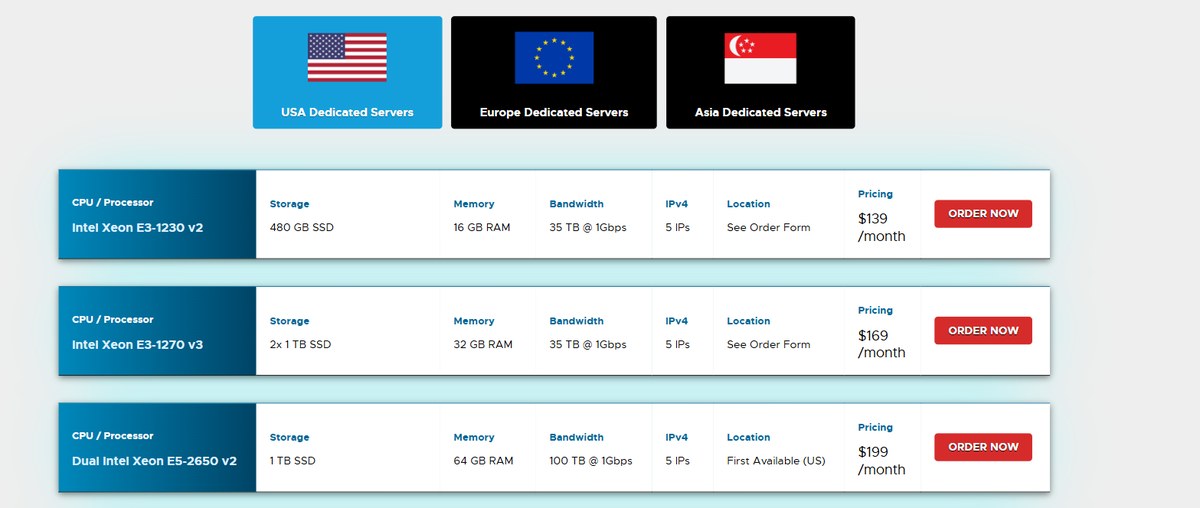
This is what most people mean by the phrase, and it is where the bulk of the RackNerd dedicated servers sit. Single tenant, your hardware, five IPv4 addresses as standard, and transfer allowances that run from 35 TB up to 200 TB a month.
The catalogue splits into USA, Europe and Asia tabs before you even reach the configurations. Source: racknerd.com/dedicated-servers
Two of these stand out. The Virtualization Node Special at $349 bundles 256 GB of RAM with 29 IPv4 addresses – that IP count is the tell, because it is aimed at people who want to resell VPS instances off a single box. And the 160 TB Storage Server Special at $479 puts ten 16 TB drives in a Los Angeles DC-02 chassis with 200 TB of monthly transfer, which is a backup or media archive machine rather than a web server.
The catalogue is also split by region before you reach the configurations: USA, Europe and Asia each have their own tab, so the list you see depends on which one is selected. Prices are current on the RackNerd dedicated server plan pages.
Tier three: AMD Ryzen, the line with published benchmarks
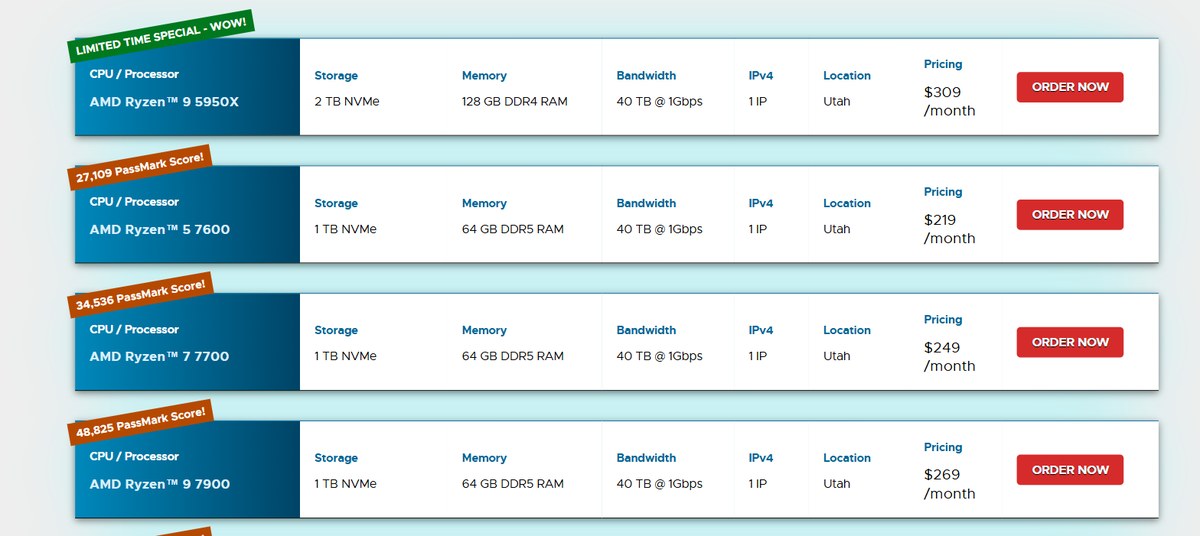
Of all the RackNerd dedicated servers this is the most interesting tier, and the only one where the company puts a number on performance rather than leaving you to guess. Every Ryzen plan is NVMe, most are DDR5, all sit in the Utah datacenter with 40 TB of transfer on a 1 Gbps port and a single IPv4 address, and the company says they are “tailor built and deployed within 24 to 36 hours”.
The PassMark badge on each row is unusual transparency for a budget host. Source: racknerd.com/amd-ryzen-dedicated-servers
Processor
Storage
RAM
PassMark (as published)
Price
AMD Ryzen 9 5950X
2 TB NVMe
128 GB DDR4
not stated
$309 / month
AMD Ryzen 5 7600
1 TB NVMe
64 GB DDR5
27,109
$219 / month
AMD Ryzen 7 7700
1 TB NVMe
64 GB DDR5
34,536
$249 / month
AMD Ryzen 9 7900
1 TB NVMe
64 GB DDR5
48,825
$269 / month
AMD Ryzen 9 7950X3D
1 TB NVMe
128 GB DDR5
62,433
$379 / month
AMD Ryzen 9 7950X3D
2x 3.84 TB NVMe
192 GB DDR5
62,433 (same CPU)
$499 / month
Run the arithmetic and the Ryzen 9 7900 is the value pick of the whole catalogue: 48,825 PassMark points for $269 works out at roughly 182 points per dollar, against about 124 for the 5 7600 and 165 for the 7950X3D. If raw throughput per month of spend is your metric, that is where the line peaks.
What a PassMark score does and does not tell you
Worth a short caveat before anyone orders on the strength of a number. PassMark CPU Mark is a composite multi-thread benchmark – it rewards core count heavily and says very little about single-thread latency, memory bandwidth or how your specific workload behaves. A database with a hot serialised write path may run better on a lower-scoring chip with faster cores than on a higher-scoring one with more of them.
The scores RackNerd publishes are the standard figures for those processors rather than measurements of these particular machines, and we have not benchmarked them ourselves. Treat them as a way to rank the tier internally, not as a promise about your application.
Tier four: unmetered 10, 20 and 40 Gbps
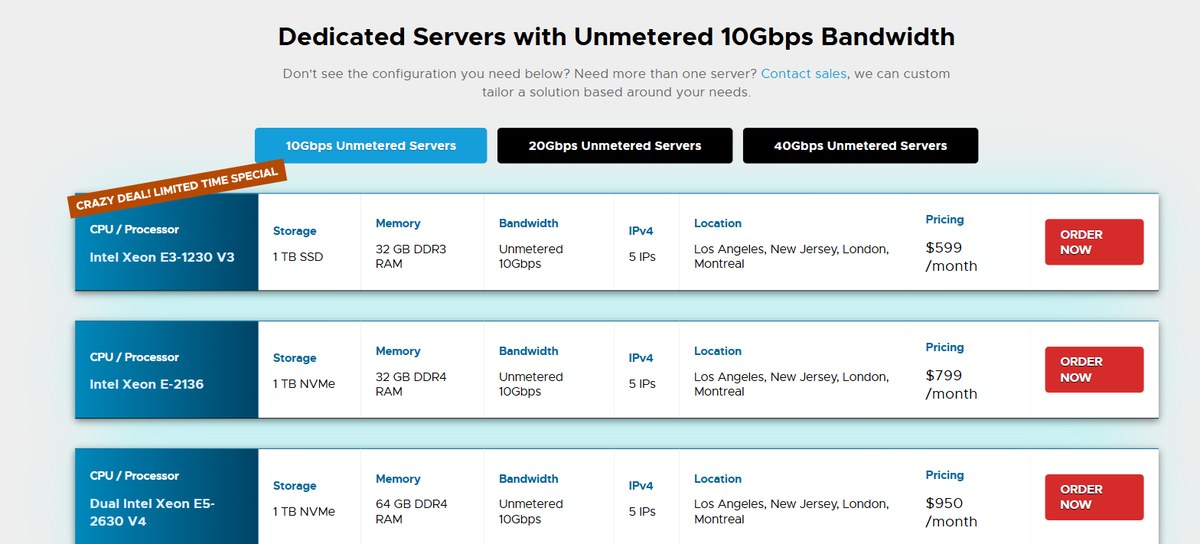
The top of the range of RackNerd dedicated servers, and a genuinely different product. “True 10Gbps Unmetered. Use it and sustain it 24×7” is RackNerd’s claim, backed by a described network of “multiple Tier 1 bandwidth providers, optimized in a BGP network blend”. No transfer cap means no overage bill, which is the entire point for CDN edges, streaming origins and large mirrors.
The same six configurations appear at 10, 20 and 40 Gbps – only the port speed and the price change. Source: racknerd.com/10gbps-unmetered-servers
All six configurations are offered in Los Angeles, New Jersey, London and Montreal, each with 5 IPv4 addresses. The hardware list is identical across the three port speeds; only the price moves.
Look at the shape of that table rather than the individual numbers. Doubling from 10 to 20 Gbps costs between $900 and $1,500 a month depending on the box; doubling again to 40 Gbps costs a further $1,300 to $2,200. Bandwidth, not silicon, is what you are buying at this tier – the cheapest 40 Gbps machine costs more than the most expensive 10 Gbps one. Work out your real sustained throughput before you climb a step.
Tier five: SEO dedicated servers and bulk IPv4
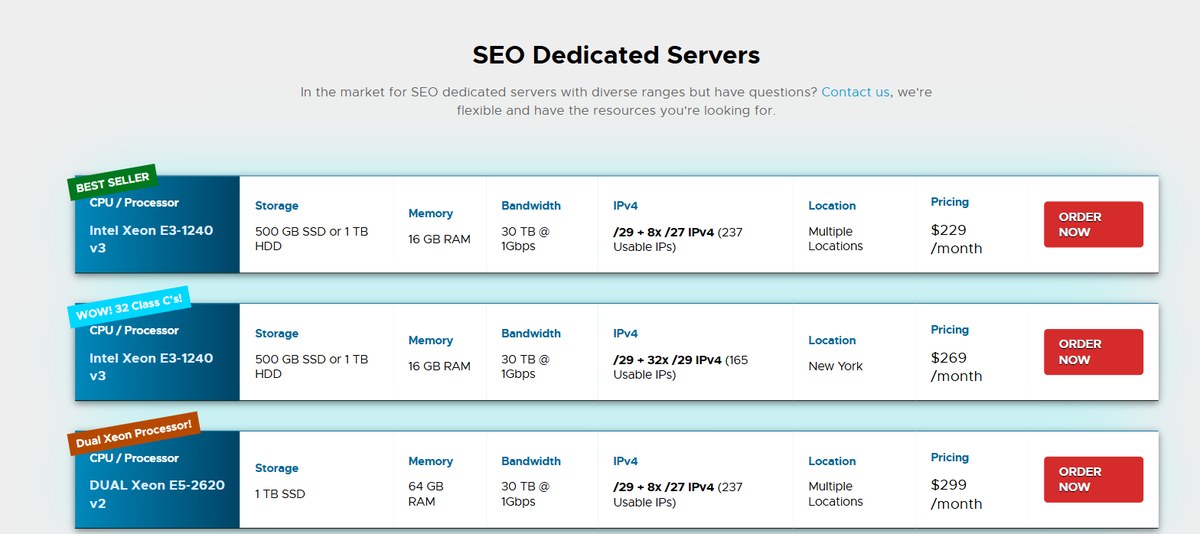
The niche tier among RackNerd dedicated servers, and the one whose value is entirely in the address space. RackNerd offers allocations “from 1x /24 IPv4 allocations, all the way up to 16x /28 IPv4 allocations (with each IPv4 range being from a different C class)”, and says these are typically deployed in 24 hours and in most cases same-day.
The spec that matters here is the IPv4 column, not the CPU. Source: racknerd.com/seo-dedicated-servers
Processor
Storage
RAM
IPv4 allocation
Location
Price
Intel Xeon E3-1240 v3 (best seller)
500 GB SSD or 1 TB HDD
16 GB
/29 + 8x /27 – 237 usable IPs
Multiple
$229 / month
Intel Xeon E3-1240 v3
500 GB SSD or 1 TB HDD
16 GB
/29 + 32x /29 – 165 usable IPs
New York
$269 / month
Dual Xeon E5-2620 v2
1 TB SSD
64 GB
/29 + 8x /27 – 237 usable IPs
Multiple
$299 / month
The middle plan is the interesting one: fewer usable addresses than the cheaper option, but spread across 32 separate ranges instead of 8. You are paying for diversity of network blocks, not for the count.
A short note on /29, /27 and the words “class C”
If the notation in that table is unfamiliar: a /27 is a block of 32 addresses, a /29 is a block of 8, and a /24 is a block of 256. The suffix counts how many bits of the address are fixed, so a smaller number means a bigger block. Five addresses are “usable” out of each /29 because the network and broadcast addresses are reserved and one goes to the gateway.
The phrase “class C”, which RackNerd uses as shorthand for a /24-sized neighbourhood, is legacy vocabulary – classful addressing was replaced in 1993 by CIDR, the scheme defined in RFC 4632, the IETF Best Current Practice document for classless inter-domain routing. In practice everyone in hosting still says class C when they mean “a different /24”, and that is what the plan descriptions are getting at.
Colocation: when the hardware is already yours
Sitting beside the RackNerd dedicated servers is a colocation line, described as available “in multiple locations in the United States, with smart remote eyes and hands services”. The published plans default to the New York datacenter; other locations are quoted on request.
Plan
Rack space
Power
Transfer
Network
IPv4
Price
Single server
1U to 4U
1 Amp 120 V
10 TB
1 Gbps port
/29 – 5 usable
$179 / month
Quarter rack
10U
10 Amp 120 V
30 TB
1 Gbps port
/27 – 29 usable
$599 / month
Half rack
20U
20 Amp 120 V
100 TB
1 Gbps port
/26 – 61 usable
$999 / month
The power allocation is the number to check first. One amp at 120 V is about 120 watts, which comfortably runs a modest 1U box and will not run a GPU node. If your hardware draws more, that is a conversation with sales before you ship anything.
How long deployment actually takes
RackNerd publishes different timeframes for each class of its dedicated servers, and they are worth planning around rather than assuming everything is instant:
Hybrid dedicated – instant deployment
SEO dedicated – typically 24 hours, in most cases same day
AMD Ryzen – tailor built and deployed within 24 to 36 hours
Intel bare metal – “typically deployed in under 48 hours”
The company adds a sensible piece of advice on its own FAQ: if you have a project with a sensitive timeframe, contact them first to confirm current inventory availability and setup times. That is the honest read – these are real machines being racked, not instances being cloned.
Where RackNerd dedicated servers are available
The FAQ states that RackNerd “operates out of 20+ global datacenter locations in North America, Europe, and Asia”, that dedicated servers are available in every location, and that inventory for specific configurations varies by location – the order form tells you which datacenter your server will be set up in.
In practice the individual plan pages pin some tiers to specific cities: the Ryzen line is listed in Utah, the unmetered line in Los Angeles, New Jersey, London and Montreal, and the 160 TB storage special in Los Angeles DC-02. If a particular city matters to you, our guide to all 20 RackNerd datacenter locations lists the carriers, certifications and test IPs for each one so you can measure the route before you commit.
The discount that is running right now
A banner currently sits across every page of the site: “Save 15% off for life on all dedicated servers using promo code 15OFFDEDI”. Applied to the RackNerd dedicated servers priced above, that is roughly $5.85 a month off the $39 hybrid, $40 off the $269 Ryzen 9 7900, and $90 off the $599 entry to the unmetered line – recurring, not first-month-only, as the company words it.
Promotional codes rotate and expire without notice, so check the banner is still there when you order rather than trusting this paragraph. The current RackNerd promotions page is the live source.
Which tier of RackNerd dedicated servers suits you
You need dedicated resources today on the smallest budget – hybrid at $39. Accept the HDD and the single IP.
Standard production web or app server – Intel bare metal at $139 to $199. Five IPs and 35 to 100 TB of transfer covers most sites comfortably.
CPU-bound work: game servers, compilers, busy databases, rendering – Ryzen 9 7900 at $269 is the sweet spot of the range.
You want to resell VPS instances – the $349 Virtualization Node Special, for the 256 GB of RAM and 29 IPv4 addresses.
Backups, media archives, anything storage-heavy – the $479 160 TB storage special.
Sustained high-volume transfer – the unmetered line from $599, and size the port to measured throughput rather than to ambition.
Large, diverse IPv4 footprint – SEO dedicated from $229.
You own the hardware already – colocation from $179.
If none of those describes you and the workload would fit on a virtual machine, it probably should – our RackNerd AI VPS review and the main RackNerd review cover the cheaper end of the catalogue in detail.
Verdict on RackNerd dedicated servers: 4.5 out of 5
The range is the achievement here. A provider whose reputation was built on very cheap VPS plans now sells a coherent bare metal ladder that runs from a $39 hybrid to a $5,099 unmetered EPYC, and the rungs are spaced sensibly rather than padded out with near-identical SKUs. Full root, IPMI and custom ISO support on every tier – including the $39 one – is more than this price bracket usually offers.
Publishing PassMark numbers on the Ryzen line deserves particular credit. It is the one place in the budget hosting market where you can compare two plans on something firmer than adjectives, and it makes the Ryzen 9 7900 identifiable as the value pick rather than merely plausible.
The half point comes off for two practical frictions. Deployment is measured in hours to days rather than minutes on every tier except hybrid, and inventory for specific configurations varies by city in a way you only discover at the order form. Neither is unusual for real bare metal, but both are reasons to confirm availability before you build a launch date around a machine.
For anyone whose workload has outgrown a VPS, the ladder of RackNerd dedicated servers is a straightforward way to climb without changing provider. Compare the current configurations and promotions and pick the rung that matches the bottleneck you actually have.
The iPhone 18 no ports theory is suddenly everywhere. A video making the rounds on TikTok and social media appears to show something startling: an iPhone — labeled as the “iPhone 18” — charging through a small magnetic connector instead…
Hottest fashion trends 2026 reviewed honestly — which trending styles are actually wearable, which are overhyped, and what’s worth buying right now in the US market. Quick Verdict: 2026’s biggest fashion trends fall into two camps: genuinely wearable evolutions of…
PS5 Pro review 2026 — I tested it for 30 days. Here’s the honest verdict on performance, graphics, and whether upgrading from a standard PS5 is actually worth the money. Quick Verdict: The PS5 Pro is the most capable PlayStation…