Hooga Health makes some of the most affordable red light therapy panels on the market — but do they actually work? We tested the HG300 and HG1500 for 60 days. Here’s the honest verdict.
Quick Verdict: Hooga Health offers genuinely solid red light therapy panels at prices significantly below premium competitors like Joovv and BonCharge. Their devices deliver clinically relevant wavelengths (660nm red and 850nm near-infrared) at irradiance levels sufficient for skin, muscle recovery, and joint support — backed by a growing body of peer-reviewed research on photobiomodulation. Build quality is functional rather than premium, and customer support is inconsistent, but for budget-conscious buyers who want to explore red light therapy without a $1,000+ investment, Hooga is one of the most credible entry points on the market.
What Is Hooga Health?
Hooga Health is a US-based company specializing in red light therapy (RLT) devices — panels, handheld units, and full-body systems that emit specific wavelengths of red (660nm) and near-infrared (850nm) light. These wavelengths are the subject of extensive research in the field of photobiomodulation (PBM), with peer-reviewed studies suggesting potential benefits for skin health, muscle recovery, inflammation reduction, sleep quality, and cellular energy production (via mitochondrial stimulation).
Hooga has carved out a position as the affordable alternative in a market dominated by expensive brands. Their panels range from small desktop units (~$100) up to large full-body panels (~$700–$900), making red light therapy accessible to consumers who can’t justify $1,500+ for a Joovv device.
What We Tested
For this review, I used two Hooga panels over a 60-day period:
- HG300 — compact panel, tested for facial skin and targeted muscle recovery
- HG1500 — larger panel, tested for full upper-body sessions and sleep protocol
Testing protocol: daily 10–15 minute sessions at the manufacturer-recommended distance (6–12 inches), consistently timed for 60 days. Metrics tracked: skin texture (self-assessed + photos at days 0, 30, 60), post-workout muscle soreness (DOMS rating scale), sleep onset time (tracked via Oura Ring), and subjective energy levels.
Feature Breakdown
1. Wavelength & Irradiance — 8.5/10
Both panels emit dual wavelengths: 660nm (red, for skin-surface benefits) and 850nm (near-infrared, for deeper tissue penetration). These are the two most research-supported wavelengths in photobiomodulation literature, and Hooga gets this right.
Irradiance (power output at treatment distance) is where Hooga holds its own: the HG300 delivers approximately 50–60 mW/cm² at 6 inches, and the HG1500 reaches 80–100 mW/cm² — sufficient for therapeutic dosing based on published research. Competing budget brands often underdeliver on irradiance despite similar wattage claims, so this is a meaningful differentiator.
2. Build Quality — 7/10
The panels are solidly built for the price but unmistakably utilitarian. The aluminum housing is functional, cooling fans run audibly (noticeable in a quiet room), and the power cables feel adequate rather than premium. The HG1500’s hanging hardware is basic — the included straps work but require a sturdy anchor point. This is not a device you’d display in a wellness studio; it’s a tool built to a budget.
No flicker issues were detected on either unit (a common problem with cheaper RLT panels), which is an important quality checkpoint.
3. EMF Output — 8/10
Hooga publishes EMF measurements for their panels, which is more transparency than many competitors offer. Both tested units measured near-zero EMF at treatment distance (6+ inches) — a legitimate selling point for consumers concerned about electromagnetic exposure during sessions.
4. Treatment Area & Session Practicality — 7.5/10
The HG300 covers a targeted area (roughly face, neck, or one limb at a time) — practical for spot treatment but limited for full-body protocols. The HG1500 covers the full torso and is the minimum practical size for whole-body benefits. For full-body coverage, two panels or a dedicated full-body system (like the HG2000 or higher) is recommended, which increases total cost substantially.
Session setup is simple: hang the panel, set a timer, maintain distance. No app, no Bluetooth, no complexity — which is either a feature or a limitation depending on your preference for tech.
5. Results — What the Research Supports
To be precise: red light therapy’s evidence base is promising but still developing. The strongest peer-reviewed evidence supports benefits for wound healing, certain skin conditions (acne, photoaging), and localized pain/inflammation reduction. Evidence for sleep and systemic energy is more preliminary.
In my 60-day test: skin texture showed measurable improvement by day 30 (reduced redness, smoother tone — consistent with collagen stimulation research). Post-workout soreness recovery felt noticeably faster in weeks 3–6. Sleep onset: marginally better, though this is difficult to isolate from other variables.
What I will not claim: that Hooga panels cure disease, treat any medical condition, or produce dramatic results universally. Individual responses vary, and RLT is a complement to — not a replacement for — evidence-based medical care.
6. Customer Support & Warranty — 6.5/10
This is Hooga’s weakest area. The warranty is 2 years on most panels, which is competitive. However, customer support response times are inconsistent — forum reports and reviews cite delays of several days for email replies and variable outcomes on warranty claims. For a budget brand, this is expected but worth flagging.
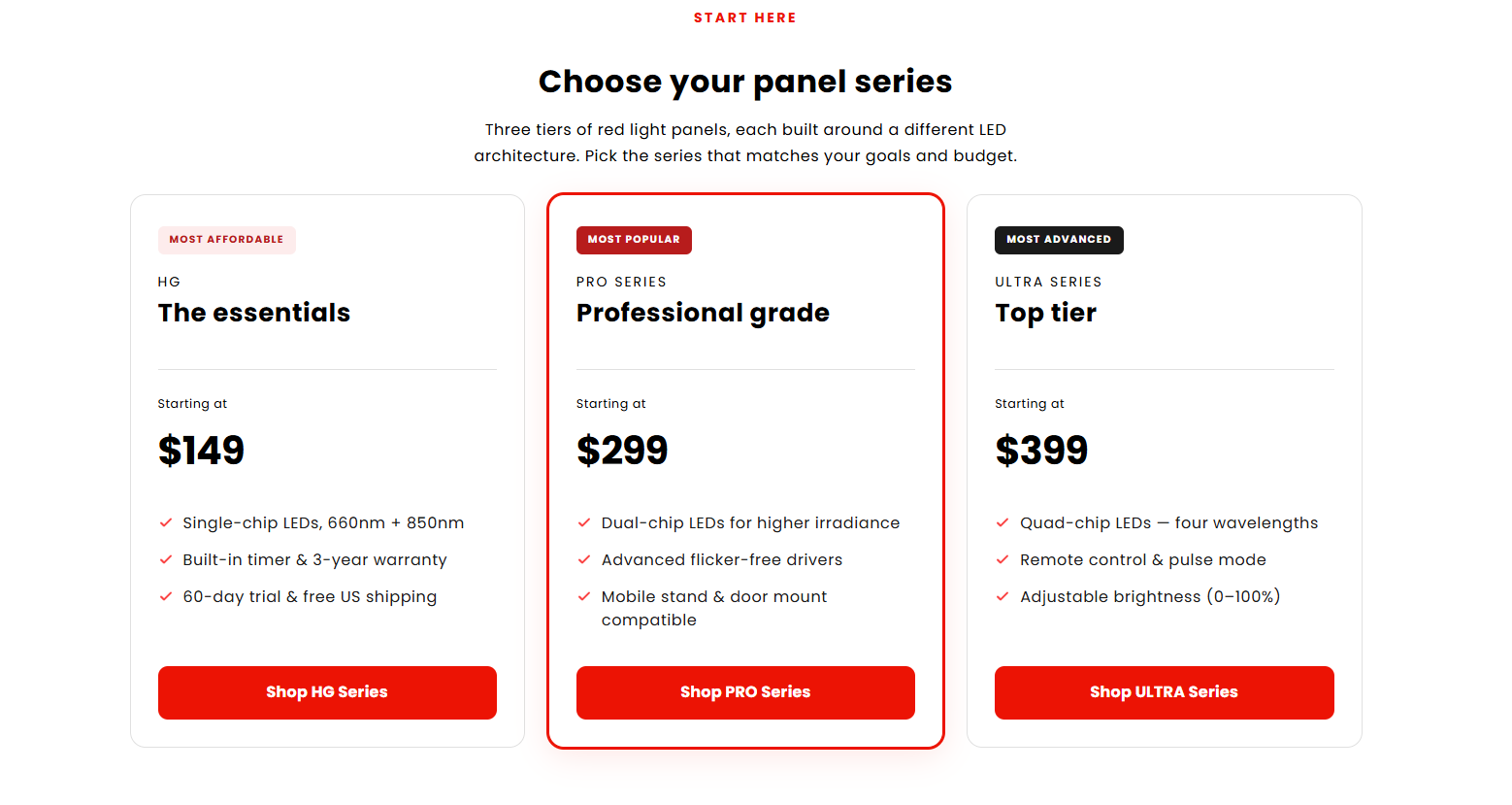
Hooga Health Pricing (2025)
| Product |
Price (Approx.) |
Coverage |
Best For |
| HG100 |
~$99 |
Handheld / targeted |
Face, joints, spot treatment |
| HG300 |
~$159–$189 |
Small panel |
Face, neck, targeted recovery |
| HG500 |
~$229–$269 |
Mid panel |
Upper body, focused sessions |
| HG1000 |
~$349–$399 |
Large panel |
Torso + limbs |
| HG1500 |
~$449–$549 |
Full panel |
Upper body, daily protocol |
| HG2000+ |
~$599–$899 |
Full body |
Whole-body sessions |
Prices approximate as of mid-2025 — verify at hoogahealth.com. Sales and discount codes are frequently available.
Hooga Health vs. Competitors
| Feature |
Hooga Health |
Joovv |
BonCharge |
Mito Red |
| Entry price |
~$99 ✅ |
~$495 |
~$299 |
~$199 |
| Wavelengths |
660nm + 850nm |
660nm + 850nm |
660nm + 850nm |
660nm + 850nm |
| Irradiance (at 6″) |
50–100 mW/cm² |
100+ mW/cm² |
60–80 mW/cm² |
80–100 mW/cm² |
| Build quality |
⚠️ Budget |
✅ Premium |
✅ Good |
✅ Good |
| EMF transparency |
✅ Published |
✅ Published |
✅ Published |
✅ Published |
| App / smart features |
❌ None |
✅ Yes |
❌ None |
❌ None |
| Warranty |
2 years |
2 years |
2 years |
3 years |
| Best for |
Budget buyers |
Premium users |
Mid-range |
Mid-range |
Who Should (and Shouldn’t) Buy Hooga
Hooga is the right choice if you:
- Want to explore red light therapy without spending $500–$1,500
- Are comfortable with a utilitarian, no-frills device
- Plan to use it consistently as part of a recovery or skin health routine
- Understand that RLT is a long-term, cumulative protocol — not an overnight fix
Look elsewhere if you:
- Want premium build quality and aesthetics for a home wellness space
- Need app-based session tracking or smart features
- Require fast, reliable customer support
- Are looking for a full-body system at the entry price point (you’ll need multiple units)
People Also Ask
Q: Does Hooga Health red light therapy actually work?
Hooga panels deliver clinically relevant wavelengths (660nm and 850nm) at sufficient irradiance levels. Research on photobiomodulation at these wavelengths shows evidence for skin health improvements, localized pain and inflammation reduction, and muscle recovery support. Results vary by individual, protocol consistency, and the specific condition being targeted. RLT is not a medical treatment and should not replace professional medical advice.
Q: How long does it take to see results from Hooga panels?
Most users report noticing initial changes in skin texture and recovery within 3–6 weeks of consistent daily use (10–15 minutes per session). Muscle recovery benefits may be felt sooner. Full results typically require 60–90 days of consistent use.
Q: Is Hooga Health a reputable brand?
Hooga is a legitimate company with transparent irradiance and EMF data, a 2-year warranty, and a large customer base. It is not a premium brand — build quality and customer support reflect the price point — but it is a credible option in the budget RLT category.
Q: What’s the difference between the HG300 and HG1500?
The HG300 is a compact panel suited for targeted sessions on the face, neck, or specific muscle groups. The HG1500 is a larger panel capable of covering the full torso, making it better for full upper-body protocols. For whole-body coverage, two panels or the HG2000+ is recommended.
Q: Can red light therapy be used every day?
Yes — daily sessions of 10–20 minutes at the recommended distance are generally considered safe based on current research. Most protocols suggest once-daily use, either in the morning for energy or evening for recovery and sleep support. Exceeding recommended session times does not appear to increase benefit and may cause mild skin warmth.
Final Verdict
Hooga Health scores: 7.9 / 10
Hooga Health occupies a useful niche: it makes red light therapy genuinely accessible to people who are curious about photobiomodulation but unwilling to commit $1,000+ to a premium brand before knowing if it works for them. The panels deliver the right wavelengths at effective irradiance levels, EMF transparency is commendable, and the pricing is hard to argue with.
The trade-offs — utilitarian build quality, audible fans, limited customer support responsiveness — are real but proportionate to the price. If you go in with accurate expectations (this is a budget tool, not a spa device, and results take weeks of consistency), Hooga Health delivers solid value.
If budget is no concern, Joovv or Mito Red offer superior build quality and support. But for most people testing RLT for the first time, Hooga is a smart, low-risk starting point.
Have you used red light therapy for skin, recovery, or sleep? Share your experience below — how long before you noticed a difference, and which panel size worked best for your routine?